How to get started with the Alvik robot
How to get started with the Alvik robotDate of publication: 08-08-2025 Update date: 21-10-2025 🕒 4 min read
The Alvik robot is a small educational robot designed to help people learn about robotics through hands-on experience. Powered by an Arduino Nano ESP32 microcontroller, this robot can perform simple tasks like moving, avoiding obstacles, and following lines.
It’s a popular tool for students and hobbyists who want to explore how robots work and practice programming.
Hardware you need:
- Arduino Alvik kit
- PC/notebook
1. Design and components
The Alvik robot has a lightweight chassis, typically made of plastic or metal, which houses all its parts.
The robot moves using two wheels, each powered by a small DC motor that allows it to go forwards, backwards, and turn. At the back, a small caster wheel provides stability and helps the robot move smoothly.
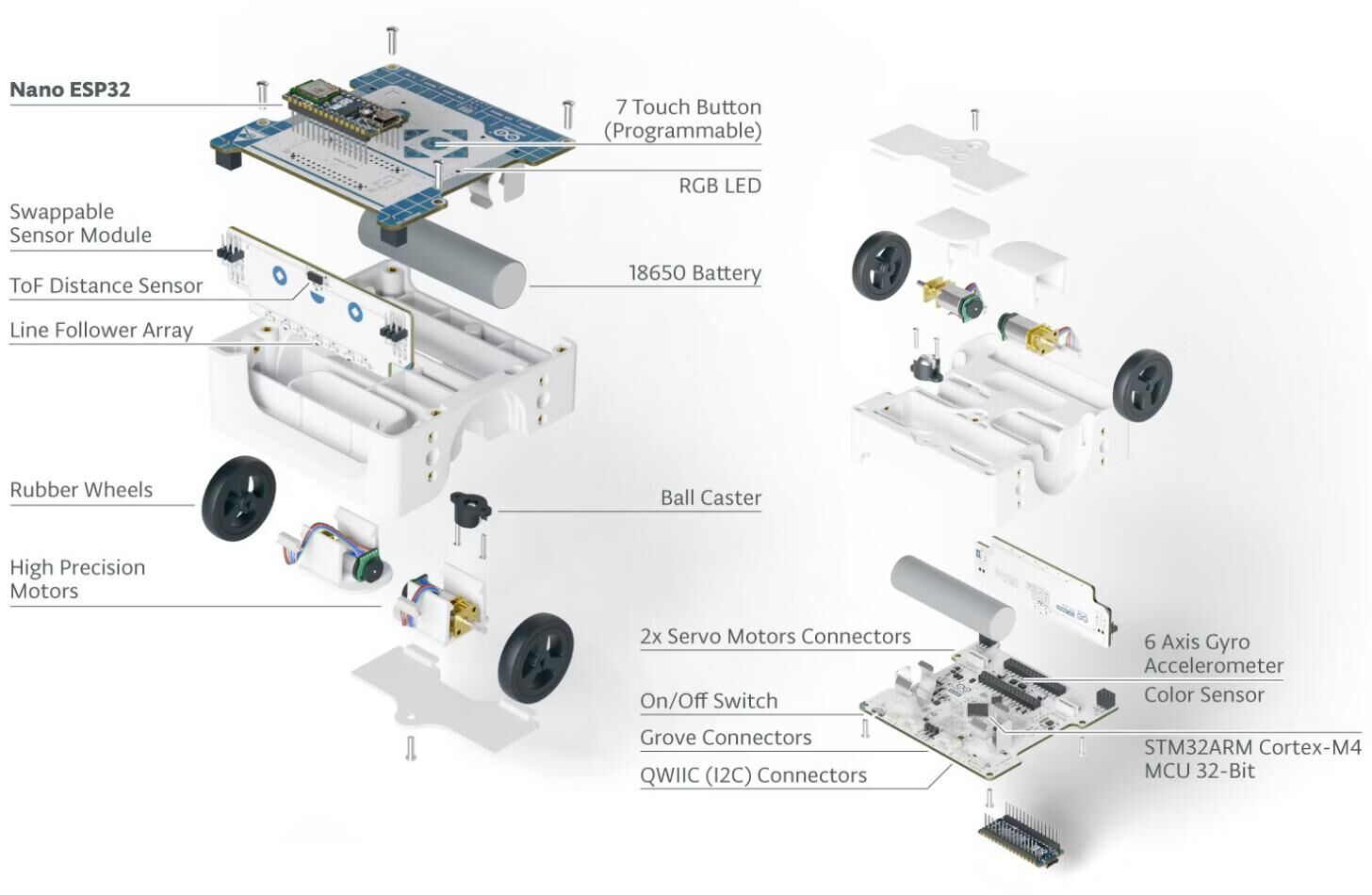
The robot’s functionality comes from its sensors. An ultrasonic sensor at the front allows it to detect and avoid obstacles by measuring the distance to objects.
Infrared sensors beneath the robot enable it to detect lines on the ground, making it capable of following a path marked by a dark line.
The motor driver translates the signals from the Arduino into physical movement by controlling the motors. The entire robot is powered by rechargeable batteries, which provide the necessary energy for both the motors and sensors.

2. How the Alvik robot works
The Alvik Robot can function autonomously or be controlled manually. In the autonomous mode, it can move and react to its environment using its sensors. For example, when the ultrasonic sensor detects an obstacle, the robot can stop, change direction, and avoid the object.
Similarly, when it follows a line, the infrared sensors detect the contrast between the line and the surface, guiding the robot along the path.
In the manual mode, the robot can be controlled remotely using a computer or a smartphone. Some versions come equipped with a Bluetooth module, allowing users to send commands wirelessly and steer the robot in real time.
3. Customization and flexibility
One of the best features of the Alvik robot is its flexibility. Users can easily customize it by adding extra sensors or components to expand its abilities. For example, a user might install additional sensors like a camera or a temperature sensor to enable new functions. The robot’s code can also be modified through the Arduino programming environment, allowing for creative and unique projects.

4. How the Alvik robot helps you learn and experiment
The Alvik robot is a great tool for learning about robotics and programming. In schools and universities, it helps students understand how robots work by getting hands-on experience. By using the robot, students can learn about important STEM subjects like science, technology, engineering, and math.
They can also practice problem-solving by programming the robot to perform tasks like following lines, avoiding obstacles, and reacting to its environment.
For hobbyists and anyone interested in robotics, the Alvik robot is a flexible platform that can be customized for different projects. You can easily add new sensors, adjust its code, or change its parts to fit your needs. Whether you want to experiment with a new idea or test a prototype, the robot’s simple design makes it easy to work with. Its ability to move on its own or be controlled remotely adds to the fun and learning possibilities.

Overall, the Alvik robot is a great starting point for learning about robots. It’s simple enough for beginners to understand, but also allows advanced users to explore new ideas and projects. Whether you’re in a classroom or experimenting at home, it gives you a hands-on way to explore robotics and technology.
This simplified version aims to keep the language clear and accessible while combining the ideas of learning, experimenting, and the robot’s flexibility. Check out the next article where we introduce some actual projects!
Transfer Multisort Elektronik (TME) is one of the world’s largest global distributors of electronic components, electrotechnical parts, workshop equipment, and industrial automation. The catalog includes over 1,500,000 products from 1,300 leading manufacturers. TME’s modern logistics centers in Łódź and Rzgów (Poland), with a combined area of over 40,000 m², ship nearly 6,000 packages daily to customers in more than 150 countries.
TME also invests in the development of knowledge and skills of young engineers and electronics enthusiasts through the TME Education project, and supports the tech community by organizing the TechMasterEvent series, promoting innovation and experience exchange.