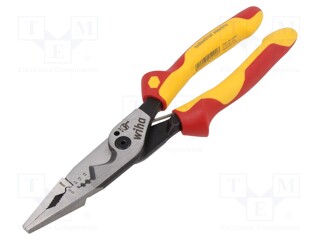
Insulated Pliers
(455)Insulated pliers are a subgroup of pliers designed for work with parts that might be energised. For safety reasons, all works related to electrical, network and power supply installations should be carried out with appropriately insulated tools. This also applies to works with devices disconnected from the power grid, such as power inverters equipped with high-capacitance capacitors storing significant amounts of energy, which can cause an electric shock. It is equally important to ensure proper protection when working with photovoltaic cells or antenna wiring with possible dangerous high-frequency currents. Using insulated tools is required by local regulations in every country. Electricians who undertake work without proper equipment must take into account not only the possible (and unnecessarily high) health risk, but also disciplinary measures that might be taken against them. The same applies to the employees who do not provide their employee technicians with appropriate tools. To sum it all up: no matter what type of electric work you perform, even when working in a repair service for household appliances & electronics or in domestic conditions, you should always use pliers and other tools with proper insulation. They are very easy to distinguish, because all such tools have labels, placed on the handles, stating the maximum operating voltage.
Insulated pliers in practice
The insulated pliers section includes most types of pliers – from universal tools, commonly referred to as pliers, to accessories for working with wires and mechanical parts, to the ones designed for precision cutting. Specific subgroups of the products and their applications, along with the explanation why using insulated pliers is recommended, are shown below.
Gripping and universal pliers
Pliers are a part of basic equipment of any workshop, maintenance&repair service or even home tool bag. It is important to note that not every set of pliers has good insulating properties – a lot of users, including professionals, will never need to use tools with an increased level of protection. Still, a relatively small investment in insulated tools will make them fully universal. They are just as good as standard pliers in terms of their functionality and durability, they are made of steel (often chemically and mechanically resistant chromium-vanadium steel) and can be comfortably handled even in spaces that can be dangerous for human health, such as fuse boxes. What is more, the handles of insulated pliers are usually made of high quality anti-slip materials and are ergonomically shaped to prevent the hand from slipping towards the jaws. Using such tools ensures work ergonomics all the time, not only when installing or upgrading wiring.
Cutting pliers
One of the most common activities during installation work is making sures that the wires are of correct length. Here, the insulation of the pliers is perhaps of the greatest importance because when laying new cable runs, and especially during their modernisation, it is easy to get lost and grab inadvertently a live wire (for example, as a result of connecting the wrong conductor to the phase mistakenly). When choosing cutting pliers, you should pay attention to their cutting range and leverage. These tools come in a wide range of specialisations: from elements used primarily for shortening the leads of electronic components and small, copper wires (e.g. telecommunication installation, where significant voltages and alternating currents can be present), to wire-cutting tools, for example when fencing electrical pens on farms.
Crimping pliers
Given that crimping pliers are mainly used for handling wires, mostly network cables, connectors in control and fuse boxes, it is indisputable that insulated tools are the recommended choice in those cases. Such items are designed mainly for electricians – they are adapted for gripping sleeves of all standard diameters, so a single tool is enough to carry out basic electro-technical work.
Slip joint pliers and tongue-and-groove pliers
It may seem that in the case of plumbing work, using insulated tools is an exaggerated precaution. Nothing could be further from the truth. In many countries, plumbing and central heating systems can be legally used to ground the protective conductor of an electrical system, as well as amateur radio transmitting stations. What’s more, full separation of the mains supply from the plumbing is impossible – current leakage may occur due to damage to the insulation inside household appliances, as well as inside garden and submersible pumps. Residual circuit breakers minimise the risk of such irregularities, however they will never be fully eliminated. That’s why slip joint pliers and tongue-and-groove pliers used by plumbers should have a proper level of protection. Of course, slip joint pliers are also used during works with network connections and similar elements of the power network – that’s why the absolute order to use insulated tools should not come as a surprise to anyone.
Important certifications of tools for electricians
When choosing pliers for professional purposes, you should pay attention to their compliance with the relevant international and domestic standards. The basic standards concerning insulated tools include:
DIN/ISO 5743
A standard that defines general characteristics for pliers – it does not specify their insulating properties.
DIN/ISO 5745
A set of rules specifying the permissible dimensions of pliers – which ensures their combability with a wide range of bolt/screw heads – and standardised dimensions of handles.
DIN/ISO 5746
A certificate that is currently withdrawn, but it is still often included in manufacturers’ technical documentation. It defines a set of designing rules and testing conditions for professional and household use pliers.
DIN/ISO 5749
The basic standard defining the preferable structure and durability of diagonal cutting pliers.
DIN/ISO 8976
Similarly to the standards described above, a reference to the design and testing of pliers is mentioned here – in this case regarding multiple slip joint tools (in practice: primarily slip joint pliers).
EN/IEC 60900
This is the most essential international standard in the field of insulated hand tools. It specifies their safety standards and applies to any tools designed for use with voltages up to 1000V AC and 1500V DC.
VDE
Quality mark awarded by Verband Deutscher Elektrotechniker, a German association of electrotechnicians. It means that a given product has been tested for durability and safety by the VDE Testing and Certification Institute.
Warehouse: