Programmers and debuggers J-Link from Segger
Programmers and debuggers J-Link from SeggerDate of publication: 13-12-2024 🕒 9 min read
Programmers J-Link from Segger are used by manufacturers of electronic devices, their designers, and also for learning. They allow for efficient programming and debugging of circuits based on microcontrollers and microprocessors from all popular manufacturers.
From the wide portfolio of products offered by TME, you can purchase J-Link programmers manufactured by Segger. Below we present an overview of this offer: it includes standard, advanced, miniature models, and an educational variant. Additionally, we also offer adapters that facilitate the use of these devices with miniature circuits equipped with a connector made as test fields on a PCB or a Mictor 38 socket.
In this article, we discuss topics such as:
- Functionality and capabilities of J-Link products
- Segger software bundled with devices
- Characteristics of individual models
- Miniaturized and educational variants of programmers
- Adapters for connectors in miniaturized circuits
Full-size J-Link versions
J-Link programmers can be used, literally, with hundreds of microcontroller series (and tens of thousands of their models), which include systems from manufacturers such as Microchip, Texas Instruments, Infineon, STElectronics, Renesas, NXP, Espressif, Toshiba, and many others. J-Link devices have the functionality of JTAG debuggers powered from a USB port. They are based on 32-bit microprocessors with RISC architecture, allowing them to communicate at high speed with the target circuit as well as with a computer (via USB). Many of our customers do not need an introduction to Segger solutions, as they are widely used tools in development laboratories and for the production of electronic circuits (Flash programming).


Software included
The J-Link models listed above differ in several features. The first is the software licenses included with the device. The most basic package supports only fundamental functionality (programming via a virtual serial port, VCOM) and is available for free from the manufacturer's website. With the BASE version, the buyer does not receive additional applications, but they can be purchased separately. The extended license, included in the PLUS, ULTRA+, and PRO models, contains software for Windows, Linux, and macOS systems:
- J-Flash SPI – direct programming (with verification) of Flash and EEPROM memory via SPI, also for systems based on ARM architecture.
- Unlimited Flash Breakpoints – additional software functionality allowing an unlimited number of breakpoints to be set in the code, facilitating debugging after programming the target system.
- Ozone – a graphical environment for debugging and program analysis. It works with low-level languages C, C++, and Rust. It facilitates code optimization based on the registration of execution time of individual operations, core and memory load, etc. In more complex circuits (e.g., IoT) using real-time operating systems, RTOS, such as embOS or FreeRTOS™, Ozone allows monitoring processes, parameters, and stack references, giving the programmer full insight into the device's operation.
- Another important feature of the extended license is RDI support, a standardized interface for diagnosing applications using ARM architecture microprocessors.
Differences between models
Thus, the difference between the PLUS and BASE versions is the software; otherwise, the model parameters are practically identical. The next level in the J-Link offer is the ULTRA+ variant, which already features better characteristics: data transmission via USB has a maximum speed of 4MB/s, JTAG and SPI signal clocking can have a frequency of up to 50MHz, while the virtual serial port operates with a throughput of up to 10MBd. In the PRO model, we get the same capabilities, but an additional improvement is the RJ45 connector and Ethernet interface, which allows programming devices at a greater distance than USB. And even remotely: after designating a gateway, access to the debugger will be possible from computers connected to the same local network. Such functionality optimizes production processes and laboratory work on prototypes.
The most important differences between the individual J-Link models are described in the table below:
| Symbol | BASE | PLUS | ULTRA+ | PRO |
|---|---|---|---|---|
| Power source | USB | USB | USB | USB |
| Output voltage range | 1.2…5V | 1.2…5V | 1.2…5V | 1.2…5V |
| Data upload from USB | 1MB/s | 1MB/s | 4MB/s | 4MB/s |
| Max JTAG speed | 15MHz | 15MHz | 50MHz | 50MHz |
| Max SPI speed | 12MHz | 12MHz | 50MHz | 50MHz |
| Max SWO speed | 30MHz | 30MHz | 100MHz | 100MHz |
| Max VCOM speed | 115200Bd | 115200Bd | 10MBd | 10MBd |
| Sampling frequency | 1kHz | 1kHz | unlimited | unlimited |
| USB interface | • | • | • | • |
| RJ45 interface | • | |||
| JTAG interface | • | • | • | • |
| J-Link license | • | • | • | • |
| J-Flash (SPI) license | • | • | • | |
| J-Link RDI/RDDI license | • | • | • | |
| Ozone license | • | • | • |
Compact versions
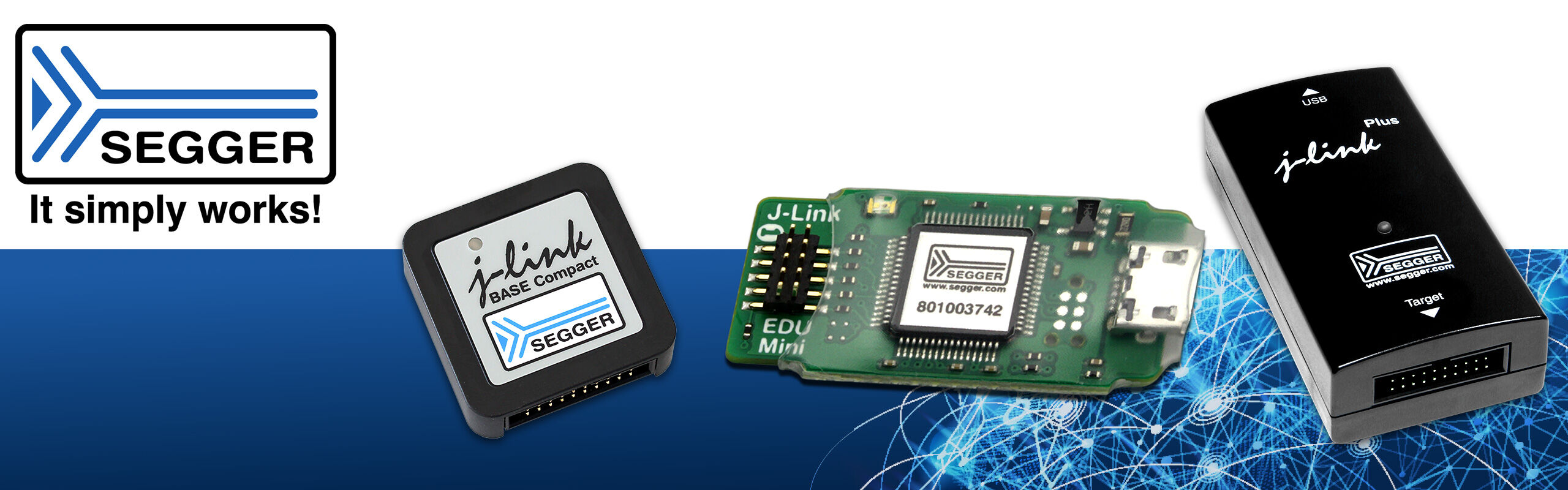
TME also offers compact versions of BASE and PLUS programmers. They have very small dimensions (46x46x17mm) but possess the same functionality. They are connected using a USB C socket. They are intended for direct mounting in a prototype. The manufacturer also foresees the possibility of mounting on a PCB, e.g., to create a strictly specialized testing device or automate the programming process in mass production and similar applications.


The simplest programmer available from Segger's offer is the EDU Mini model, which, as the name suggests, is intended for training and educational purposes. The device's functionality is limited but supports working with many systems, including microcontrollers based on ARM and RISC-V architectures. The programmer's characteristics compared to those described above are as follows:
| Characteristics | |
|---|---|
| Power source | USB |
| Output voltage range | only 3.3V |
| Data upload from USB | yes |
| Max JTAG speed | 4MHz |
| Max SPI speed | 4MHz |
| Max SWO speed | 100MHz |
| Max VCOM speed | no virtual serial port |
| Max sampling frequency | 1kHz |
| USB interface | yes (Micro USB) |
| JTAG interface | yes |
| RJ45 interface | no |
| Licenses | J-Link, Ozone |
Accessories
To enable J-Link programmers/debuggers to work with circuits equipped with other types of connectors, the manufacturer provides dedicated adapters. The first is an adapter for a 6-pin needle connection, allowing device manufacturers to maintain compatibility with Segger devices by placing only six test points on the PCB. The limitation in this case is the lack of JTAG interface support (the SWD interface is used). It is, however, available in adapters with a Mictor 38 connector, used in circuits based on ARM architecture. In this version, the only limitation will be the lack of connectivity with Trace pins, which are provided in the standard but are not supported by the 20-pin output of J-Link programmers.