Fiber optic cables
Fiber optic cablesDate of publication: 11-07-2019 Update date: 10-04-2026 🕒 6 min read
For industries that rely on speed and quality of data transmission, cables have been developed that use optical rather than electrical signals. Traditional conductors have been replaced with fibers, and information transport is entrusted to optical signals.
Key Information at a Glance
- Optical fibers replace traditional electrical cables, enabling data transmission via optical signals.
- Types of optical fibers: polymer (POF), glass (GOF), and glass-polymer (PCF).
- Classification of cables based on the direction of transmission: SIMPLEX (unidirectional) and DUPLEX (bidirectional).
- Classification based on the number of modes (bundles of light): single-mode fibers (long range up to 150km) and multimode fibers (short distances, high bandwidth).
- Use of multimode fibers mainly in local consumer networks.
- Markings of optical fibers, e.g., 980/1000 indicate the diameter of the core and cladding of the cable.
Depending on the type of fiber used, users can choose between:
- A polymer optical fiber (POF), with a core made of organic material;
- a glass optical fiber (GOF) with a core often made of quartz glass;
- a glass-polymer optical fiber (PCF), with a glass core and a plastic cladding.
Data transmission is possible in either a unidirectional or bidirectional manner. Cables that transmit in one direction are called SIMPLEX, while those that can transmit and receive signals in both directions are called DUPLEX. Depending on the number of transmitted light bundles (modes), cables are divided into single-mode and multimode. Single-mode fibers are designed for transmitting a single light wave over long distances, up to 150 km. In the case of multimode fibers, dispersion phenomena prevent data transmission over long distances. Such cabling is used among consumers requiring high bandwidth, e.g., in local networks over short distances. When choosing optical fiber cables, one encounters unclear, often complicated markings, the correct interpretation of which can be a challenge for those not familiar with cabling. One such dimension is the optical fiber 980/1000, indicating the diameter of the core (980 microns) and the diameter of the cladding (1000 microns).
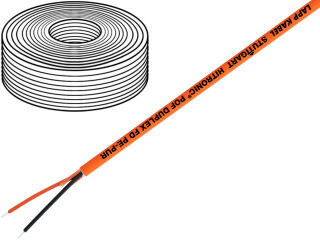
TME offers HITRONIC® POF polymer optical fibers from Lapp, enabling data transmission in one or two directions. To this first group belong the SIMPLEX version cables, with optical fibers:
- SIMPLEX-PE - a black cable with a polymer optical fiber, enabling unidirectional data transmission, with a fiber dimension P980/1000 made of PMMA and fluoropolymer cladding.
- SIMPLEX-PE-PUR - an orange, halogen-free cable with a polymer optical fiber. The cable enables unidirectional data transmission. The fiber with a diameter of P980/1000 is made of PMMA and fluoropolymer cladding. The external PUR cladding makes it resistant to oils and high temperatures.
- SIMPLEX-FD-PE-PUR - an orange, halogen-free cable intended for use in guides and moving connections. The internal polymer optical fiber with a diameter of P980/1000 enables unidirectional data transmission. The cable is dedicated to moving applications, due to its very high flexibility.There are also DUPLEX version cables, with dual optical fibers:
- DUPLEX-PE - a black, halogen-free cable with a polymer fiber, enabling data transmission and reception in both directions (DUPLEX). The fiber with a diameter of P980/1000 contains a core of PMMA and fluoropolymer cladding. The vein cladding is made of polyethylene (PE).
- DUPLEX-PE-PUR - an orange halogen-free cable with a polymer fiber, in a version enabling data transmission and reception in both directions (DUPLEX) Polyurethane cladding (PUR) provides resistance to high temperatures and oils. Two fibers with a diameter of P980/1000 are covered with a polyethylene (PE) buffer.
- DUPLEX-HY-PE-PUR - an orange halogen-free cable with increased resistance to stretching. Polyurethane cladding provides additional resistance to temperature and oils. The use of two plastic fibers, protected by a cladding, enables the transmission and reception of the signal in both directions.
- DUPLEX-FD-PE-PUR - an orange, halogen-free cable intended for moving connections, enabling bidirectional data transmission. Polymer fibers covered with a polyethylene (PE) buffer, additionally protect the optical fibers. The external polyurethane cladding provides resistance to high temperatures and oils.
- DUPLEX-PNB-PA-PUR - a green cable for PROFINET type B applications, permanently installed. Thanks to the use of two PMMA fibers with a diameter of P980/1000, it enables the transmission and reception of the signal in both directions. The external polyurethane cladding (PUR) protects the cable from oils and has features of cables resistant to high temperatures.
- DUPLEX-PNB-PA-PVC - a cable for PROFINET type B applications, in green, with an external PVC cladding. Dedicated to permanent application in an industrial environment. Two optical fibers with a diameter of P980/1000 enable the transmission of information in both directions.
- DUPLEX-PNC-PA-PUR - a green cable intended for PROFINET type C applications, with moving connections used in guides. A distinguishing feature of the cable among the HITRONIC® POF series is its high flexibility, while maintaining the ability to work under heavy mechanical load. The properties are largely provided by the external polyurethane cladding, which additionally protects the cable from oils.
FAQ – Frequently Asked Questions about Optical Fiber Cabling
What is an optical fiber and how does it work?
An optical fiber is a special cable used to transmit data in the form of light signals. It consists of a core made of glass or synthetic material (polymer) and a cladding that reflects the light back into the core. The phenomenon that allows data transmission in an optical fiber is total internal reflection. This allows light to travel long distances without significant loss of signal quality. Optical fibers allow for very fast data transfer and are resistant to electromagnetic interference, making them an excellent solution in telecommunications, industry, and home applications.
What are the differences between single-mode and multimode optical fibers?
Single-mode fibers have a small core diameter, allowing the transmission of the light signal in only one mode (one bundle of light). This minimizes the phenomenon of dispersion, allowing the signal to travel significant distances – up to 150km, without the need for amplification or signal regeneration. Multimode fibers, on the other hand, have a larger core diameter, which allows the transmission of multiple modes of light simultaneously. However, this causes greater dispersion, limiting the range of transmission. This solution works well in local computer networks over shorter distances, providing high bandwidth transmission.
What does the 980/1000 marking on an optical fiber cable mean?
The 980/1000 marking on an optical fiber cable refers to the dimensions of the core and the cladding of the fiber and is given in microns (μm). The first number (980) indicates the diameter of the core of the cable, through which light signals are transmitted. The second value (1000) specifies the diameter of the external protective cladding, which surrounds the core and provides the right conditions for total internal reflection of light. This marking is typical for polymer optical fibers (POF), which are commonly used in industrial applications and local data transmission networks.
What are the types of optical fiber cables in terms of transmission direction?
Optical fiber cables can be divided into two basic types in terms of the direction of data transmission: SIMPLEX and DUPLEX. SIMPLEX type cables allow data transmission in only one direction, from the transmitter to the receiver. They are used where bidirectional data exchange is not necessary or where one-way communication is sufficient. DUPLEX type cables, on the other hand, are equipped with two independent optical fibers, allowing simultaneous data transmission and reception in both directions. DUPLEX cables are used in systems requiring full bidirectional communication, such as LAN networks, industrial automation systems, and telecommunications infrastructure.
What are the characteristics of polymer optical fiber cables (POF)?
Polymer optical fiber cables (POF – Polymer Optical Fiber) are made of synthetic materials, most often PMMA (polymethyl methacrylate), which makes them highly flexible and resistant to mechanical damage. Due to their structure, they are easier to install and cheaper to produce than glass optical fibers (GOF). POFs provide efficient data transmission over short distances (up to several dozen meters), making them an ideal solution for consumer applications, local computer networks, automation systems, audio-video installations, and industrial mobile applications. Due to their resistance to electromagnetic and chemical interference, they also perform well in harsh industrial conditions, such as in the presence of oils or high temperatures.
Why are optical fibers resistant to electromagnetic interference?
Optical fibers are resistant to electromagnetic interference (EMI) because they transmit data using light, not electrical current. In traditional copper cables, the flowing current generates an electromagnetic field, which can cause interference with neighboring cables or devices. Optical fibers do not have this drawback, as they do not conduct current and do not generate a magnetic field, ensuring reliable signal transmission even in highly disturbed environments, such as production halls, power plants, or data centers. This feature makes optical fibers an extremely valuable solution wherever data transmission reliability is crucial.
What are the practical applications of optical fiber cables?
Optical fiber cables have a wide range of applications in many fields. In telecommunications, they serve as the backbone of infrastructure providing fast and reliable internet access and long-distance telephone communication. In industry, they are used in automation and robotics to transmit data between machines and control systems, especially where signal isolation from electromagnetic interference is necessary. In homes, optical fibers are used to create internet networks, digital television, and high-quality audio-video systems. Additionally, they are increasingly used in smart cities and monitoring systems due to the security of data transmission.
Transfer Multisort Elektronik (TME) is one of the world’s largest global distributors of electronic components, electrotechnical parts, workshop equipment, and industrial automation. The catalog includes over 1,500,000 products from 1,300 leading manufacturers. TME’s modern logistics centers in Łódź and Rzgów (Poland), with a combined area of over 40,000 m², ship nearly 6,000 packages daily to customers in more than 150 countries.
TME also invests in the development of knowledge and skills of young engineers and electronics enthusiasts through the TME Education project, and supports the tech community by organizing the TechMasterEvent series, promoting innovation and experience exchange.