Spectrum analyzer: application and practical use in electronic diagnostics
Spectrum analyzer: application and practical use in electronic diagnosticsDate of publication: 21-05-2025 Update date: 10-04-2026 🕒 8 min read
In the world of modern electronics, where radio, digital, and analog signals intertwine in complex circuits, the spectrum analyzer has become the tool of choice for engineers and technicians. This device allows you to see what is invisible to the eye – the frequency spectrum of a signal – and thus understand its structure, detect interference, and assess transmission quality.
In this article, we explain how a spectrum analyzer works, the principles behind its data processing, and why its application extends far beyond traditional research laboratories. An example? A single glance at the analyzer's graph can identify the source of interference in a Wi-Fi network or examine the output characteristics of an RF amplifier in a medical device. Importantly, the spectrum analyzer offers functionalities unavailable to traditional oscilloscopes – it analyzes signals in the frequency domain, not time, making it indispensable in radio signal diagnostics, EMI/EMC measurements, or harmonic detection. And how does it compare to a multimeter? Where a multimeter will only show voltage, the analyzer reveals the entire frequency structure of the signal. In the following sections, we will delve into the principles of these devices, present their types and specific applications, showing why the spectrum analyzer is today one of the most versatile tools in the electronic diagnostics arsenal.
- What is a spectrum analyzer
- How a spectrum analyzer works
- Key parameters
- Practical applications
- Advantages and limitations
- Development directions
What is a spectrum analyzer?
A spectrum analyzer is a specialized electronic device used to study signals in the frequency domain. Its primary task is to show how the signal's energy is distributed across different frequencies. This allows for precise determination of the frequency components that make up the signal, their amplitude, and how they change over time. This form of analysis is crucial in assessing transmission quality, identifying electromagnetic interference, noise, distortions, and the presence of unwanted harmonics that can significantly affect the operation of electronic devices.
In practice, this means that a spectrum analyzer is indispensable in applications such as testing radio paths, characterizing RF components, or compliance testing with EMI/EMC standards. Its capabilities, however, are not limited to radio signal analysis – it is equally effective in audio signal analysis, mechanical vibration analysis, or switching power supply diagnostics.
Compared to other popular measurement tools, the spectrum analyzer offers a completely different perspective:
- Oscilloscope measures signals in the time domain, presenting voltage changes as a function of time;
- Multimeter allows only basic electrical measurements, such as voltage, current, or resistance;
- The spectrum analyzer provides information about the signal's frequency structure, enabling its full spectral characterization.
It is this ability to "peek" into the frequency world that makes the spectrum analyzer not only a complement but often a key tool in the process of diagnosing and optimizing electronic systems.
How a spectrum analyzer works
To understand how a spectrum analyzer works, it is worth starting with its basic function – transforming a signal from the time domain to the frequency domain. This process is based on sampling the input signal and processing it using the Fast Fourier Transform (FFT). Thanks to FFT, the analyzer can decompose the signal into its frequency components, allowing you to see which frequencies are present and with what strength.
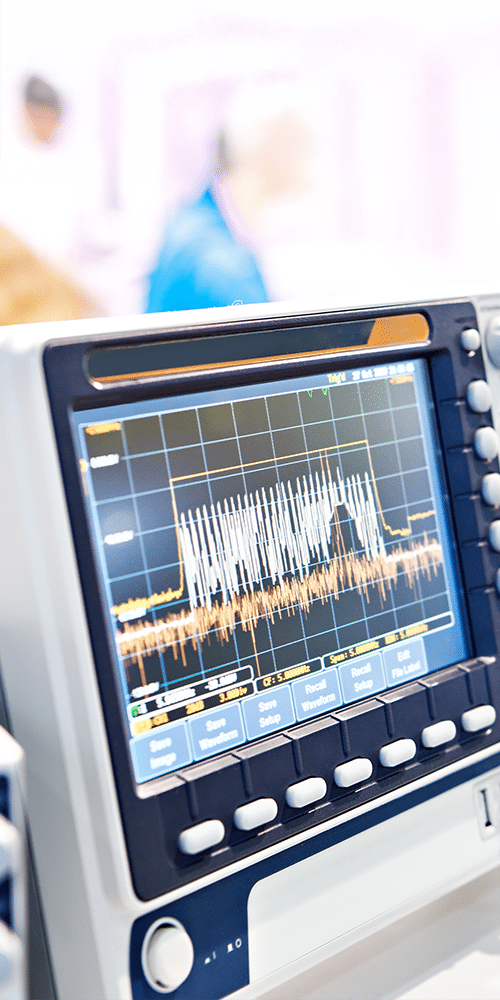
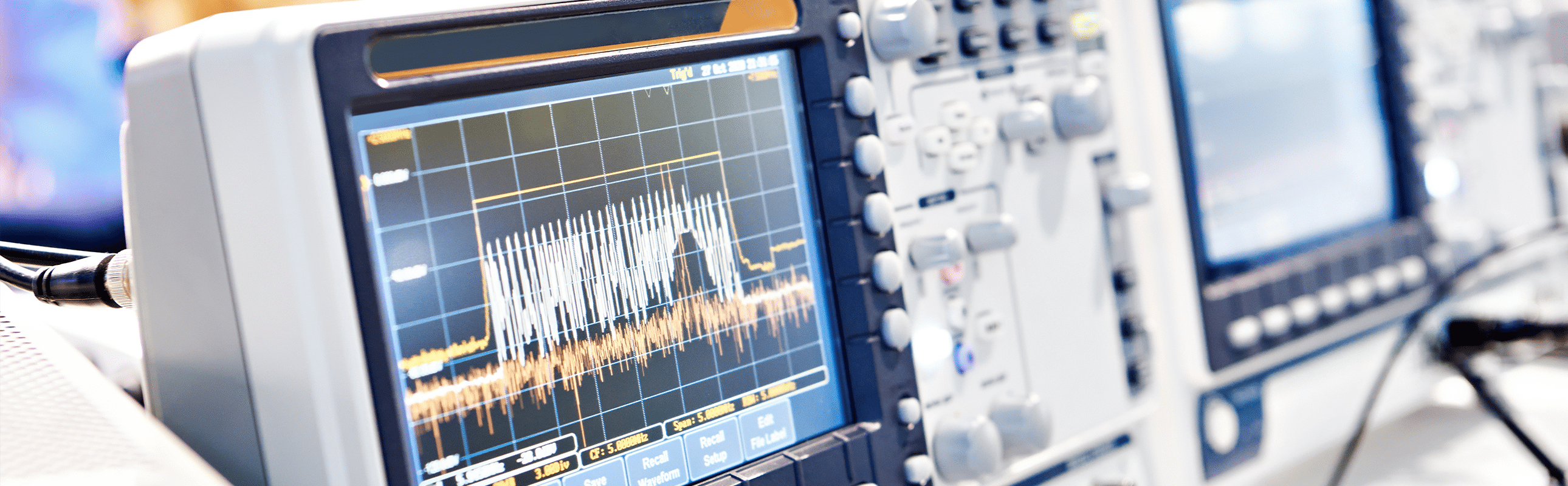
On the device's screen, the results are presented in the form of a graph – the horizontal axis (X) corresponds to frequency, and the vertical axis (Y) shows amplitude or power level. This graphical representation enables easy identification of interference, noise, and harmonic signals. A key parameter that affects the quality of this visualization is the Resolution Bandwidth (RBW). Narrower RBW allows better differentiation of signals with similar frequencies, although it usually involves longer sweep times.
Several types of spectrum analyzers are available on the market, differing in architecture and purpose:
- Swept-tuned analyzers use classical superheterodyne architecture. They are reliable for measuring stable signals but may not detect short-duration signals.
- FFT (digital) analyzers rely on the Fast Fourier Transform technique. They enable fast analysis of a wide frequency range, offering high accuracy and the possibility of automatic measurements.
- Real-time spectrum analyzers (RTSA) capture signals without any "dead times," allowing for the detection of fleeting events, such as interference in wireless systems.
- Vector signal analyzers (VSA) measure not only amplitude but also the phase of the signal. This makes them ideal for analyzing complex digital modulations, e.g., in wireless communication systems.
Each of these types has its unique advantages and finds application in different measurement scenarios. The choice of the appropriate analyzer depends on the type of signal being analyzed and the requirements for speed, accuracy, and frequency range.
Key technical parameters
For a spectrum analyzer to effectively support electronic diagnostics, it must be appropriately selected for the specific application. Key technical parameters determine the precision, speed, and usefulness of measurements. Knowing them helps not only in choosing equipment but also in correctly interpreting results.
Frequency range determines what signals the device can analyze. For audio applications, a range up to several tens of kHz is sufficient, while RF or microwave analysis requires equipment reaching even above 20GHz. A too narrow range will limit measurement capabilities, so it is worth choosing an analyzer compatible with the working range of the analyzed circuit.
RBW (Resolution Bandwidth) affects the ability to separate signals with similar frequencies. Narrower RBW means greater spectral resolution but extends sweep time. In precise measurements, such as detecting interference close to the working signal, narrow RBW is indispensable.Sensitivity determines the minimum signal level the analyzer can detect. The lower the device's own noise level, the better its ability to work with very weak signals. This is especially important in applications such as monitoring distant transmitters or testing low-signal devices.
Dynamic range is the difference between the weakest and strongest signal that can be measured simultaneously. A high dynamic range allows for analyzing a weak signal even in the presence of strong interference. This is crucial, for example, when analyzing the spectrum next to an active transmitter.
Sweep time determines the speed at which the analyzer can scan the selected frequency range. Shorter time is beneficial for analyzing time-varying signals but often means a compromise with RBW resolution.
Trace detectors are responsible for processing and presenting data on the screen. Depending on the selected mode, the analyzer can show maximum values (peak detector), averaged values (average), or instantaneous samples (sample). The choice of the appropriate mode affects the ease of identifying interference and assessing noise levels.
Understanding these parameters is the basis for the conscious use of a spectrum analyzer and allows for fully utilizing its capabilities in practical diagnostics.
Practical applications in diagnostics
After understanding the principle of operation and key parameters of a spectrum analyzer, it's time to look at its practical applications in the daily work of engineers, technicians, and service personnel. This device is used where precise spectrum analysis of signals is essential, whether in a laboratory, production, or field environment.
In telecommunications and wireless systems, such as 5G, Wi-Fi, or radar, spectrum analyzers help assess signal quality, identify interference, and verify the correct operation of transmitters. In practice, this means, for example, the ability to identify overloaded Wi-Fi channels or diagnose instability in data transmission.
In RF and microwave circuit diagnostics, the analyzer enables detailed characterization of components such as filters, amplifiers, and oscillators. Spectral analysis allows for assessing bandwidth, gain, or the presence of unwanted harmonics, significantly streamlining the tuning and design process of high-frequency circuits.
During electromagnetic compatibility (EMC/EMI) tests, the spectrum analyzer is an invaluable tool for locating sources of interference and preliminary verification of device compliance with emission standards. Quickly identifying problematic frequencies helps avoid costly corrections at the final project stage.
In the field of audio and vibration analysis, analyzers are used to assess acoustic or mechanical signals. They allow, for example, to detect audio signal distortions that may be unnoticed in time analysis or identify specific frequencies in a machine's vibration signal – which is crucial in predictive diagnostics.
In power supplies and digital systems, spectrum analyzers are used to detect switching noise, unwanted emissions, or interference affecting the proper operation of logic circuits. An example is the analysis of a switching power supply, where thanks to spectral signal presentation, it is possible to quickly detect output interference or faulty operation of power transistors.
In practice, using a spectrum analyzer allows:
- verifying the quality and purity of a transmitter's signal
- quickly locating sources of electromagnetic interference
- assessing the performance of bandpass filters and RF amplifiers
- optimizing channel distribution in wireless networks.
Thanks to these capabilities, the spectrum analyzer becomes a versatile diagnostic tool, significantly shortening analysis time and improving the quality of technical conclusions.
Advantages and limitations of spectrum analyzers
We have already shown how wide the application of a spectrum analyzer is in electronic diagnostics. It is now worth looking at the balance of benefits and challenges associated with its practical use. This device offers many functions that are difficult to replace with other tools, but – like any solution – it is not free from certain limitations.
The most important advantages of a spectrum analyzer include the ability to detect faults early, before they lead to system failure. Thanks to high precision and spectral analysis, an engineer can quickly locate sources of problems, such as interference or mismatches in the circuit. The analyzer also enables identification of unwanted electromagnetic emissions, which can cause device compatibility issues or disrupt the operation of neighboring systems.
One of the greatest assets is the ability to analyze complex modulated signals, e.g., used in modern communication systems. Combined with high accuracy and wide measurement capabilities, this makes the spectrum analyzer a versatile tool, indispensable in many fields of electronic engineering.
On the other hand, some limitations may pose a barrier for users, especially beginners. Advanced models of analyzers are expensive, making their purchase justified only for specialized applications. Additionally, working with the device requires knowledge of signal analysis, which may generate the need for training or practical experience.
In digital analyzers, which are based on the Fourier transform, one must also consider high computational requirements. The need for large data processing power means that these devices must be equipped with fast ADC converters and efficient processors, affecting both their price and size.
Despite these challenges, the advantages of spectrum analyzers definitely outweigh, especially in the context of precise diagnostics and growing technical requirements in modern electronics.
New development directions
As electronic systems become more complex and diagnostic requirements grow, spectrum analyzers are also undergoing dynamic evolution. Manufacturers are developing new functionalities that not only increase measurement precision but also make devices more intelligent, mobile, and versatile. These changes have a direct impact on how engineers use spectrum analyzers in practice.
One of the most promising trends is the integration of artificial intelligence (AI) technology and cloud services. Modern analyzers can automatically recognize signal types, classify interference, and suggest possible sources of problems. Thanks to integration with cloud platforms, users can remotely monitor measurements, share data with the team, or archive results in real-time. This solution significantly increases work efficiency, especially in distributed industrial environments.
Simultaneously, we are observing progress in equipment miniaturization. Contemporary spectrum analyzers are increasingly available in portable versions, which, despite their compact size, offer functions comparable to stationary models. The ability to perform measurements in the field, without the need for large test setups, becomes particularly valuable in service applications and wireless infrastructure diagnostics.
Another significant direction is the development of analyzers with wider real-time bandwidths, allowing for even more effective detection of fleeting events. Wider bandwidth means the ability to simultaneously analyze a larger frequency range without data loss, which is crucial in research on modern transmission technologies, such as 5G or Wi-Fi 6E.
Particular attention should also be paid to the trend of creating integrated devices that combine the functions of a spectrum analyzer and an oscilloscope in one housing. Such solutions allow for signal analysis in both the time and frequency domains, eliminating the need to use two separate instruments. This is not only a space-saving measure but also increased convenience and work efficiency.
All these directions indicate that spectrum analyzers are moving towards more accessible, automated, and versatile tools, which will better meet the needs of modern electronic diagnostics.
Summary
The spectrum analyzer is today one of the most important tools in the arsenal of any specialist dealing with electronics, telecommunications, or wireless systems. By transforming a signal from the time domain to the frequency domain, this device allows you to see phenomena hidden from other measuring instruments – interference, intermodulations, or unwanted harmonics become visible and possible to precisely identify. In practice, this means not only faster fault diagnosis but also the ability to prevent them before they disrupt the operation of devices or systems.
It is worth remembering that spectrum analyzers are not reserved exclusively for research laboratories or large companies. Thanks to ongoing miniaturization and integration with modern software, more and more models are reaching field engineers, technical universities, and even ambitious hobbyists. Even a basic USB analyzer can be used to analyze the spectrum of radio signals from your own Wi-Fi router, while advanced models allow real-time tracking of interference in the 5G band or analyzing digital modulations in IoT systems.
In an era of increasing complexity of electronic circuits and heightened quality requirements, the spectrum analyzer is no longer a luxury – it is a necessity. Its versatility, accuracy, and continuous technological development make it an indispensable ally in everyday engineering work – whether diagnosing a simple circuit or certifying a complex wireless system.
Transfer Multisort Elektronik (TME) is one of the world’s largest global distributors of electronic components, electrotechnical parts, workshop equipment, and industrial automation. The catalog includes over 1,500,000 products from 1,300 leading manufacturers. TME’s modern logistics centers in Łódź and Rzgów (Poland), with a combined area of over 40,000 m², ship nearly 6,000 packages daily to customers in more than 150 countries.
TME also invests in the development of knowledge and skills of young engineers and electronics enthusiasts through the TME Education project, and supports the tech community by organizing the TechMasterEvent series, promoting innovation and experience exchange.