Plain bearings demystified- a complete guide for everyone
Plain bearings demystified- a complete guide for everyoneDate of publication: 18-06-2025 🕒 16 min read
Although often hidden in mechanisms, plain bearings play a key role in the reliable operation of machinery - from the hinge in a door to the engine in a car. In this article you will learn about their principle of operation, types, materials, applications and practical tips for selection and operation.
- What are plain bearings? The basics of their operation
- Plain bearings construction
- Plain bearings classification
- Materials used in plain bearings
- Operating parameters and performance
- Advantages and disadvantages of plain bearings
- Plain bearings applications
- Plain bearings selection and design
- Assembly and operation
What are plain bearings? Basics of their operation
Definition and basic functions
Plain bearings, also referred to as bushes or pans, are machine elements that enable relative motion between two mating parts - usually a shaft and a stationary body. Their main task is to reduce friction and wear on the working surfaces. Plain bearings take up loads and ensure smoothness and stability of motion. In addition to reducing friction, these bearings protect working surfaces from wear and allow compensation of misalignment, vibrations or structure deflections.
Plain bearings are free of rolling elements. This makes them simpler to build, dampen vibration better and can operate under higher static and shock loads. However, they tend to have a higher coefficient of friction at start-up and are more sensitive to inadequate lubrication. Thanks to their simplicity of design and lack of rolling elements, they are also relatively insensitive to shock and easy to integrate with other components.
Typical conditions and applications
Plain bearings perform best in places, where high loads, low speeds and harsh environmental conditions -for example high humidity, dust, vibration. They are successfully used in combustion engines, pumps, hinges, household appliances, agricultural machinery, photovoltaic panels and vehicles. Their versatility comes from the ability to select different types of construction and materials for a specific application.
History and development of the technology
The concept of Plain bearings has been with mankind for thousands of years. As far back as ancient Egypt, wooden bushings were used to reduce the resistance of moving stone blocks. In the Middle Ages, panes were used in water mills and clock mechanisms. Over the centuries, these bearings have evolved from simple forms made of wood and stone, to precision components made of metals, plastics and composites. Modern technology makes it possible to design bearings that operate greaselessly, resistant to high temperatures, corrosion and strong dynamic loads. The development of material science, machining and surface engineering techniques have allowed a significant expansion of their range of applications.
Mechanism of action and role of lubricating film
Plain bearings operation is based on sliding - that is, direct movement of the shaft journal surface relative to the pan. To minimize wear and reduce energy loss, a thin film of lubricant is inserted between the mating surfaces or materials with self-lubricating properties are used. This thin lubricating film can take various forms - from hydrodynamic oil, through grease injected from the outside, to grease released from the porous structures of the material.
Depending on the design and operating conditions, bearings can operate under different lubrication regimes:
- hydrodynamic lubrication, in which an oil film forms spontaneously during movement,
- hydrostatic lubrication, when the lubricant is injected from an external pressure source,
- boundary lubrication or dry lubrication, in which surface contact is partial or continuous, but limited by lubricating additives in the material.
The key objective of each of these regimes is to limit direct contact and reduce friction to a minimum. Proper lubricating film thickness and material selection have a significant impact on durability, performance and operational safety of the bearing.
Plain bearings design
Main structural elements
A typical plain bearings consists of three basic parts, which together form the so-called sliding node. Each of these elements has a specific function and must be properly selected for the operating conditions.
The casing is the stationary part of the bearing, which constitutes its external housing. It can be made as a separate component or be an integral part of the machine,for example engine block. The body material is most often steel, cast iron or aluminum, but in lighter constructions plastics are also used.
The pan (sliding sleeve) is a component located inside the body, which is in direct contact with the rotating shaft journal. Made of materials with a low coefficient of friction and good wear resistance, the pan can be a replaceable component or an integral part of the body. Its properties are crucial to the functioning of the entire bearing.
The shaft journal, which is the surface of the shaft, which interacts with the pan and performs sliding motion. It should be suitably hardened and smooth, to reduce friction and wear. As a journal material, steel subjected to heat treatment and precision grinding is most often used.
Bearing performance depends on the mutual fit of these components, as well as the correct radial clearance and lubrication gap geometry.
Plain bearings design variants
Depending on application and design needs, plain bearings can come in various design variants, for example:
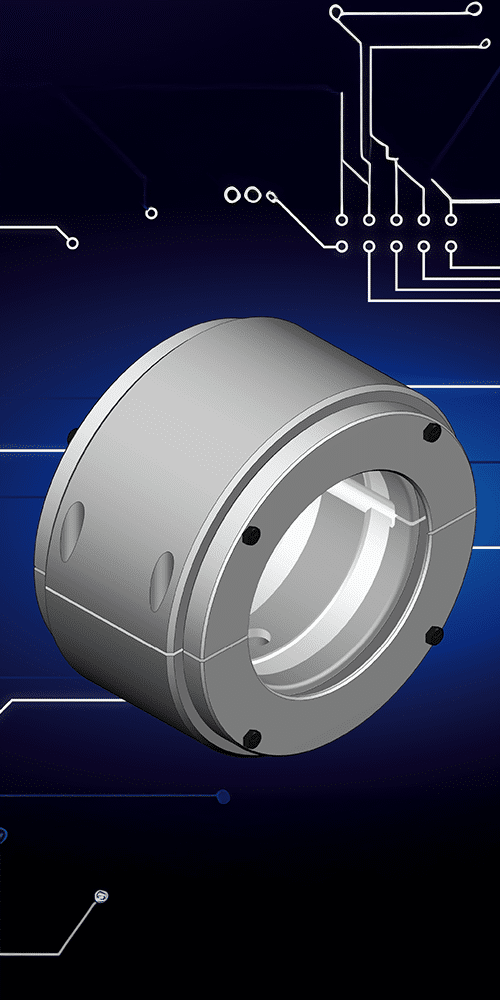
- Divided bearings - consist of two bushing halves, which makes them easy to install and remove without removing the shaft. They are mainly used in large industrial machines and engines, where access to the shaft is limited.
- Flanged bearings - have an integrated flange, that prevents the bearing from sliding along the shaft axis. The flange also facilitates assembly and accurate positioning of the sleeve in the housing. Such solutions are often found in mechanisms requiring the transmission of low axial loads.
- Spherical bearings and spherical bearings- are designed, so that they can compensate for shaft and housing misalignment. Thanks to their spherical contact surface, they provide angular deflection capability, which is particularly useful in suspension systems, joints and structures subject to dynamic displacement.
The variety of designs makes it possible to optimally select a bearing for a specific application, taking into account the load direction, available mounting space and operating conditions.
Plain bearings classification
Plain Bearings come in many varieties of design and materials. Their diversity is due to the need to adapt to specific operating conditions, such as the type of movement, direction of loads or lubrication method. Below are the most common divisions, which make it easier to choose the right type of bearing.
By lubrication
The type of lubrication has a key effect on a bearing's operating characteristics, its service life and range of applications. In practice, there are several types of bearings depending on, how the function of separating sliding surfaces is realized.
Dry bearings (self-lubricating)
Do not require additional lubricants during operation. They are made of materials with self-lubricating properties, such as PTFE, graphite, oil-saturated bronze sinters or composites. They are ideal for use in equipment, where maintenance is difficult or impossible.
Oil bearings
Most commonly used in industrial machinery and motors. Lubrication is by oil or plastic grease. They are divided into two subtypes:
- hydrodynamic - lubricant is drawn into the bearing gap by shaft motion, forming a so-called. lubricating wedge,
- hydrostatic - lubricant is forced into the bearing under pressure from an external source, which allows the lubricating film to be maintained even at low speeds.
Air bearings
Instead of a lubricating fluid, compressed air is used. They come in two versions:
- aerostatic - air is supplied under pressure from the outside,
- aerodynamic - an air cushion is formed spontaneously as a result of motion. Air bearings allow operation at very high speeds and almost zero friction, that is why they are used in measuring devices, precision spindles and medical equipment.
Due to the direction of the load
Plain bearings can be adapted to transmit different types of forces, which determines their geometry and mounting method.
Transverse bearings (radial) transmit forces acting perpendicular to the shaft axis. This is the most common group, used for example in motors, pumps and guides.
Thrust (axial) bearings provide force transmission along the shaft axis. They are used among others.in. as thrust washers in actuators or piston mechanisms.
Angular contact (combined) bearings transmit radial and axial forces simultaneously. They are used in systems, where load direction changes dynamically or movements along complex trajectories occur.
Other design types
In addition to the classic division, plain bearings there are many special designs, that allow their use in unusual conditions or make them easier to install.
Balls, flange bearings, integral, articulated
Bushings are the simplest and most commonly used form. Flanged bearings have an additional expansion to facilitate mounting. Integral bearings are made directly into the material of the housing. Spherical (spherical) bearings, on the other hand, allow for angular misalignment and compensate for misalignment.
Bearings mounted in housings
These are prefabricated bearing units housed in special mounting housings. Such solutions simplify installation and are popularly used in agricultural machinery, construction and transport machinery.
Thanks to this design diversity, plain bearings can be precisely matched to the needs of even the most demanding applications.

Materials used in plain bearings
Selecting the right material for a plain bearings is critical to its durability, efficiency and reliability. The shell material must not only provide low friction resistance, but also effectively transfer loads, dissipate heat and withstand harsh environmental conditions. Today's technology offers a wide range of solutions - from traditional metals to modern composites, plastics and ceramics.
Main material groups
Metals
Among the most commonly used are bronzes, which combine good wear resistance with easy machining and affordable cost. Babits, feet, or alloys of lead and tin, are used where, where the ability to "deposit" contaminants and work with a low coefficient of friction is needed. Cast iron is mainly used in tandem with hardened steel pivots. Feet are lightweight and conduct heat well, while steels are used as both pan material, and bodies - especially in structures requiring high mechanical strength.
Plastics
Modern polymers offer good chemical resistance and the ability to operate without lubrication. PTFE (Teflon) has an extremely low coefficient of friction and a wide temperature range, although it requires stabilization with reinforcing additives. POM (polyacetal) provides rigidity and low moisture absorption. PA (polyamide, nylon) is versatile, but can absorb water. PEEK is a high-performance material for extreme conditions, and UHMWPE (ultra-high molecular weight polyethylene) shows excellent abrasion resistance.
Composites and sinters
Composites combine the advantages of different materials - for example, a metal base with a polymer layer with sliding properties. Steel structures are often used-bronze-PTFE. Metal sinters, most often made of bronze or iron, have a porous structure saturated with oil, which allows them to work as self-lubricating bearings.
Ceramics
Material mainly used in special applications, where extreme hardness is required, chemical resistance and electrical insulation. Due to its brittleness and high cost, ceramics are mainly used in measuring instruments, medical and precision devices.
Material selection criteria
When selecting a material for a pan, there are several key parameters to consider, that affect the efficiency and life of the bearing.
Friction coefficient, wear resistance and durability
The material should provide low resistance to motion and exhibit high wear resistance, especially under unstable lubrication conditions. For self-lubricating materials, their ability to form a transfer film is also important.
Capacity, PV limit, corrosion and temperature resistance
Each material has a limited load-carrying capacity and sliding speed, expressed by the so-called. pV limit. The effect of temperature on mechanical and lubrication properties and the material's resistance to moisture must also be considered, chemicals and corrosive environment.
Pan-pin compatibility
The selection of sliding pair materials has a direct impact on the durability of the entire node. Typically, a combination of a harder journal with a softer pan is used, which undergoes controlled wear and protects the more expensive shaft. It is also important, that both materials have adequate tribological properties and good cooperation under real conditions.Thanks to advanced materials, plain bearings can be used even in places, where other technical solutions previously prevailed. The right choice of material is the foundation of their reliability and longevity.
Operating parameters and performance
Evaluating a plain bearings does not end with its design and material. Key to proper performance are the operating parameters, which determine the efficiency, service life and operating safety. These primarily include the coefficient of friction, load carrying capacity and the so-called PV limit. Their correct analysis and control are indispensable in the design of plain bearings systems.
Coefficient of friction
The value of the coefficient of friction (µ) depends on the type of materials, surface condition, lubrication method and operating conditions. For plain bearings, it can vary from below 0,01 (for hydrodynamic bearings) to even 0,3 in the case of dry operation with improperly selected material. The lowest friction occurs, when the surfaces are completely separated by a layer of oil or gas. Under boundary conditions, where the lubricating film is thin or discontinuous, friction increases significantly.
Many factors influence the value of the coefficient of friction:
- lubrication regime, that is, the type and thickness of the lubricating film,
- physical and chemical properties of the lubricant, for example oil viscosity,
- smoothness of sliding surfaces and their hardness,
- relative speed of movement and load,
- operating temperature and presence of contaminants.
Particularly important is the role of lubrication - its presence, quality and method of delivery. A well-chosen lubricant reduces direct contact between surfaces, reduces friction and increases the life of the entire system. In self-lubricating bearings, the film is formed by the bushing material or by a lubricant embedded within the composite structure. Their effectiveness depends, among other things, on the quality of the fit with the shaft and the stability of operating conditions.
Bearing capacity and PV limit
The load carrying capacity of a plain bearings is its ability to carry loads without deformation or damage. It is calculated as the surface pressure, that is, the ratio of the force to the area of the contact surface:
P = F / A
where: F is the loading force, and A is the effective sliding surface.
Each material of the pan has a certain maximum permissible pressure value, exceeding of which leads to loss of mechanical properties, permanent deformation or accelerated wear.
The second key parameter is the PV limit - the product of surface pressure (P) and sliding speed (V). It defines the maximum permissible operating conditions of the material, at which the heat generated by friction can be safely dissipated:
PV = P × V
If the PV limit is exceeded, the bearing may overheat, lose lubricity and seize. Therefore, it is necessary to check already at the design stage, whether the load and speed are within the recommended PV range for the material in question, taking into account the relevant safety factor.
Durability and service life of bearings
Plain bearing life is the time or number of operating cycles, after which the component wears beyond the permissible values. Durability depends on many interacting factors:
- size and nature of the load - static, dynamic, impact,
- sliding speed and cycle time,
- temperature generated by friction and ambient conditions,
- lubrication efficiency and its regularity,
- hardness, roughness and condition of the journal surface,
- resistance of the pan material to abrasion and fatigue,
- presence of impurities, moisture, chemicals.
The mounting of the bearings also has a large impact on durability. Errors such as misalignment, too tight a fit, improper radial clearance or improper surface treatment can significantly accelerate wear and lead to premature failure. For this reason, it is extremely important to follow the manufacturers' recommendations and check the operating parameters during use.
A well-designed and properly operated plain bearings can achieve a service life that is comparable, and in many cases even higher than a roller bearings. The key is to consider all critical parameters already at the design stage.
Advantages and disadvantages of plain bearings
Plain bearings have been used for years in others engineering fields due to their versatility and simplicity. However, like any engineering solution, have both their advantages, as well as limitations. Knowing their advantages and disadvantages is crucial when deciding whether to use them in a specific mechanical system.
Benefits of using plain bearings
Quiet operation and vibration damping
The absence of rolling elements makes, plain bearings operate almost silently. In addition, a layer of lubricant or a material structure (for example plastics and composites) effectively dampens mechanical vibrations, which improves the comfort of the whole device.
Simple construction and low cost
Plain Bearings have an uncomplicated design, which translates into lower manufacturing and assembly costs. They are lighter and take up less space compared to roller bearings of similar load capacity. In simpler applications, it is even possible to manufacture them as an integral part of an enclosures.
Resistant to shocks, corrosion and extreme conditions
Thanks to their large contact area, they are resistant to shock loads and temporary overloads. Depending on the material, they can operate in dusty environments, humid, chemically aggressive, and even in high or very low temperatures. The use of suitable plastics and composites eliminates the need for lubrication, making them attractive in hard-to-reach applications.
Limitations of plain bearings applications
Possibility of seizure, higher friction at start-up
In case of improper selection of material, grease material or mounting clearance, direct contact between pan and journal can occur, with the risk of seizure. Especially during the starting phase, before a lubricant film is formed, there is more resistance to movement than in roller bearings.
Speed and load capacity limits
Although plain bearings withstand high static loads well, their speed limits are lower than those of roller bearings. Operating too fast or under too high loads can lead to overheating, loss of lubricating film and accelerated wear.
Susceptibility to improper mounting and lubrication
Installation requires a precise fit, especially when it comes to concentricity and radial clearance. Installation errors or inadequate lubrication are among the most common causes of failure. In many cases, a slight deviation from the manufacturer's recommendations can drastically shorten the life of the bearing.
Plain bearings vs. roller bearings
When plain bearings are better
They work well where, where quiet running is important, small installation space, resistance to dirt and low manufacturing and service costs. They are particularly advantageous in slow-running applications, with high static or shock loads, and also where, where regular lubrication is not possible.
Disadvantages and advantages of plain bearings over roller bearings
Compared to roller bearings, plain bearings offer better impact and dirt resistance, but tend to have a higher coefficient of friction and lower efficiency at high speeds. Roller bearings are easier to standardize and have a more predictable fatigue life, but are more expensive and more susceptible to installation errors and contamination.
An informed choice between plain bearings and roller bearings should be based on an analysis of operating conditions, operating costs, service availability and required service life. In many cases, plain bearings are the more practical and economical solution.
Plain bearings applications
The versatility of plain bearings makes them, that they are present in almost all sectors of industry and everyday life. Thanks to the variety of designs, materials and lubrication methods, they can be easily adapted to very different operating conditions - from simple household mechanisms to sophisticated technological equipment and systems operating in extreme environments.
Industry and automotive
In the automotive industry, plain bearings are an indispensable part of internal combustion engines. They work for example as main and connecting-rod bearings, where they must support high dynamic loads and ensure low resistance to motion. They are also used in suspension systems and brakes, where vibration damping is important, resistant to contamination and easy to service.
In agricultural and construction machinery, plain bearings are used in arm hinges, joints, guiding elements and at points with difficult access to lubrication. They often operate there under conditions of high dust, moisture and fluctuating temperatures, where standard roller bearings would quickly fail.
Everyday equipment
In everyday equipment, plain bearings are valued for their simplicity, low cost and the possibility of maintenance-free operation. In washing machines, dishwashers and fans use self-lubricating bushings, which do not require maintenance for the lifetime of the device. In furniture and door and window hardware, these bearings are responsible for the smooth movement and quiet operation of hinges or slides.
In bicycles they are used, among others.in. in pedals, shock absorber hinges and seatposts. Their resistance to dirt and moisture allows for reliable operation in variable weather conditions.
Precise and advanced systems
In equipment requiring high precision and low resistance to motion, plain bearings are often used because of their ability to provide a precise fit and low vibration levels. In steam and gas turbines, they operate at extreme temperatures and speeds, where operational stability and material durability are required.
In medical equipment, such as tomographs, surgical robots or laboratory equipment, quiet operation and maintenance-free operation are important. Bearings made of air or sterilization-resistant plastics are often used in such applications.
Space and aerospace industries use specialized plain bearings capable of operating in vacuum conditions, radiation and large temperature differences. Low weight, reliability and vibration resistance make them indispensable in satellite applications and flight control systems.
Energy and renewable industries
Plain bearings play an important role in systems using renewable power sources. In photovoltaic panels, they are used in solar tracking mechanisms, where motion is slow, but a high level of reliability and weather resistance is required.
In wind turbines, they work.in. in blade-shifting systems and in the tilting mechanisms of nacelles. There they have to withstand variable loads and low speeds while operating in environments exposed to moisture, dust and temperature fluctuations.
In offshore installations, such as oil rigs or offshore wind farms, plain bearings are chosen for their corrosion resistance, durability and ability to operate in harsh, isolated conditions.
Plain bearings applications are therefore extremely broad and are constantly expanding with the development of new technologies and materials. In many cases, they are not only an alternative, but even a better choice than rolling solutions.
Selection and design of plain bearings
Proper selection and design of plain bearings is the key to trouble-free operation and long service life. Unlike roller bearings, the design of a sliding node requires a careful analysis of operating conditions and the correct combination of materials. Already at the design stage, it is worth taking into account not only the basic technical parameters, but also the specifics of the environment and the expected reliability.
Selection criteria
The primary factor affecting bearing selection is load - both its value, as well as its nature. Plain bearings withstand static and impact forces well, but must be properly selected for the type of force - radial, axial or combined. Equally important is sliding speed, an increase of which is associated with increased heat emission and the risk of exceeding the PV limit.
Operating temperature also affects the choice of materials - some plastics have limited heat resistance, while ceramics or metals remain stable even at high values. Environmental conditions, such as the presence of dust, moisture, chemicals or vibration, determine the need for sealed bearings, self-lubricating or with special coatings.
It is also important to determine the type of movement:
- rotary motion requires good geometric fit and effective lubrication,
- linear motion places high demands on surface wear resistance,
- Oscillating motion causes frequent changes of direction and can lead to so-called. surface fatigue, therefore requires materials with high elasticity and resistance to micro-slip.
Design calculations
Basic mechanical calculations are required to ensure the life of a plain bearings. The key parameters are surface pressure and PV limit, whose calculation formulas we have presented above.
Exceeding the PV limit for a given material can lead to overheating, loss of lubrication properties and premature bearing failure.
It is also important to remember the proper tolerances and fits, that ensure proper mounting clearance. Too little clearance can lead to seizure, and too much can lead to vibration and wear. Typical radial clearance ranges from a few to several hundredths of a millimeter and should always be in accordance with the manufacturer's recommendations or the bearings catalog.
Design guidelines
When designing a sliding node, it is useful to follow some proven principles:
- avoid sharp edges and abrupt cross-sectional changes, which can generate local stresses,
- provide easy access to working surfaces for inspection or possible bushing replacement,
- take thermal expansion of materials into account, especially in applications subject to large temperature fluctuations.
It is extremely important to select the right material for both the pan, and the shaft journal. A typical combination is a hard journal (steel, hardened cast iron) mating with a soft pan (bronze, plastic, composite). This combination minimizes the risk of shaft damage and allows for controlled wear of the less costly pan.
The importance of proper lubrication should also not be overlooked. If the bearing is not self-lubricating, the method of supplying lubricant must be envisaged, its type and frequency of servicing. In some applications, it is also beneficial to use lubrication grooves or oil storage tanks.
Thoughtful design of the sliding node translates directly into durability, efficiency and reliability of the entire system. A well-chosen and designed bearing is an investment in machine stability and reduced operating costs.
Assembly and operation
For Plain Bearings to perform reliably for a long time, it is essential to install it correctly and check it regularly during operation. Both the quality of installation, as well as the maintenance method have a direct impact on the service life and operational safety of the system. Below are the most important rules and practical tips for installation, lubrication and fault diagnosis of plain bearings.
Bearings installation
The first step before installation is to carefully prepare the mating surfaces. The housing and shaft must be clean, dry and free from burrs, that could interfere with the fit or damage the surface of the pan. For press-fit bearings, ensure that the seat geometry is correct - a fit that is too tight can lead to distortion, too loose to vibration and improper shaft guidance.
Also key is the alignment of the system. Even small deviations can cause uneven wear, bearings overheating or difficulty maintaining a lubricating film. In the case of split bearings, care must be taken to ensure that the two halves fit together accurately and that the housing bolts are tightened evenly.
Bearings with grease holes or grooves should be oriented in such a way, to ensure effective distribution of lubricant during operation. It is also good practice to mark the mounting position, which makes it easier to service or replace the bushing later.
Maintenance and lubrication
Not every plain bearings requires lubrication, but in many cases it is necessary for durability and low friction. Dry bearings and those made of self-lubricating materials (for example porous sinters, PTFE composites) operate without the need for external lubricant supply. Others should be provided with a suitable lubrication method - manual, drip, circulating or pressurized.
Lubricants are divided into several main groups:
- mineral and synthetic oils are used in systems with rapid movement and high temperatures,
- plastic lubricants are used at low and medium speeds and in closed applications,
- solid lubricants, such as graphite or molybdenum disulfide, perform well in extreme conditions or where, where liquid lubricants cannot be used.
For proper operating conditions, lubricant condition and quantity should be checked regularly. For bearings with limited access, it is advisable to use automatic grease nipples or central lubrication systems.
Diagnostics and common problems
Regularly inspecting the condition of bearings allows you to detect signs of wear or damage before a more serious failure occurs. The most common signs of wear include:
- increased radial or axial play,
- increase in operating temperature,
- unusual sounds, vibration or resistance to movement,
- visible signs of seizure, discoloration or cracking of the pan.
If damage is found, the bearing should be remanufactured or replaced. Reconditioning usually consists of replacing the insert or pan, and, in some cases, it is also possible to repair the sliding surfaces by bushings or slip-coating.
It is important, that each replacement is preceded by an analysis of the cause of failure, for example incorrect lubrication, improper assembly or operation outside the permissible load range. This approach minimizes the risk of recurrence of the problem and allows to maintain high efficiency of the entire system.
Correct installation, thoughtful lubrication and conscious operation are the key elements of successful plain bearings use in practice.
Summary
Plain bearings are simple, yet extremely versatile mechanical components, which, thanks to their design, prove themselves in a wide range of applications - from domestic appliances to heavy industry and space technology. Their operation is based on sliding motion between the shaft journal and the pan, often assisted by a lubricating film, which reduces friction and wear.
The biggest advantages of plain bearings are quiet operation, effective vibration damping, shock resistance and ability to operate in harsh environments. Although they have their limitations - such as higher friction at start-up, lower limiting speeds or sensitivity to improper mounting - they can offer long life and reliability when properly selected and operated.
Choosing the right bearings should take into account parameters such as load, speed, temperature, type of movement and operating environment. The choice of material is also crucial - from classic bronze, through plastics, to modern composites and self-lubricating bearings. An important part of the design is to analyze the PV parameters and ensure appropriate tolerances and lubrication.
Modern trends - including automation, e-mobility, the development of self-lubricating technologies and intelligent monitoring systems - mean that, that plain bearings continue to gain new applications. Their role in engineering is growing, and the future of this technology seems as sustainable, as durable as the bearings themselves, which operate noiselessly and reliably in thousands of applications around the world.
Transfer Multisort Elektronik (TME) is one of the world’s largest global distributors of electronic components, electrotechnical parts, workshop equipment, and industrial automation. The catalog includes over 1,500,000 products from 1,300 leading manufacturers. TME’s modern logistics centers in Łódź and Rzgów (Poland), with a combined area of over 40,000 m², ship nearly 6,000 packages daily to customers in more than 150 countries.
TME also invests in the development of knowledge and skills of young engineers and electronics enthusiasts through the TME Education project, and supports the tech community by organizing the TechMasterEvent series, promoting innovation and experience exchange.