Does the quality control system always require a smart camera?
Does the quality control system always require a smart camera?Date of publication: 21-07-2026 🕒 8 min read
 Automatic quality control was once associated with costly smart cameras and elaborate vision systems. Today, the development of artificial intelligence and compact embedded platforms means that many AI Vision Inspection applications can be implemented much more simply. How does modern quality control using AI work and where is it best to start your own project?

A faulty part is not always easy to spot
Imagine a production line where a new part appears every few seconds. In the case of mass production, manual inspection of each element would not only be time-consuming but also uneconomical. For this reason, modern manufacturing plants are increasingly using automated quality control systems that perform inspections of each product in a repeatable and equally accurate manner. The role of the operator does not disappear – it changes its nature. Instead of checking all the details, a person usually only verifies those products that have been previously marked by the system as potentially non-compliant. This approach increases the efficiency of the process and allows focusing on cases requiring actual assessment.
In many production processes, a slight deviation from the norm – a poorly executed print, missing an element, improper color, or damaged surface – can cause the finished product to fail quality standards.
Over the years, such tasks were entrusted to employees or specialized vision systems based on smart cameras. Both solutions have their advantages, but each also has certain limitations. Manual control is time-consuming and prone to errors due to operator fatigue, while professional vision systems often require significant financial outlays and specialized knowledge during implementation.
Is there an intermediate solution?
What exactly is AI Vision Inspection?
Traditional vision systems rely on a set of predefined rules. The software analyzes the image, measures distances, detects edges, or compares shapes with a stored pattern. This approach works in many applications, but becomes less effective when the controlled products differ from each other or when the number of possible variants is very large.

Artificial intelligence changes the way such systems operate.
Instead of rigidly programmed rules, a machine learning model is used, which learns to recognize the characteristic features of the product based on provided examples. After proper training, it can classify images, detect inconsistencies, or identify specific objects with high efficiency.
As a result, the system does not need to receive a detailed description of each possible defect. In many cases, it is enough to teach it what a correct product looks like or prepare a set of example photos showing both correct and defective elements.
To make this possible, the model must be trained in advance on a properly prepared set of photos showing both correct and defective products. Based on this, it learns to recognize the characteristic features of individual classes and detect deviations from the pattern.
AI does not replace the operator – it supports them
One of the most frequently repeated myths about artificial intelligence is the belief that it is supposed to completely replace humans. In practice, modern quality control systems play a completely different role.
Their task is to perform repetitive tasks with unchanging accuracy for many hours of work. Humans still make decisions about further proceedings with the product, while the AI system helps detect elements that require additional control.
This approach helps reduce the number of overlooked defects, shorten inspection times, and relieve operators from monotonous tasks.
Where do such solutions work best?
AI Vision Inspection systems find application in many industries.

They are most commonly used for:
- detecting missing elements,
- assembly correctness control,
- quality checking of prints and markings,
- color recognition,
- product classification,
- detecting surface damages,
- verifying the presence of labels or codes.
Importantly, similar solutions do not have to be implemented across the entire production line at once. More and more often, the first step is to build a small test station that allows checking the effectiveness of the AI model in real conditions.
How does a modern AI Vision Inspection system work?
Although the term AI Vision may sound complicated, the basic principle of operation of such systems is relatively simple. The camera captures an image of the product, and then a specially trained model analyzes it and compares it with patterns recorded during the learning process.
Depending on the application, the system can answer various questions:
- Are all elements properly assembled?
- Does the product have the right color?
- Are there any scratches or cracks on the surface?
- Is the label in the right place?
- Is the print complete and legible?
- Does the product belong to the proper quality class?
The biggest advantage of this approach is the ability to analyze the image in real time and maintain the same accuracy regardless of the number of products checked.
From image to decision
Like vibration monitoring, the vision system also performs several subsequent stages of data processing.
The typical process looks like this:
Camera → Image Processing → Machine Learning Model → Classification → Decision
Depending on the type of application, the final result may be:
- information about a correct product,
- detection of a defect,
- assignment of the product to the appropriate class,
- rejection of the element from the production line,
- passing information to the operator or control system.
Increasingly, analysis is performed locally, without the need to send each frame of the image to a server. This reduces delays, decreases network load, and allows for faster response to detected irregularities.
From Proof of Concept to implementation
One of the biggest advantages of modern AI tools is the ability to very quickly prepare a demonstrator.
There is no need to design a complete quality control station right away. A much more sensible solution is to start with a small pilot project.
A typical scenario might look like this:
- Select one process requiring quality control.
- Prepare a station with a camera and appropriate lighting.
- Collect photos of correct and defective products.
- Train the machine learning model.
- Test effectiveness in real conditions.
- Expand the solution to additional stations.
This approach allows for a quick assessment of the effectiveness of the solution and determines whether automatic quality control will bring the expected benefits.
Arduino UNO Q as a platform for AI Vision applications
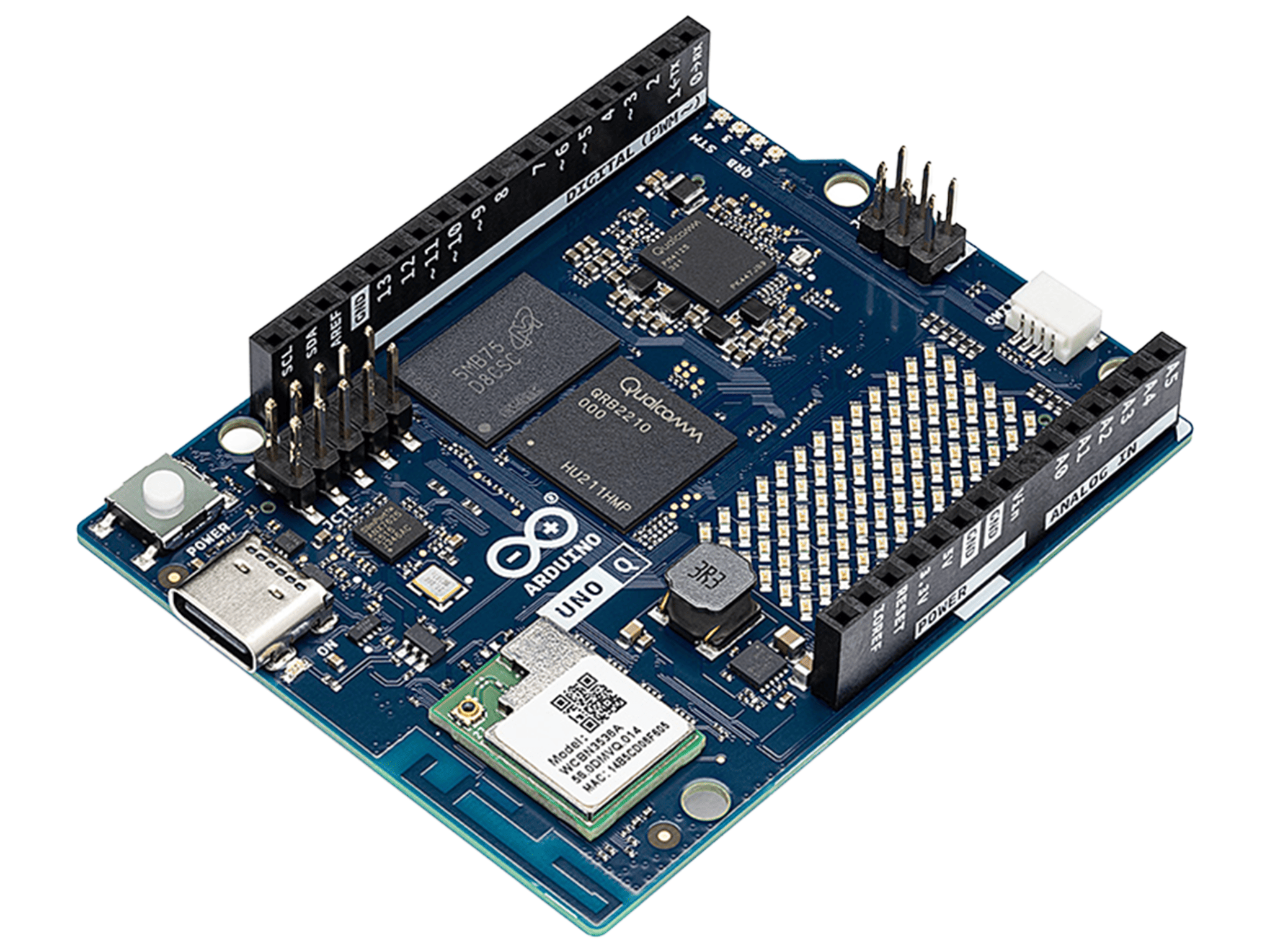
In the campaign "Discover practical applications of Edge AI with Arduino UNO Q" Arduino shows that artificial intelligence can find application not only in data centers or industrial computers but also in compact devices working directly at the production line.
The Arduino UNO Q platform enables the construction of demonstrators and applications using local image analysis and cooperation with cameras compatible with the Arduino ecosystem. This makes it possible to create a system that analyzes the image directly on the device and only transmits the classification result or information about the detected inconsistency.
The platform is suitable both for building demonstrators and Proof of Concept projects, as well as for implementing the first applications using AI Vision.
What does a typical solution architecture look like?
│
▼
Arduino UNO Q
│
Initial image processing
│
Machine learning model
│
Product classification
│
├── OK / NOK signal
├── Operator notification
└── PLC / SCADA / MES system
This architecture can easily be expanded with additional elements such as LED lighting, part presence sensors, communication modules, or a user interface.
What components will be needed?
Building a simple AI Vision Inspection station does not require a large number of components, but the right choice of components is crucial for the quality of the system's operation.
The basic set may include:
| Product | Function |
|---|---|
| Arduino UNO Q | control and data processing platform |
| Camera compatible with Arduino | image registration |
| LED lighting | ensuring repeatable image acquisition conditions |
| Part presence sensor | synchronization of photo taking |
| Communication module | transmission of analysis results (Uno Q natively supports Bluetooth /WiFi) |
| Power supply, cables, and connectors | building a complete station |
All the elements necessary to build a demonstrator or prototype can be compiled in the TME offer, and then develop the project as new requirements arise.
Summary
Just a few years ago, automatic quality control was a solution associated mainly with costly vision systems. The development of machine learning models and compact embedded platforms, however, has made building your own AI Vision Inspection station much more accessible.
Starting with a small pilot project allows verifying the effectiveness of the solution, gaining experience, and gradually developing the system as the company's needs grow. For many companies, such a pilot becomes the first step towards implementing automatic quality control based on artificial intelligence.
Platforms such as Arduino UNO Q, combined with cameras, appropriate lighting, and other components available in the TME offer, enable the construction of modern applications using artificial intelligence for automatic quality control.

Discover more applications of Arduino UNO Q
Quality control using AI is just one example of the capabilities of the Arduino UNO Q platform.
See also how to use it for:
- Condition Monitoring and vibration monitoring of machines,
- Running local AI agents directly on the device.
Go to the page "Discover practical applications of Edge AI with Arduino UNO Q"
Transfer Multisort Elektronik (TME) is one of the world’s largest global distributors of electronic components, electrotechnical parts, workshop equipment, and industrial automation. The catalog includes over 1,500,000 products from 1,300 leading manufacturers. TME’s modern logistics centers in Łódź and Rzgów (Poland), with a combined area of over 40,000 m², ship nearly 6,000 packages daily to customers in more than 150 countries.
TME also invests in the development of knowledge and skills of young engineers and electronics enthusiasts through the TME Education project, and supports the tech community by organizing the TechMasterEvent series, promoting innovation and experience exchange.