Measuring Instruments
(22 886)All electro-technical projects require using precise measuring instruments. However, when electricity is involved, if you don’t have appropriate meters and other related equipment, it is actually impossible to design circuits properly.
The “Measuring instruments” section in the TME product catalogue contains all the equipment that is necessary for electronic engineers and electricians to perform their work. All such devices are used in laboratories, service centres, workshops and even on production lines. Moreover, we strive to make our product offer most suitable to the needs (and budgets) of not only professionals, but also hobbyists, pupils, students and individual customers. Therefore, we will discuss this assortment from the point of view of both amateurs and specialist engineers.
Multimeters
Multimeters are basic, but at the same time, extremely versatile measuring instruments. In the majority of cases, these are small-sized devices that facilitate studying various physical properties. Their precision and functionality range increases along with their price, but even the lower-end models offer a measurement range sufficient for basic electric and electronic work performance (i.e. voltmeter, ammeter and ohmmeter functions). The range of such “basic” activities includes home power supply system diagnostics, inspecting performance of components of white goods, consumer electronics, machinery, car systems, etc. Each multimeter comes with the circuit continuity testing function, which facilitates conducting this most elementary electric system tests. Note also that such tests are very difficult to conduct safely without a multimeter.
Higher-end, more expensive multimeters offer more advanced functions: True RMS to facilitate precise voltage and current measurements for more complex non-sinusoidal signal waveforms, measurements at a higher resolution and with higher accuracy , operating precision electronic components (e.g. checking capacitor capacitance or clock signal frequency) and vice versa: higher-voltage circuit diagnostics, e.g. for 3-phase systems up to 1000 V. Multimeters can also be optionally equipped with thermocouples for temperature measurements. Devices designed for machinery park or power supply system inspections (also PV installations) make it possible to store thousands of measurement results and then export them in a form of a computer file. Wireless multimeters become increasingly popular, as their Bluetooth modules ensure communication with smartphones or tablets to provide necessary control functions.
The TME product catalogue includes mostly digital multimeters, however, a comprehensive selection of analogue models is also available. They are still preferred by some professionals, most often due to their robustness and ease of use. The assortment is complemented with stationary laboratory multimeters offering, for example, higher measurement accuracy and resolution.
Multimeter accessories
Note that measuring instrument accessories are presented in a separate TME product catalogue category. Nevertheless, the “multimeter” subgroup contains accessories dedicated to specific device models or brands. It facilitates searching for compatible products, such as adaptors, attachments, high-voltage probes, as well as bags and cases indispensable when instruments are used in the field conditions.
Clamp meters and attachments
Clamp meters perfectly enhance standard multimeter capabilities. They make it possible to measure current values without connecting the meter to the circuit. Their principle of operation is relatively simple. When the jaws are closed, the attached wires create an induction coil. If they encircle a cable, the AC current flowing through it induces a magnetic field and, as a consequence, generates an alternating voltage at the meter coil leads. As the voltage is proportional to the magnetic field present around the cable, the meter precisely indicates the current flowing through the tested circuit. Such a measurement method offers another considerable advantage, namely safety of operation. This safety is ensured even while handling high voltages present in the power grid and currents of the order of kA.
Clamp meters often come with multimeter functionalities, i.e. they are equipped with probe connectors to facilitate voltage, resistance, DC current, etc. measurements. Simultaneously, numerous multimeter models can be equipped with measuring clamp attachments supplied with a device or available for purchase in this product catalogue section.
Electric system testers and meters
This product category includes numerous instruments used by professionals to ensure the correct power supply line operation. They include specialist devices for taking measurements within building electric systems, such as insulation resistance meters or earthing resistance meters, i.e. instruments practically indispensable for making household and industrial power supply connections, as well as performing such tasks as connecting utilities on building sites, installing underfloor heating systems or creating renewable energy supply systems. Professional users can also make use of multifunctional instruments accelerating performance of standard inspection tests, even in large facilities, as advanced software makes it possible to record collected measurement results to facilitate the documentation development process. Instruments with a narrower range of functionalities include universal voltage and cable continuity testers and automated electric energy quality analysers, i.e. instruments essential for general maintenance technicians and industrial automation system maintenance technicians. This assortment also includes instruments designed for renovation and construction purposes, e.g. cable finders/locators.
Environmental meters
In contrast to other product groups containing various measuring instruments, this section of the TME product catalogue includes devices with a wide range of applications, used not only to handle electronic systems. A luxmeter (illumination meter or foot-candle meter) is a perfect example of an instrument suitable for numerous diverse applications, as it can be used not only to inspect illumination systems in work facilities (and their compliance with applicable OHS regulations), but also in such applications as photography, gardening, PV panel installation and many other fields. This group also includes such instruments as vibration meters, tachometers or range-finders whose applications cross the traditional boundaries of electronic and industrial automation systems. Our assortment also includes instruments used for air quality testing. These include temperature, humidity, pressure, gas concentration, wind strength meters, etc., which facilitate assessments aimed at checking whether a given environment meets the optimum requirements for certain purposes (e.g. human comfort, food storage, server room component operation or plant growth).
Pyrometers and thermal-imaging cameras
Another important group of environmental meters includes such devices as pyrometers and thermal-imaging cameras. They are similar in terms of their operating principle, and facilitate contact-free temperature measurements by analysing infrared radiation emitted by the objects tested. These instruments are used in applications requiring high hygiene levels (pharmaceutical, medicine and food industry) and resistance to extreme thermal conditions, i.e. both refrigerant and oven status monitoring, etc.
Pyrometers report average temperatures from measurement areas, whereas thermal-imaging cameras take simultaneous temperature measurements within the entire visual field of their lenses. Such features enable them to detect the following anomalies: thermal bridges in construction projects, overheating components in electronics, leaks in gas and hydraulic lines, people with elevated body temperatures (even if present within a large group of other people). The TME product catalogue features IR cameras designed for technical operations, enclosure diagnostics or even automated industrial process monitoring.
Inspection cameras, boroscopes
Products included in this group are designed for such purposes as visual inspections of inaccessible or hard-to-reach spaces. Good examples of such applications include inspections of sanitary and ventilation systems or inspection wells. A camera attached to a long probe can be inserted into narrow slots or ducts to transmit images to a display located on the surface. Boroscope heads are typically equipped with light sources. This product group features mobile and battery-powered devices, including models with cameras fixed to a rigid or flexible cable, which are used by service technicians or car mechanics to investigate interiors of inspected machinery, domestic appliances or car systems. The differentiating features of these products include a high degree of leak-tightness and mechanical resistance.
Panel meters
These instruments are used to monitor key physical values in control cabinets, heavy machinery or power engineering equipment. Operators use them to instantly check important system operating parameters, such as power consumption, supply line voltage or quality of the energy supplied from the mains. Such meters are provided by specialist manufacturers, and their characteristic features include long service life and resistance to interferences. They are used both by industrial machinery manufacturers (as components) and in application-specific control panels. They are available in analogue and digital versions.
Computer and phone network testers
ICT professionals can surely get interested in our diverse assortment of instruments designed forcommunication (phone and computer) network diagnostics. This product category includes both cable testers (also with remote modules designed for operation over long distances) and state-of-the-art analysers designed by specialist manufacturers for distributed infrastructure inspection purposes. They come with built-in connection quality testing features and make it possible to locate cabling faults with great precision. Moreover, integrated software comes with such functions as automatic report generation or even uploading data to the cloud, which greatly enhances coordination of operations performed by various technical teams.
Lab equipment
Lab measuring instruments are designed mostly for professional applications, however, our product catalogue also includes affordable models with a limited range of functionalities. Several instrument types are included in this product group:
- RLC bridges (to measure capacitance, inductance and resistance values);
- spectrum analysers (to analyse signals over wide frequency bands to help identify interferences, harmonics, etc.);
- generators (to generate signals of a preset shape and frequency, which is extremely useful for testing filters and analysing amplifier performances, etc.);decade counters/boxes (simple devices that generate preset resistance in a circuit) and electronic loads (advanced, programmable instruments simulating receiver devices with specific parameters, essential for prototyping most consumer electronics products, industrial controllers, power supply systems, etc.);
- calibrators for voltage, current, thermocouples and overpressure systems;
- data acquisition systems (solutions for taking simultaneous measurements at multiple points to facilitate performance of comprehensive equipment tests.
The instruments included in the above-mentioned groups are very diverse, both in terms of their parameters and functionality, so that a technician of any specialisation can freely select a device that meets not only their needs, but also personal preferences.
Oscilloscopes and scopemeters
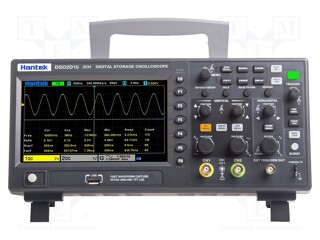
While discussing electronic measuring equipment, one must also mention oscilloscopes. In the simplest terms, these are devices which present a voltage value chart within a preset time frame (i.e. at a specified frequency). In other words, oscilloscopes let us “see” voltage fluctuations. In practice, such a definition is extremely narrow, as every digital oscilloscope offers an extensive range of functionalities for electronic circuit analyses, testing and diagnostics. A user with an elementary command of the laws of physics can also use it to test current, resistance, power and other values. Such tasks are further streamlined as basic functions of oscilloscopes include performing mathematical operations on obtained values.
Oscilloscopes come with 2 or 4 channels to conduct measurements at several circuit points. Their basic parameter is frequency which ranges from a few tens of MHz (to handle the majority of analogue circuits) up to a few tens of GHz (a bandwidth required to diagnose microprocessor circuits, digital communication protocols, etc.). Devices equipped with touchscreens have recently become very common, as they not only accelerate work, but also facilitate operation through the use of an intuitive interface. Note also that even a mid-range oscilloscope has considerable computing power and operates as a strictly specialised computer. Moreover, an Ethernet connection or USB protocol enables is to operate dedicated lab equipment (e.g. MATLAB or LabVIEW) to run comprehensive analyses of circuits, integrated circuits, etc.
An abbreviated list of features commonly offered by modern oscilloscopes includes:
- mathematical functions triggered with a selected signal; automatic measurements of time, amplitude, etc.;
- testing electronic components (diodes, transistors);
- logic signal analyser (recording a waveform of several logic signals in a relatively long period of time – this feature is used, for example, to diagnose serial communication protocols);
- spectrum analyser (facilitates identification of harmonics, electric/radio signal interferences, etc.).
The assortment of oscilloscopes also includes mobile instruments for field operations and scopemeters dedicated to strictly specialised industrial applications. They are particularly useful for machinery controller (motor) diagnostics, electric system troubleshooting in heavy vehicles and machinery or detecting interferences in telecommunication lines or radio and TV systems.
Power supplies
The TME product catalogue section devoted to measuring instruments also includes laboratory power supply units. Similarly to oscilloscopes and multimeters, these are basic-level devices necessary for both expert and amateur electronics engineer. They provide a precisely regulated energy source with specific parameters. They come with built-in voltage regulators, adjustable current limiters, meters for these values, as well as certain safety features mitigating the risk of damage to both the power supply module and consumer.
A laboratory power supply can come with 1, 2, 3 or 4 channels, sometimes separated to provide a symmetrical voltage source, which is useful, for example, when handling audio and radio systems. Clear advantages of numerous models available on offer include their compact size and even transportable enclosures. Some units ensure silent operation, since their systems are convection-cooled, which makes forced air circulation with a fan unnecessary. Similarly to oscilloscopes, the capabilities of laboratory power supplies extend well beyond their primary application range. Such optional features include power factor control, integrated arbitrary generator, AC power supply capability, variable adjustment resolution, battery simulation, setpoint exceeding alarms, measurement result storage, auxiliary outputs or setting locks. Such options as memory of settings and their recall capability are also very popular. More advanced models, designed for prototyping workshops or precision electronics service centres, are equipped with communication modules (USB, Ethernet) facilitating remote adjustment of operating parameters. Laboratory power supply modules operate within the range of up to a few kW and supply currents of several amperes.
Warehouse: