Microchip Technology at TME – security systems
Microchip Technology at TME – security systemsDate of publication: 06-11-2026 🕒 7 min read
In terms of meeting cybersecurity requirements Microchip Technology offers its customers secure hardware solutions, software tools, services helping designers implement trusted device identity, Secure Boot, authentication, protection of credentials stored in the device, secure provisioning and other fundamental security functions.
Cyber Resilience Act
Currently, the requirement to ensure cybersecurity for embedded devices in European Union countries is no longer merely a matter of good practice, but is also becoming a legal obligation. At the end of 2024, the EU CRA regulation (Cyber Resilience Act) came into force, establishing mandatory cybersecurity requirements for products with digital elements placed on the EU market. The regulation covers both hardware and software, as well as related remote data processing solutions. It places a large part of the responsibility for device security on its manufacturer and aims to ensure that cybersecurity is considered already at the device design stage and subsequently maintained throughout its entire period of use. The manufacturer is required to conduct a cybersecurity risk assessment, design the product in accordance with the principles of “secure by design” and “secure by default”, reduce the potential attack surface, protect data and implement authentication mechanisms, as well as ensure an effective vulnerability management process throughout the declared support (lifetime) period of the product. The product should be placed on the market without known vulnerabilities that could be exploited by unauthorized parties, and the manufacturer must ensure appropriate procedures for identifying and eliminating threats during the support period. For example, a simple temperature controller, an industrial Ethernet controller, an IP camera or a network gateway will require entirely different levels of protection. At the same time, the manufacturer should have procedures enabling the identification of potential vulnerabilities, their analysis, and the remediation of detected vulnerabilities by providing users with appropriate patches and updates.

From a practical point of view, for a device designer this means that it should have the following mechanisms:
- Root of Trust: the device should have a reliable starting point for the security process, preferably hardware-based. This may be a protected MCU area, a security chip (secure element) or a dedicated security module.
- Secure Boot: the processor should launch only firmware whose authenticity and integrity have been cryptographically verified.
- Signed firmware updates: having a bootloader alone is not enough. Updated firmware should be digitally signed, and the device should reject unauthorized images.
- Secure key storage: private keys, symmetric keys and other confidential cryptographic data should not be stored in unprotected Flash memory areas.
- Debug interface control: JTAG, SWD, UART or the bootloader should be disabled or appropriately secured in a production device.
- Communication protection: communication with the cloud, a mobile application or other devices should use modern cryptography, such as TLS, DTLS or appropriate application-layer protocols.
- Device authentication: a unique identity for each device is increasingly used – a key or certificate assigned already during production.
- Principle of Least Privilege: individual software blocks should have only the permissions that are actually needed.
- Attack surface minimization: unnecessary ports, protocols, services and interfaces should be disabled.
- Update mechanism throughout the product support period: the manufacturer must assume that vulnerabilities will be discovered after the product has already been sold.
Microchip Technology's approach to cybersecurity is based on building a chain of trust, founded on Root of Trust – a trusted hardware or software element enabling verification of the integrity and authenticity of subsequent system components. The manufacturer's approach can be simplified into the following chain:
Hardware Root of Trust → Secure Boot → Key protection → Device authentication → Secure communication → Secure firmware update → Product lifecycle management
 Source: Microchip Technology
In the hardware area, Microchip Technology offers solutions with varying levels of sophistication: from security features built into PIC and AVR microcontrollers, through microcontrollers with dedicated security subsystems, to external Secure Element chips, HSMs and dedicated Platform Root of Trust controllers.
Multi-layered approach to security
Microchip Technology solutions can be arranged into several groups:
| Solution group | Examples | Main function in the security system |
|---|---|---|
| MCUs with basic security features | PIC, AVR, e.g. AVR DU | code protection, programming and debugging lockout (PDID), secure update |
| MCUs with advanced security mechanisms | SAM L11, PIC32CM LS | secure boot, TrustZone, code and data isolation, hardware cryptography |
| MCUs with HSM / secure subsystem | PIC32CZ CA90 | hardware-isolated cryptographic operations and key storage |
| SecureElement / CryptoAuthentification | ATECC608, TA101, ECC204, SHA10x | key storage, authentication, hardware trust anchor |
| Platform Root of Trust | CEC173x, TS1800, TS50x | platform verification, secure boot, attestation, firmware protection |
| Secure provisioning | Trust&GO, TrustFLEX, TrustCUSTOM, TrustMANAGER | secure assignment and management of keys and device identities |
32-bit PIC32 family microcontrollers
Microcontrollers from the PIC32 family offer diverse security mechanisms, from basic protection of memory and program code to advanced cryptographic functions, secure boot (Secure Boot) and isolation of system resources. Depending on the series, they can be used in applications requiring software, data and communication protection, including IoT devices and industrial systems.
 Source: Microchip Technology
Microchip Technology microprocessors
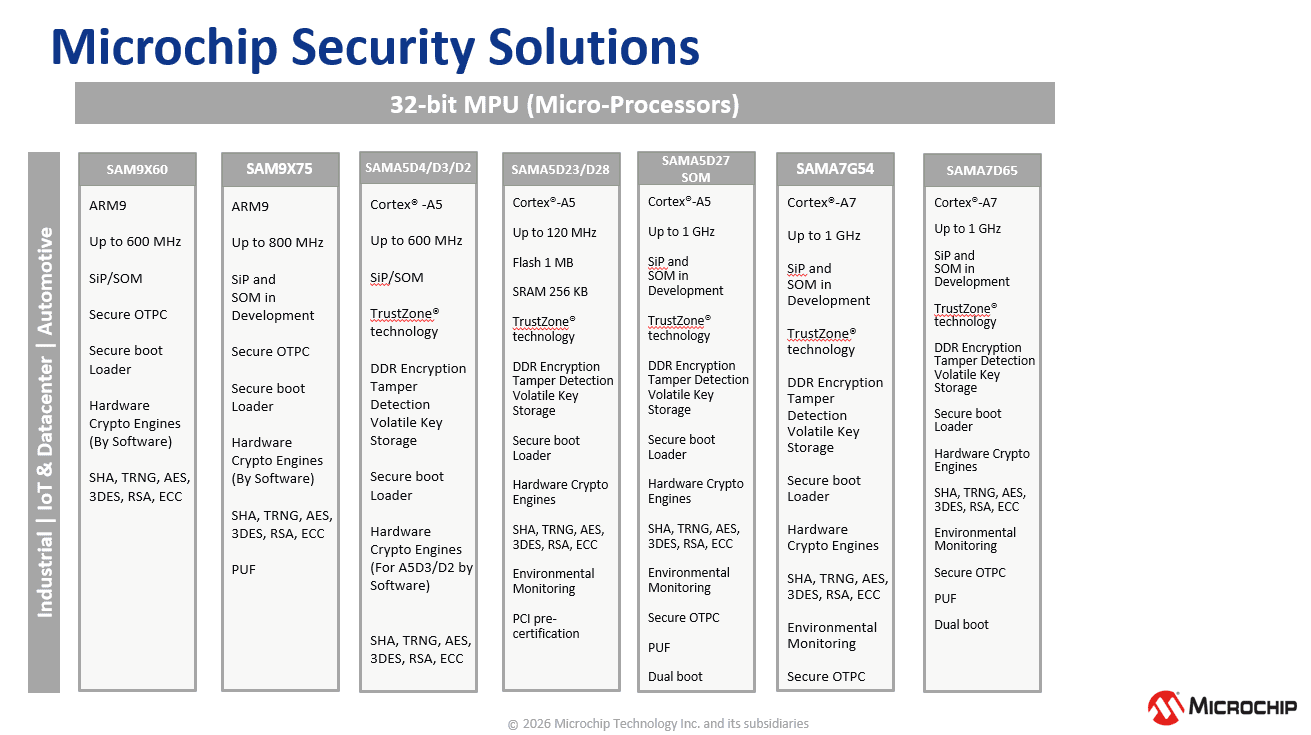
Microchip Technology microprocessors designed for more advanced embedded systems are equipped with mechanisms supporting software and data protection. These include secure boot, hardware acceleration of cryptographic operations, and solutions enabling the isolation of selected system resources. These features are particularly important in devices operating under operating systems that require reliable communication and protection against unauthorized access.
Microprocessor offering at TME
 Source: Microchip Technology
Microchip Technology digital signal microcontrollers
dsPIC digital signal microcontrollers combine real-time control functions with software and data protection mechanisms. Depending on the family, they offer, among other things, memory protection, secure boot, protection against unauthorized debugging and hardware support for cryptographic operations. These solutions are used primarily in motor control systems, power electronics and industrial automation.
 Source: Microchip Technology
Microchip Technology security chips (secure key storage/authentication)
Dedicated Microchip Technology security chips complement the mechanisms integrated into microcontrollers and microprocessors. These solutions enable, among other things, secure storage of cryptographic keys, device authentication and verification of software integrity. By separating selected security functions into dedicated chips, it is possible to reduce the risk of confidential data exposure even if the security of the main processor is compromised.
 Source: Microchip Technology
One of Microchip Technology's most important groups of security products is the CryptoAuthentication family of chips.
Their primary task is to store the most sensitive cryptographic data in an area isolated from the application firmware. For example, a private key can be generated or stored inside a Secure Element and never needs to leave the chip. Instead of reading the key, the processor can only request an operation:
Data → Secure Element → cryptographic operation → result
As a result, taking control of the microcontroller firmware does not necessarily automatically mean taking control of the device's private key.
ATECC608
ATECC608 is one of the most widely used Secure Element chips in the Microchip Technology portfolio.
The chip can be connected to virtually any MCU or MPU via I²C or a single-wire interface. A typical architecture may therefore be:
MCU → ATECC608 → network / cloud
ATECC608 stores the device's cryptographic identity, while the microcontroller is responsible for the actual application.
Transfer Multisort Elektronik (TME) is one of the world’s largest global distributors of electronic components, electrotechnical parts, workshop equipment, and industrial automation. The catalog includes over 1,500,000 products from 1,300 leading manufacturers. TME’s modern logistics centers in Łódź and Rzgów (Poland), with a combined area of over 40,000 m², ship nearly 6,000 packages daily to customers in more than 150 countries.
TME also invests in the development of knowledge and skills of young engineers and electronics enthusiasts through the TME Education project, and supports the tech community by organizing the TechMasterEvent series, promoting innovation and experience exchange.