Accurate measurements: basic limitations
Accurate measurements: basic limitationsDate of publication: 10-12-2025 🕒 8 min read
This and the next two articles contain information extremely important for anyone even somewhat interested in precise measurements. These are not guidelines for designers. This is a popular science, as accessible as possible, presentation of the main factors limiting accuracy.
Piotr Górecki – electronics popularizer. Currently publishes his own magazine "Understanding Electronics". Previously, for many years he was the Editor-in-Chief of a popular Polish magazine (Electronics for Everyone). He is also the author of hundreds of articles and educational projects. Until 1993, he worked in the telecommunications industry.
This article is the fifth in a series about measurement and measurement accuracy. The series began with introductory material contained in the article Accuracy and measurement range in electronics. In subsequent articles, we discussed various issues related to accuracy. Among others, it was stated that frequency and time can be measured with an accuracy or rather uncertainty even much better than 10-12, that is 0.000001 ppm = 0.0000000001%. Meanwhile, voltage and resistance can be measured in the laboratory with an accuracy (uncertainty) slightly better than 10-9, in other words 0.001 ppm, or 0.0000001%.
Very important questions are: Can measurements be made even more accurately? Are the limits defined by currently available technical possibilities? Will technical progress allow these limits to be gradually and without restriction be pushed further and further, enabling increasingly accurate measurements? Or have we already reached insurmountable limits determined by fundamental physical laws, making further progress impossible or very limited? This, however, concerns only the best laboratories and the best, most expensive professional equipment.
What about hobbyists? With what maximum accuracy can a modern, moderately wealthy hobbyist measure?
In the article Accuracy and precision in the hobbyist’s practice, we indicated that in the vast majority of cases, an electronics enthusiast does not need to measure with accuracy greater than 1%. Usually, they do not need to, but firstly, in certain cases more accurate measurements are necessary. Secondly, many of us simply would like to measure everything as accurately as possible. Thirdly, with the very broad market availability today, more and more people are interested in the actual accuracy of their measuring instruments, especially multimeters. Increasingly, people pay attention not to the attractive appearance of a multimeter, but to its parameters, including accuracy. We want to buy meters with truly good technical parameters and, most importantly: we want to verify the accuracy of the meters we own.
Within the initiative Understanding Electronics, we will approach these matters as practically as possible. Hence, the articles show the capabilities and limitations of various meters. However, in this article and related ones, we will discuss the main accuracy limitations occurring in workshop conditions, especially amateur ones.
Many electronics enthusiasts would like to conduct the most accurate measurements possible. And it is possible! Possible, but under certain conditions: one must understand the causes and sources of errors and uncertainties in order to eliminate them. Here are the most important details.
Economic accuracy limitations
We preliminarily noted that the basic limitation in practice is price. Simply stated, a good, accurate meter must contain high-quality components. This cannot be said about meters costing a few dozen zlotys from unknown brands.
A modern multimeter is essentially a (milli)volt DC voltmeter, which, with the participation of various auxiliary circuits: dividers, amplifiers, converters, measures a wide range not only of DC voltage and current but also (thanks to additional circuits) AC voltage and current, resistance, and capacitance. Therefore, the accuracy of a multimeter largely depends first of all on the employed (milli)volt meter. This millivoltmeter is some kind of analog-to-digital converter (ADC), cooperating with a reference voltage source.
In the cheapest meters, an ICL7106 integrated circuit or a related one is often still used, where the reference voltage source is built into the IC. Better meters use various other integrated (milli)voltmeters. Some have the reference voltage source built into the ADC IC, in others there is a separate ADC and a separate reference voltage source.
 Photo 1
Photo 1 shows almost all the electronic components of a budget multimeter (cost about 100 PLN), which, apart from the specialized processor (under the black resin) and 24C02A memory, contains an ICL8069 reference voltage source.
Simply stated, the greater the required accuracy, the better and more expensive both the ADC and the reference voltage source must be. Nowadays, integrated 24-bit or even 32-bit converters (Figure 2) are readily available. Of course, they are quite expensive – the better ones cost as much as the entire meter shown in Photo 1 and are not perfect either, with their main problems being imperfect linearity and noise.
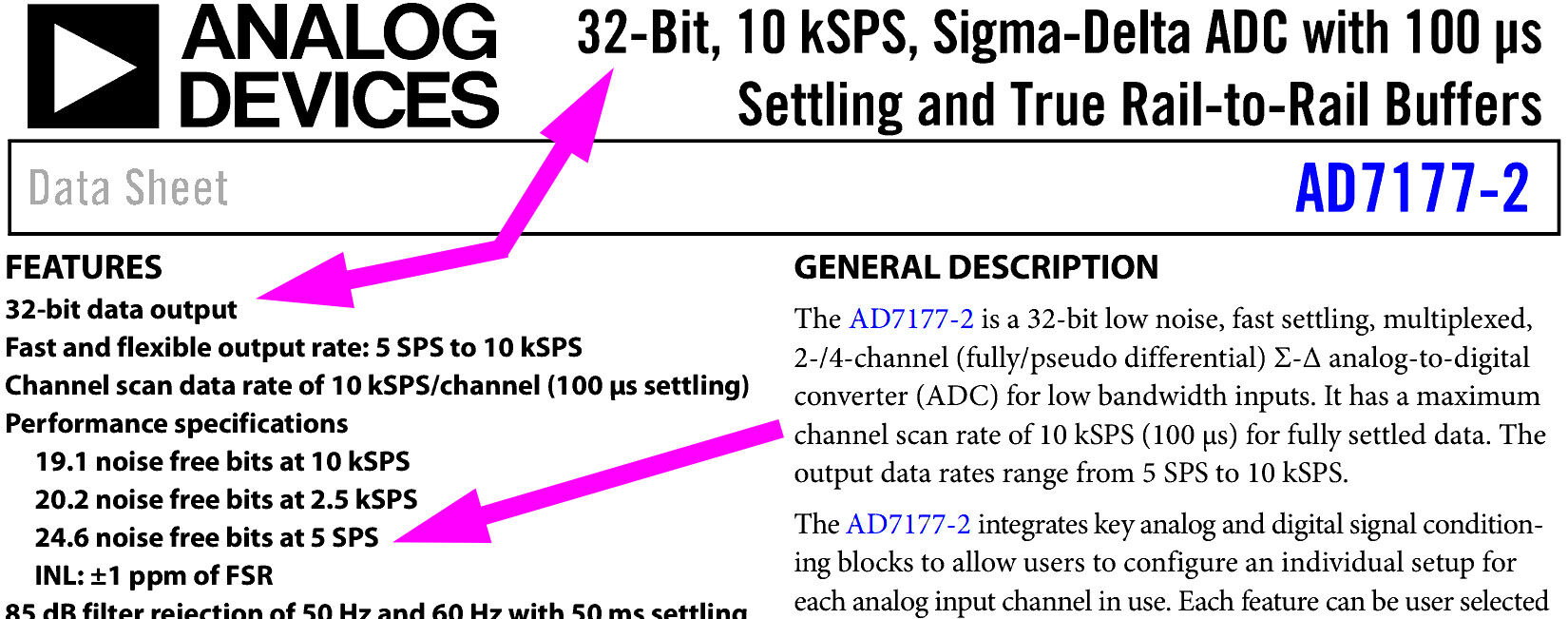 Figure 2
The cheapest reference voltage sources can be bought for a zloty or even less, while the best currently serially produced integrated reference voltage IC LTZ1000 costs several hundred zlotys in retail. To allow the integrated (milli)voltmeter to measure over various ranges, dividers and shunts—resistors—are needed. Popular so-called "precision" resistors are ridiculously cheap, especially in SMD versions. However, the best serially produced resistors (hermetic metal-foil ones) cost several hundred zlotys each. The most accurate multimeters contain many such expensive resistors, which already explains what constitutes the price of such instruments, often reaching several thousand dollars.
A multimeter must also contain other circuits, such as converters or amplifiers. An essential component is a converter for AC to DC waveforms. Previously, this was called a "rectifier," and in cheap multimeters simple rectifiers, often active rectifiers, are still used. In extreme cases, such primitive solutions make it impossible to measure AC currents.
Sometimes an active rectifier can be built from a cheap LM358 operational amplifier. Surprisingly, this provides quite good parameters for such a cheap solution. Unfortunately, such averaging rectifiers do not correctly measure distorted waveforms but only sine waves; therefore, better meters use various True RMS converters. Cheaper and more expensive converters depending on accuracy and frequency range.
The provided information signals that there are no ideal multimeters. Those close to ideal are terribly expensive, and all others are the result of numerous compromises that, among other things, limit accuracy. However, there is good news: a contemporary modest hobbyist can measure with great accuracy, but they should have appropriate knowledge, primarily about limitations. Then they can make the most of what is available to them and avoid traps resulting from mistaken assumptions.
Is tolerance the most important?
The least informed consider tolerance to be the most important problem—that is roughly the maximum permissible deviation from the nominal value. This mainly concerns resistors.
There are many resistors in meters. In practice, none of them has a nominal value indicated on the casing, which undoubtedly affects meter accuracy. The reference voltage source has some nonzero tolerance as well. Deviations related to tolerance can also be found in other meter circuits.
At the same time, the notion that component tolerance is the fundamental cause of poor accuracy of measurement instruments is entirely wrong! The tolerance problem could be eliminated entirely! For example, by complicating the circuit and adding correction elements, in the simplest case, adjustable potentiometers. They were also used in inexpensive meters. An example is in Photo 3, where an old multimeter shows five trimmers. The presence of such correction circuits, of course, raises the price of the instrument. It seems that the more such potentiometers, the greater the accuracy can be obtained over various ranges and functions. Previously, such conclusions were correct.
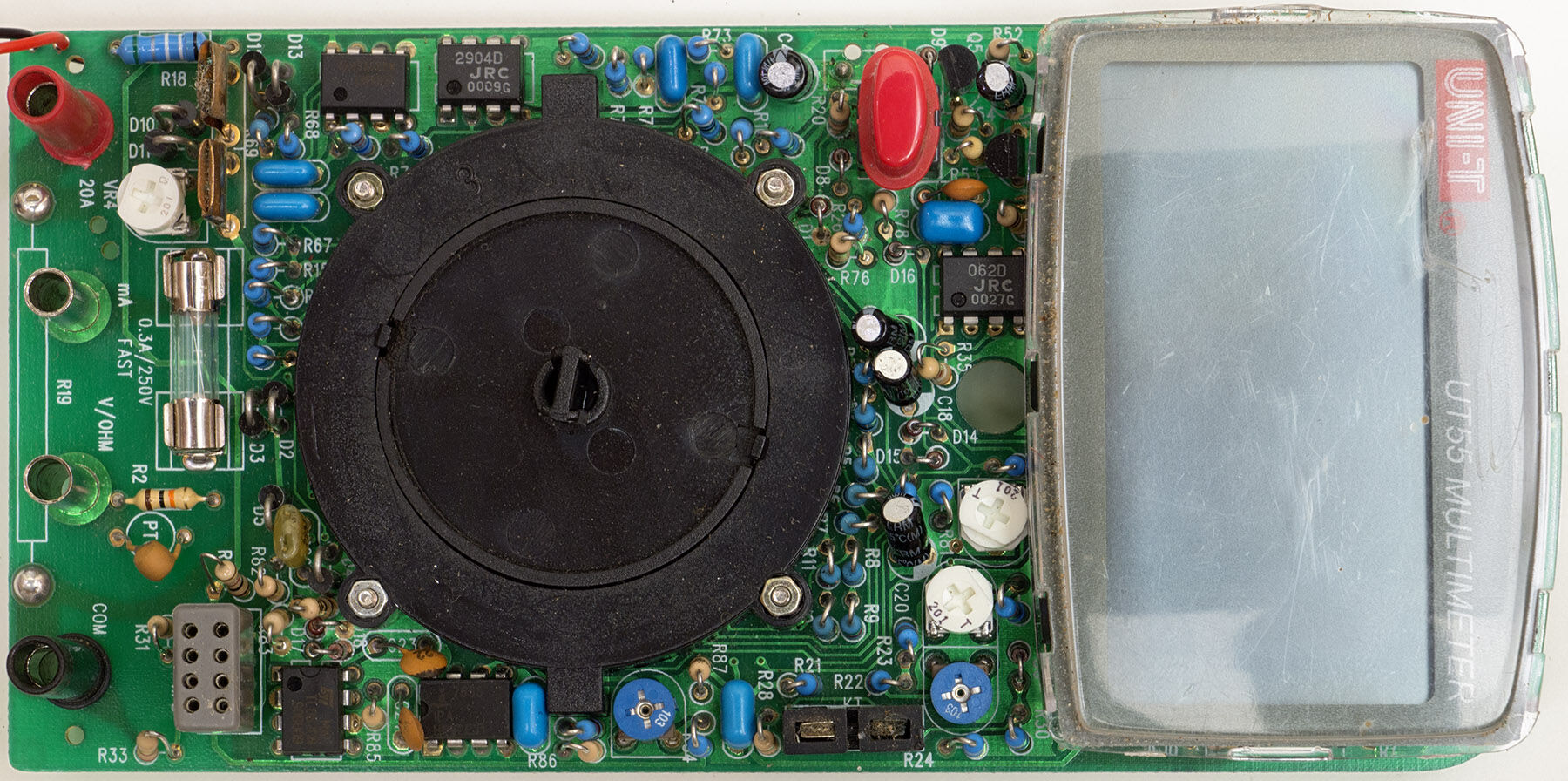 Photo 3
Previously yes, but today definitely no! One needs to know that other correction methods are used today, which practically do not increase the cost, at least the cost of materials. In modern multimeters, there are no tuning potentiometers at all—as in the earlier Photo 1, where correction information is stored in 24C02 Flash memory. This is very good, not only because of component costs. In such meters, the tolerance problem could be entirely removed digitally.
Better meters either contain an ADC and a classical microprocessor, or their main IC is a specialized microprocessor with an accurate ADC and various auxiliary circuits, including a built-in True RMS converter. Most importantly, the digital data from the ADC before being sent to the display is processed by the microprocessor’s program. After production, reference voltages and currents can be applied to its inputs to carry out and introduce a software correction so that the display shows correct results. Similarly, resistance measurement results resistance, capacitance, and possibly other quantities can be corrected.
Software correction can adjust indications on all ranges and functions of the multimeter, which allows completely eliminating the effect of component tolerance on the system.
Of course, this requires time and appropriate equipment. Hardware-wise, the meter is then much less complicated, but the cost of time-consuming calibration and necessary equipment is added. Therefore, in practice, due to labor and time costs, the software calibration in cheaper instruments is not complete but, say, performed only on some ranges.
In any case, full software calibration could completely eliminate the tolerance problem, i.e., the variation of parameters between individual units. It could, but it absolutely does not solve the most important accuracy problems of meters.
Serious problem – thermal stability
Somewhat more experienced electronics enthusiasts know that temperature significantly affects the parameters of practically all electronic components. This includes resistors, capacitors, and reference voltage sources. They also know these changes are repeatable, characterized by parameters called thermal coefficients (of resistance, capacitance, voltage), expressed in percent or parts per million per degree Celsius (%/°C, ppm/°C).
Here, it should be reminded that 1 ppm is 0.0001%, so seemingly very small. In earlier articles, we noted that the best multimeters measure DC voltages and resistances with accuracy, or rather uncertainty, on the order of precisely 1 ppm (10^-6).
A preliminary idea of how difficult this is to achieve is provided by resistors. It is well known that today’s popular 1% tolerance resistors (±1%), often called precision, usually have a temperature coefficient of resistance (TCR) up to 100 ppm/°C, more precisely ±100 ppm/°C. The temperature effect cannot be ignored if we want to measure as accurately as possible in a temperature range, say from +15 °C to at least +30 °C—which can be the extreme indoor temperature in which measurements are taken. In field conditions, ambient temperature can be below zero! Then the expected temperature change range will be more than 30 degrees! A "precision" resistor with TCR = 100 ppm/°C will change its resistance by 1500 ppm or 0.15% over a 15-degree Celsius change.
Recall that a 4.5-digit meter (0...19999) has a resolution of 0.005%, or 50 ppm. If this multimeter used “precision” resistors with TCR = ±100 ppm/°C, then the mentioned temperature changes could shift readings by ±1500 ppm, i.e., ±0.15%. This means destroying accuracy even if the instrument was calibrated after production.
It is already clear that for truly accurate measurements significantly better resistors are needed. As a first approximation, the thermal coefficient TCR of the best and most expensive resistors can be assumed to be about 1 ppm/°C. Catalogs list resistors with even better TCR values, down to 0.2 ppm/°C or even less.
It should be remembered, however, that the TCR coefficient is not the most important issue at all. Firstly, the thermal coefficient, even in polynomial form, could be taken into account and its influence eliminated by performing program calibration of the instrument at different temperatures. With modern technical means, this is available even to amateurs and is sometimes utilized by them.
Secondly, the temperature influence problem could be eliminated by placing the instrument in a really good thermostat. Many laboratory measuring instruments use thermostats. Some stabilize temperature to hundredths of a degree Celsius. Hobbyists can also build effective and accurate thermostats.
However, even effective elimination of ambient temperature changes does not solve the issue of really accurate measurements and their reliability. Neither tolerance nor temperature influence are the biggest problems. These are elementary issues, at least roughly known to most electronics enthusiasts. For truly accurate measurements, other problems have much greater practical significance. We will start to discuss them in the next article. ©
Piotr Górecki
Transfer Multisort Elektronik (TME) is one of the world’s largest global distributors of electronic components, electrotechnical parts, workshop equipment, and industrial automation. The catalog includes over 1,500,000 products from 1,300 leading manufacturers. TME’s modern logistics centers in Łódź and Rzgów (Poland), with a combined area of over 40,000 m², ship nearly 6,000 packages daily to customers in more than 150 countries.
TME also invests in the development of knowledge and skills of young engineers and electronics enthusiasts through the TME Education project, and supports the tech community by organizing the TechMasterEvent series, promoting innovation and experience exchange.