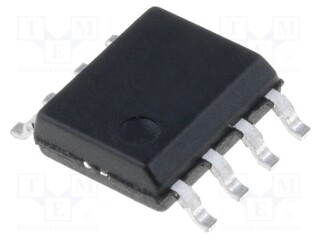
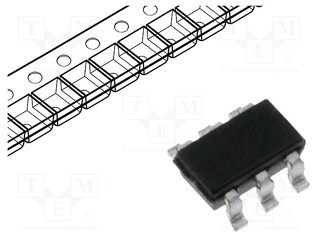
EEPROM memories - integrated circuits
(4 194)EEPROM (Electrically erasable programmable read-only memory) is an electronic component with a long history. It is not a new invention, as it dates back to the first half of the 1970s. EEPROM memories offered one of the first methods of permanent data storage in electronic systems. In fact, it should be said that this technology is still being developed, because Flash memories, present in SSDs, SD cards or flash drives, have many features in common with EEPROM, primarily in terms of construction. It should also be noted that EEPROM is slowly being displaced by its successor because in recent years the development of production methods has made the use of Flash components price competitive (they also offer a much higher capacity and read/write speed). However, in many applications EEPROMs are still successful .
EEPROM - features. EEPROM stands for "electrically erasable and programmable read-only memory" This is a non-volatile memory type (data is stored after power failure). These systems use FGMOS transistors , i.e. the "floating-gate MOSFET ". FGMOS is a type of transistor equipped with: control gate (control) and floating gate (floating). The first allows you to change the load of the second, while the load on the floating gate is maintained. Consequently, the channel between the source and the drain remains permanently open or permanently closed (absent). By combining FGMOS transistors in CMOS technology, a microscopic size, one-bit memory cell (de facto logic gateway) is obtained, the state of which can be changed and preserved. A byte consists of eight bits, 8192 gates is a kilobyte, etc.
EEPROM chips - application
EEPROM chips offer simple methods of writing/reading a small number of data (in the order of kilobytes), including through commonly implemented interfaces (e.g. SPI, 1-wire, I 2 C). One of the most popular applications of these products is memorizing device settings, also in the consumer electronics and household appliances sector . Thanks to them, the radio or TV retains the frequencies assigned to individual programs and preferences regarding sound processing (graphic equalizer). EEPROM chips perform similar functions even in the simplest hardware, e.g. storing information about the time at which the alarm is to be triggered.
The simplicity of EEPROM operation is associated with the organization of memory cells. The devices are organized in pages in which each byte has an address (8- or 16-bit, depending on the model). Writing and reading functions require the address of the first frame – this value is automatically incremented as the data is retrieved/entered from/into the buffer. Thanks to this, the reading can be carried out using individual commands and can be performed by an inexpensive, basic microcontroller. Some models of microcontrollers (e.g. popular AVR have a built-in EEPROM system for saving data from the program (without a programmer).
An additional advantage of EEPROM systems is their durability and electrical resistance, which means that this type of memory has been successfully used in automotive electronics for a long time.
Important EEPROM parameters.
When choosing an EEPROM device for use in a given project, several aspects should be considered. The basic issue will, of course, be memory capacity The memory capacity of EEPROM chips offered by TME ranges from several dozen bits to megabits (Mb). Note that the value given in kilobits (kb) and megabits (Mb) is always 8-times smaller than the capacity measured in kilobytes (KB) and megabytes (MB).
EEPROM components are available in SMD (Surface Mount) format and THT (through-hole technology). There is a significant difference in the number of outputs between models with parallel interface (faster memories, with a more reliable method of communication) and serial interface. The latter can support one of several types of transmission, including 2-wire, I2C or SPI (commonly used in microprocessor and microcontroller systems).
In some cases, the access time and the clock frequency will play an important role, which translates into the maximum speed of writing and reading from memory. For some applications, this is a very important factor (e.g. fast switching between settings, which consists of a relatively large amount of data).
Of course, one should not forget about the basic parameters that must be taken into account when designing electronic devices. The first is the operating voltage. Here, many EEPROM systems have a wide operating voltage range – they can be used in 3.3V and 5V DC circuits. Typically, the nominal values range between 1.5V and 6V and are product specific. The second important aspect is the operating temperature. It is worth noting here that EEPROMs are extremely durable elements, and some models can operate even in temperatures from -40°C to 125°C .
Warehouse: