Diodes
(95 344)A diode is perhaps the oldest semiconductor device. Different diode types are used to rectify voltage, limit voltage, switch current circuits, detect and mix signals. Special types of diodes, such as tunnel diodes and capacitive diodes are used in microwave generators and radio tuning circuits.
Diodes and their selection by function
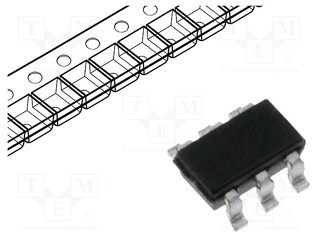
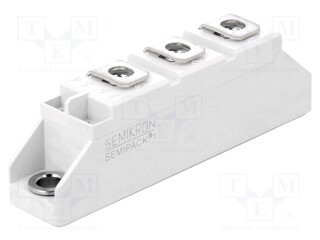
The basic classification of diodes covers functional groups, which can be further divided into subgroups, depending on the type of housing, mounting method, maximum power loss (including the possibility of using a heat sink) and others. These also include diode assemblies placed in a single housing (diode modules), or solutions that are connected in a special way, using e.g. a Graetz rectifier bridge or 8 protection diodes with a common cathode or anode for 8-bit data bus protection.
When choosing a diode for your application, you need to pay attention to a number of its parameters, not only electrical, but also mechanical ones. However, this cannot be done in isolation from the application, because, depending on the type of diode, various parameters become dominant. For example, for a rectifying diode these will be: maximum continuous forward current, maximum continuous reverse voltage, threshold voltage (also called forward voltage) at maximum forward current, reverse current at maximum reverse voltage, loss power, allowable junction temperature. On the other hand, for Zener diode, which can be used for voltage stabilisation or overvoltage limitation, the listed parameters gain a different meaning. The threshold voltage is no longer so important in most applications, because this diode works mainly in the reverse bias. What is important is the breakdown voltage and its tolerance, because this type of diode is required to repeatably and accurately stabilise voltage in the reverse direction. The forward current is also treated differently because it is mainly the reverse current, which in a rectifying diode should be as low as possible, and in a Zener diode too, but once the breakdown voltage is reached, the dynamic resistance of the diode is expected to be as low as possible. It is also expected that the transition to the junction breakdown state will be abrupt, with avalanche-like behaviour – unlike in a rectifier diode, where a mild breakdown characteristic may provide a longer diode lifetime.
Diodes and their classification by application
Othertypes of diodes, which have application-dependent characteristics, should be treated similarly. Other parameters, such as switching frequency, junction capacitance, etc. become more important. This applies especially to diodes used in high-frequency circuits, such as mixers, HV generators, detectors and other. Therefore, it would be wrong to assume that “a diode is a diode” and that a diode selected only based on the forward current and breakdown voltage would serve its purpose in every application.
Based on the function, diodes can be divided, among others, into: universal diodes (low forward current, low or medium reverse voltage, high operating frequency), rectifying diodes (high reverse voltage, high forward current, low operating frequency), pulse diodes (switching; short switching time with reversed polarity, capacitive diodes (varicaps, varactors; capacitance controlled by voltage), microwave diodes (tunnel diodes, Gunn's diodes, step recovery diodes; for rectification, generation and amplification of electrical waveforms in the microwave range), Zener diodes (for voltage stabilisation), avalanche diodes and transils (overvoltage protection). Some diode offer “glass passivated” design – a thin layer of glass used to protect the P-N junction improves the electrical characteristics, reduces the leakage current and increases the breakdown resistance.
Warehouse: