Thyristor Modules by Powersem
Thyristor Modules by PowersemDate of publication: 12-11-2024 🕒 4 min read
Thyristors remain among the most widely used semiconductor components, especially in circuits requiring control of high voltages and currents. In such cases, Powersem’s solutions are worth considering.
Powersem is a German-Indian manufacturer specializing in semiconductor power modules for almost 40 years. Powersem’s solutions are designed for current control in typical applications such as power supplies, motor controllers, and lighting systems. Below, we present a cross-section of Powersem’s thyristor module offerings—compact components ideally suited for industrial electronics, HVAC systems, heavy machinery circuits, and more.
General Characteristics of Modules
Powersem thyristor modules come in a range of configurations (detailed in the table below). TME’s catalog offers modules in single, double, and triple structures (available as independent or with common anode) as well as modules arranged in series or in antiparallel configurations (reverse polarity, parallel connection). These thyristors can handle high voltages ranging from 600V to 2kV and currents up to 300A (for select models, pulse currents can reach up to 6kA). As a result, these modules are suitable for most high-power circuits. To enable optimal thermal management, they feature mounting holes for attachment to heatsinks or other cooling elements.
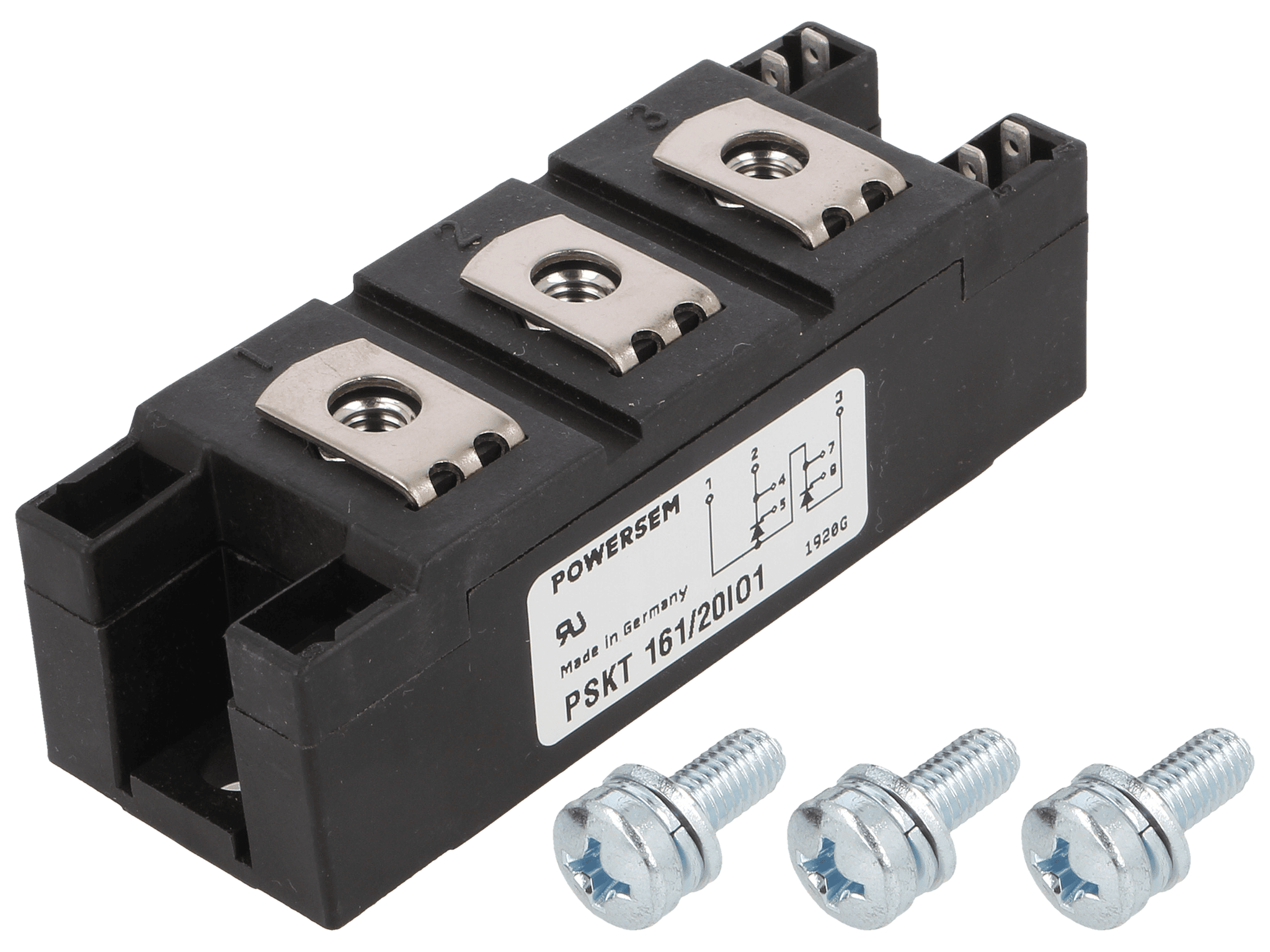 Module version with screw terminal connections.


A key advantage of thyristors is their affordability, often lower than alternative high-power transistor-based modules. They are also known for their durability. Available for PCB mounting (THT) in ECO-PAC1 and ECO-PAC2 housings, they are designed for high-load and harsh environmental conditions. Additionally, their gate current remains relatively low, from 25mA to 400mA, depending on the model, structure, and specifications.
Powersem products are intended for a range of applications such as switching and control in single- and three-phase circuits, lighting control, HVAC systems (including heaters), AC motor starting, and general-purpose semiconductor switching.