Fiber optic patchcords and pigtails
Fiber optic patchcords and pigtailsDate of publication: 16-05-2019 Update date: 10-04-2026 🕒 4 min read
Data transmission with the use of light is currently the most modern technology supporting, among others, ICT and telecommunications industry. Fiber optics make it possible to transport data with a range that cannot be compared to an electrical signal and are the basis for the increase of the available Internet speed.
Basic information about fiber optics
Elaborating on the topic of fiber optics, pay attention to the fibers inside, which transmit data or information with light. Although this is a simple definition, understanding it can be a problem. The principle of fiber optics operation was based on the phenomenon of light reflection, which at the same time is the main difference that distinguishes optical fibers from the traditional copper wire. The information carrier is no longer an electric signal but the light generated by a transmitter. Data is transmitted using the beam reflection effect at any angle. Finally, it is received by the receivers and converted back into the form of an electrical signal. The carrier is not the only feature that distinguishes this type of wires. It is also worth paying attention to:
- the diameter of optical fibers, often comparable to the diameter of a human hair;
- flexibility, which makes the bending and sudden change in the shape of the fiber optic cables do not affect the quality of the transmitted signal;
- data transfer rate, which due to the change in the carrier is unobtainable for copper cabling;
- range, the length of which is the result of generating losses with very small values;
- insulation material that protects the cable against mechanical damage and provides resistance to high temperatures.
Types of fiber optics
Depending on the material used to make the fiber optic, we can distinguish three types of these cables, differing in their purpose and properties. An important parameter taken into account when choosing the material of the core and jacket is the index of refraction, which in order to stop the beam inside the core, must have a smaller value.
- glass fiber optics, often made of high quality quartz glass;
- plastic fiber optics with a core made of organic material;
- semiconductor fiber optics characterized by a semiconductor core.
The outer layer of optical fibers is made of plastic materials, often resistant to temperature and change of mechanical properties. Depending on the purpose of the cable, it will be selected in such a way as to counteract the factors prevailing in the work environment. It is worth noting that fiber optics usually occur in three forms:
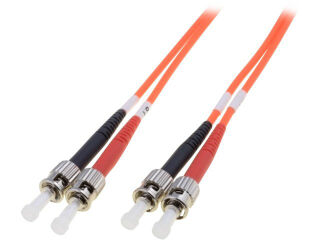
- patchcords, which are cables terminated on both sides with a specific type of connector;
- fiber optics pigtails in which the connector is mounted only on one side, allowing for wires connecting or assembly;
- cables whose cores were replaced by fiber optic.
An equally important classification dividing fiber optics is the mode structure that tells you the number of modes and core thickness.
Single Mode Fiber
Has a core thickness of 9 microns and a very large signal transmission range (up to 100 km). Due to the small thickness of the core, connecting several wires is complicated and requires special tools. The source of the input signal is a laser beam. The diameter of the outer jacket is 125 microns.
Multi Mode Fiber
Has a core thickness of 62.5 or 50 micrometers. It transmits the signal to a maximum distance of 1.5-2 kilometers and unlike single-mode components does not base its functionality on one wave. In this type of optical fiber, the input signal is divided into many rays transmitted at multiple angles, resulting in a lower data transmission rate and a smaller range. The diameter of the outer jacket is 125 microns.
Categories of multi-mode fibers Optical Multimode (OM) and single-mode Optical Single Mode (OS)
- OM 1: a wire with a core diameter of 62.5 micrometers and a jacket of 125 micrometers;
- OM 2: a wire with a core diameter of 50 micrometers and a jacket of 125 micrometers;
- OM 3: a wire with a core diameter of 50 micrometers and a jacket of 125 micrometers;
- OM 4: a wire with a core diameter of 50 micrometers and a jacket of 125 micrometers;
- OS 1: a wire with a core diameter of 9 micrometers and a jacket of 125 micrometers;
- OS 2: a wire with a core diameter of 9 micrometers and a jacket of 125 micrometers.
Types of fiber optic connectors
Fiber optic connectors come in two types, differing in the angle of termination of the connector. Connectors with flat termination Ultra Physical Contact (UPC) and with angled termination Angled Physical Contact (APC) are distinguished.
- Standard connector (SC)
- Straight Tip (ST)
- Ferrule connector (FC)
- Little connector (LC)
Fiber optics on TME offer
A novelty in the TME's offer are fiber optics from Lapp Kabel, divided into two types of connection cables:
-
Patchcords on both sides terminated with a fiber optic connector
-
Pigtails with connector on one side, and on the other end allow any connection of the cable by a thermal weld or a mechanical connection.
LAPP-29011902 - yellow fiber optic patchcord with a length of 2 meters and category OS2, terminated on both sides with a blue standard connector (SC).
LAPP-29310902 - a set of twelve two-meter-long fiber optic pigtails, in red, blue, black, white, green, brown, yellow, purple, orange, pink, gray and turquoise, with 9/125 micrometers, terminated on one side with a blue standard connector (SC).
Transfer Multisort Elektronik (TME) is one of the world’s largest global distributors of electronic components, electrotechnical parts, workshop equipment, and industrial automation. The catalog includes over 1,500,000 products from 1,300 leading manufacturers. TME’s modern logistics centers in Łódź and Rzgów (Poland), with a combined area of over 40,000 m², ship nearly 6,000 packages daily to customers in more than 150 countries.
TME also invests in the development of knowledge and skills of young engineers and electronics enthusiasts through the TME Education project, and supports the tech community by organizing the TechMasterEvent series, promoting innovation and experience exchange.