How does an accelerometer work and what is it used for?
How does an accelerometer work and what is it used for?Date of publication: 09-10-2020 Update date: 10-04-2026 🕒 8 min read
Accelerometer - what is it and what is it used for? In what solutions is the accelerometer worth using? Accelerometer is a device, that provides the ability to measure and analyze linear and angular acceleration. This function is indispensable in many basic devices and systems used in almost every field of life - both in domestic everyday devices, as well as professional industrial or research and development applications-development.
Highlights at a glance
- The accelerometer measures linear and angular acceleration in one, two or three axes
- Allows detection of vibrations, shocks, deviation from vertical and changes in motion
- Comes in MEMS versions, piezoresistive and piezoelectric - each has different properties and applications
- Used in machine diagnostics, mobile equipment, security systems and consumer electronics
- Its output signal can be processed into position data, vibration or movement of an object
From this article you will learn:
ACCELEROMETER - WHAT IS IT AND WHAT IS IT USED FOR?

Accelerometers are used in the measurement of static gravitational acceleration, which allows to determine the angle of deviation of the measured object from the vertical, as well as in measurements of dynamic acceleration due to shocks, motion, impacts or vibrations, that is, vibrations of small amplitude and low frequency, which reaches up to several tens of Hz.
- How does the accelerometer work when measuring vibrations? Accelerometer is implemented directly on the object, which is vibrating, which allows it to convert the energy of vibration into an electrical signal, which is proportional to the object's instantaneous acceleration.
- What does an accelerometer do? Vibration measurement is typically used to diagnose the operation of machinery, equipment or structures subjected to high stress, such as. steel mast structures, bridges or building structures. Accelerometers are also used in.in. to protect hard drives from damage, in medical and sports equipment, in cameras and camcorders, in smartphones, remote controls, controllers or in navigation systems.
- What is an accelerometer?It is nothing more than an acceleration transducer, that measures its own movement in space. There are three basic types of accelerometers, about which more later in the article.
ACCELEROMETER- PRINCIPLE OF OPERATION

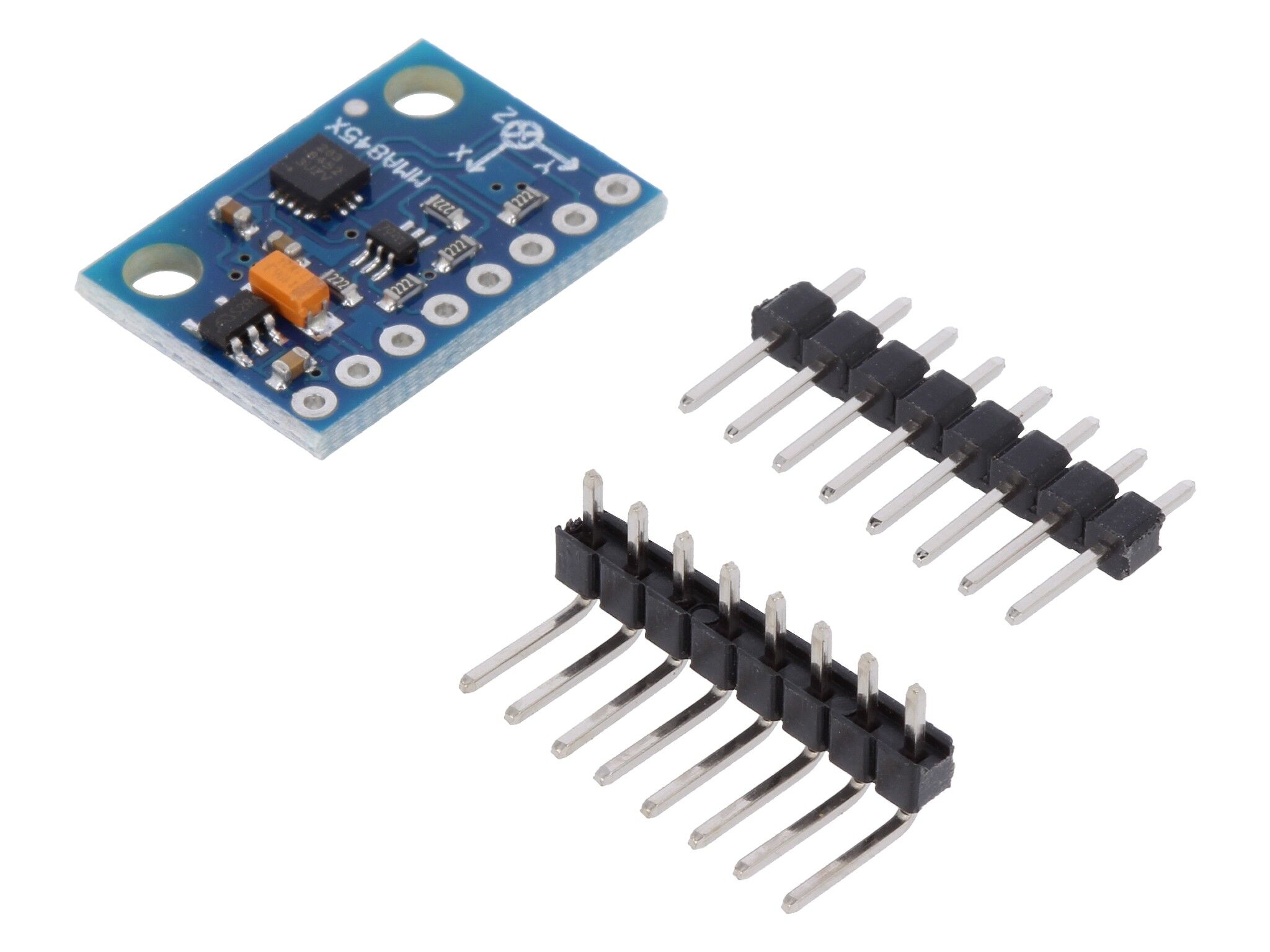
The principle of accelerometers is not very complicated. It measures the acceleration force in unit g and can measure in one, two or three planes. At present, the most widely used accelerometers are the 3-axial, whose design consists of an array of three accelerometers, and each of them measures the acceleration in a different direction - in planes X, Y and Z. An example of a 3-axial accelerometer can be model OKYSTAR OKY3230.
If the acceleration in any plane acts in the opposite direction of the one, in which the sensor was directed, the accelerometer will measure the acceleration with a negative value. Otherwise, the acceleration will be measured with a positive value.
If there is no external acceleration acting on the accelerometer, the device will measure only the ground acceleration, i.e. the force of gravity. Assuming, that the accelerometer-axial accelerometer is positioned in such a way, that the sensor in the X axis is pointing to the left, y-axis sensor downward, and the sensor in the Z-axis forward and no forces act on it, then the accelerometer will return the values: X = 0 g, Y = 1 g, Z = 0 g. If the same accelerometer is tilted to the left, its readings will show: X = 1 g, Y = 0 g, Z = 0 g. Similarly, when the deflection occurs to the right, x plane will return the result X = -1 g. The given acceleration measurement relationships are used by the algorithms of accelerometer supervisory systems.
WHAT ARE THE TYPES OF ACCELEROMETERS, HOW ARE ACCELEROMETERS BUILT?

Among the basic types of accelerometers, there are three types: MEMS capacitive accelerometers, piezoelectric accelerometers, and piezoresistive accelerometers.
MEMS capacitive accelerometers
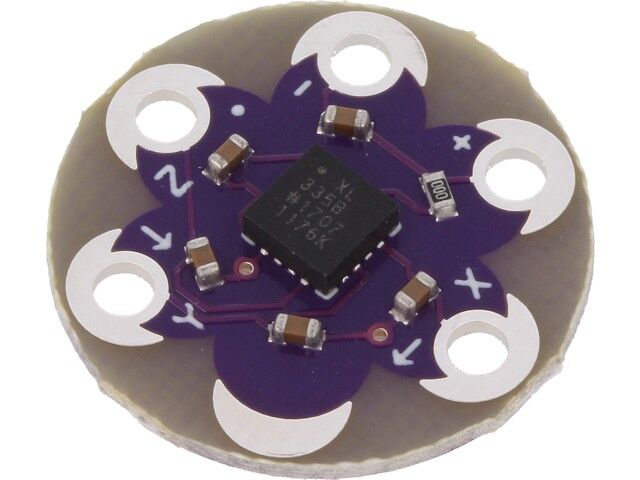
Capacitive accelerometers using MEMS technology are the cheapest, most common and smallest accelerometers on the market. How does a MEMS capacitive accelerometer work? The principle of its operation comes down to placing a weight mounted on springs. One end of the springs is attached to the facings of a comb capacitor, while the other end is attached to the mounted weight- to the mounted weight. Under the influence of the force acting on the sensor, the weight moves on the springs, which causes a change in the distance between the condensing element and the weight and thus affects the change in capacitance. An example of a MEMS accelerometer can be found in the model SPARKFUN ELECTRONICS INC. DEV-09267 or SPARKFUN ELECTRONICS INC. BOB-13926.
 SF-DEV-09267
 |
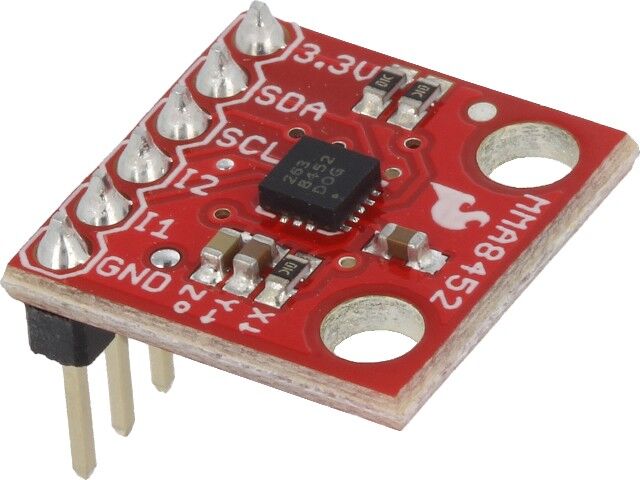 SF-BOB-13926
 |
MEMS capacitive accelerometers are mainly used in wearables, mobile devices and consumer electronics in the broadest sense. One of the biggest advantages of MEMS accelerometers is their ability to be implemented directly on a circuit board.Among the disadvantages MEMS accelerometers include low measurement accuracy, especially when measuring higher amplitudes and frequencies, making them unsuitable for specialized industrial applications.
Piezoresistive accelerometers
Another type of accelerometers are sensors that use the piezoresistive effect. What does a piezoresistive accelerometer do? Its principle of operation is similar to that of a strain gauge, that is, a sensor that measures stress. This type of accelerometer is equipped with piezoresistive material, which under the influence of an external force deforms, causing a change in resistance.
The change in resistance is then converted into an electrical signal received by a receiver integrated into the accelerometer. Piezoresistive accelerometers are characterized by a large measurement bandwidth, thanks to which they are able to record vibrations of high amplitudes and frequencies, which is useful for.in. during various crash tests.
Another advantage of piezoresistive gas pedals is the ability to measure slow-varying signals, which allows them to be used in inertial navigation systems to calculate the speed and displacement of system components.
This, how the piezoelectric accelerometer works, makes, that it is not resistant to changes in ambient temperature, which requires temperature compensation. In addition, accelerometers of this type have problems detecting weak signals, and are also much more expensive than MEMS capacitive accelerometers.
Piezoelectric accelerometers
What is a piezoelectric accelerometer? This accelerometer is one of the most widely used sensors for measuring vibration levels. For this reason, piezoelectric accelerometers are commonly used in industrial applications for diagnostics or inspection of machinery and equipment. How does the accelerometer work piezoelectric accelerometer? Its operation is similar to that of piezoresistive systems. Under the influence of acceleration, however, they do not change their resistance, and they generate an electric voltage of a certain value.The measuring element of these sensors is usually zirconate-lead titanate (PZT). Zirconate-lead titanate deforming, generates an electric charge. Piezoelectric accelerometers are characterized by high sensitivity and accuracy, making them suitable for a wide range of applications - from extremely advanced and precise seismic measurements to impact and destructive tests carried out under adverse conditions.The output signal of piezoelectric accelerometers is usually subjected to amplification and temperature compensation. The calculation of object displacement is facilitated by sending the signal to the integrator input.
Others accelerometers
Others accelerometer designs include IEPE designs, which are commonly used for vibration measurements. Also noteworthy are piezoelectric charge accelerometers, which are proven to work in extreme temperatures.
| Symbol: | Description: |
| OKY3230 | Sensor: accelerometer; 3,3÷5VDC; I2C; MMA8451 |
| SF-DEV-09267 | Sensor: accelerometer; analog; ADXL335; LilyPad; 20mm |
| SF-BOB-13926 | Sensor: accelerometer; 1,95÷3,6VDC; I2C; MMA8452Q; ±2,±4,±8g |
What is an accelerometer and what is it used for?
Accelerometer is a sensor, which measures the acceleration acting on an object. This allows it to determine changes in motion, position and detect vibrations. It finds application in.inter alia. in smartphones, medical devices, security systems or robotics.
How does an accelerometer work?
The operation of an accelerometer is based on measuring the forces acting on the internal mass of the sensor. Depending on the type, this can be a change in capacitance (MEMS), resistance (piezoresistive) or voltage generation (piezoelectric). The measured signal is converted into motion data.
Accelerometer - what does it measure exactly?
The accelerometer sensor measures linear acceleration (e.g. shocks, falls) and, indirectly, deviations from vertical. This allows you to determine the orientation of an object in space or its movement in different axes.
What is the principle of the accelerometer?
The principle of operation is that, that the mass inside the sensor moves under the influence of acceleration, which changes the electrical properties (e.g. capacitance or voltage) of the system. This allows you to convert acceleration forces into output data.
What can an accelerometer sensor be used for?
Accelerometers are used for:
- monitoring movement in smartphones and watches
- vibration detection in machines
- motion analysis in sports and medicine
- navigation without GPS signal
- security (e.g. airbags in cars)
What are the typical functionalities of an accelerometer?
Typical functionalities are:
- shock and collision detection
- yaw and orientation measurement
- recognition of gestures and physical activity
- detection of immobility or sleep
- cooperation with gyroscope and magnetometer in IMUs
Transfer Multisort Elektronik (TME) is one of the world’s largest global distributors of electronic components, electrotechnical parts, workshop equipment, and industrial automation. The catalog includes over 1,500,000 products from 1,300 leading manufacturers. TME’s modern logistics centers in Łódź and Rzgów (Poland), with a combined area of over 40,000 m², ship nearly 6,000 packages daily to customers in more than 150 countries.
TME also invests in the development of knowledge and skills of young engineers and electronics enthusiasts through the TME Education project, and supports the tech community by organizing the TechMasterEvent series, promoting innovation and experience exchange.