How to connect a dusk sensor
How to connect a dusk sensorDate of publication: 11-02-2025 🕒 5 min read
We need outdoor lighting at specific times of the day, depending on the current season. In the summer, in temperate zones, it's sufficient for street lamps to light up around 10:00 PM, while in winter, visibility becomes significantly impaired as early as 3:30 PM. Additionally, weather often has a decisive impact on outdoor lighting conditions. Keeping up with the variability of sunsets and sunrises and weather conditions is extremely burdensome for a person controlling the lighting. This is where a dusk sensor comes in handy, which instantly reacts to changing lighting conditions and turns the light source on or off.
A whole range of conditions affects the sense of security, and one of the most frequently mentioned factors causing fear and uncertainty is darkness. A situation where we are unable to see and assess our immediate surroundings causes discomfort. The response to this need was the construction of street lighting.
Dusk sensors in the TME catalog
The first solutions of this type appeared on the streets of London around the 15th century. However, it was only after the invention of the kerosene lamp by Polish pharmacist Ignacy Łukasiewicz that a true revolution occurred. From that moment on, newer and newer installations began to appear in various European countries, illuminating the streets of agglomerations. The next milestone was, of course, electrification and the installation of street lamps powered by electricity. Today, thanks to technological progress and the growing availability of solutions, we can independently create lighting for homes, yards, or company premises, which increases the sense of security.
- How a dusk sensor is built and how it works
- Where to install a dusk sensor
- How to connect a sensor
- How to set a dusk sensor
- Why the sensor doesn't work
Dusk Sensor – Construction and Principle of Operation
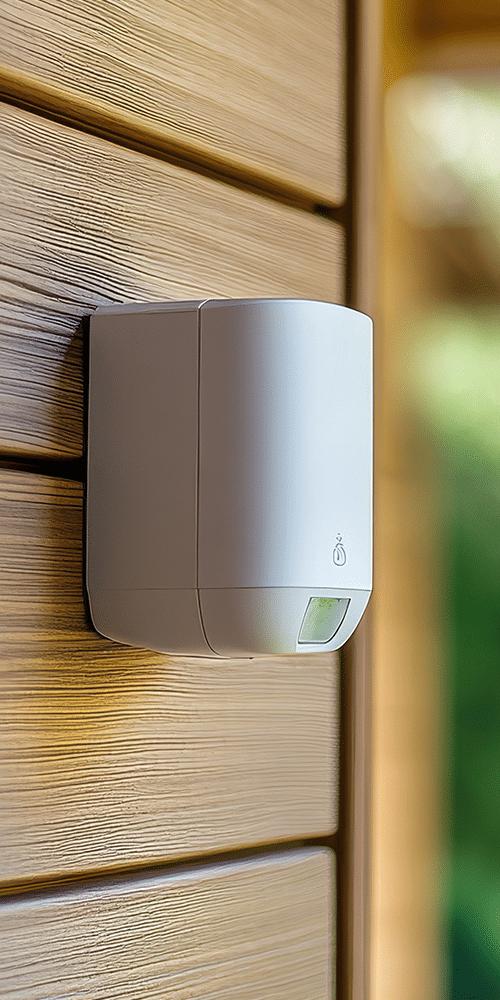
A dusk sensor is a compact electronic device designed to monitor light intensity levels in real-time and respond immediately by providing power or cutting it off from the electrical circuit under certain established lighting conditions.
The threshold values for the sensor's operation are set based on sensitivity adjustments. This way, we determine whether the lighting should activate when it's completely dark or if we preventively turn on the lamps even in cloudy autumn weather.
The construction of a dusk sensor is essentially based on three main components. These are:
- Sensor – usually in the form of a photoresistor, a small optoelectronic element with semiconductor paths applied to it, ending with two metal electrodes allowing the sensor to be connected to the electrical circuit.
- Control System – solutions based on transistors are distinguished, as well as more expensive and complex ones operating on microcontrollers.
- Actuator – as the name suggests, this component's task is to perform the task delegated by the control system. This function is fulfilled by a reliable electromagnetic relay.
There are also more advanced devices on the market, equipped with features such as sensor reaction delay or a timer programming the activation time. The first of the aforementioned functions prevents unwanted sensor activation in case of additional lighting (e.g., by a car lamp), while the second determines the time range within which the sensor should expect activation. This functionality allows minimizing costs associated with unnecessary sensor vigilance during periods when the user will definitely not require activation, but also forces activation even when lighting conditions do not clearly indicate such a necessity.
Where to Best Install a Dusk Sensor
Dusk sensors have become so popular that they find many diverse applications within single-family homes, commercial or service facilities. We use them, for example, in yard or gazebo lighting installations, but also to illuminate a garden path, parking lot, or as additional lighting for an area monitored by a CCTV camera. As you can see, there is no shortage of applications for dusk sensors, and in terms of the device's usefulness, there are essentially no limitations.
However, to ensure the sensor works correctly, a few technical issues should be remembered to prevent accidental activation of the device and meet the investor's expectations. Such a sensor should not be located in a heavily shaded area or shielded from the actual conditions prevailing around. Such a limitation of light radiation can cause the sensor to activate too early. It is also worth ensuring that the photosensitive element is not dirty or covered (e.g., by falling leaves), which could disrupt the system's proper operation.
Avoid installing the dusk sensor in areas illuminated by artificial light, as falling rays may be treated as changing ambient lighting conditions.
Consider installing the sensor at an appropriate height to prevent contact with the device and mechanical damage.
How to Connect a Dusk Sensor
The sensor connection should be performed according to the user manual provided with the device, with particular attention to the hazards associated with working in the field of integration with the electrical installation. The process of connecting the sensor should be conducted with the power completely turned off (preferably by switching off the electrical circuit in the electrical cabinet).
Depending on the type of sensor, it may be powered by 230V or 12V.
Inside the housing, there are terminals to which electrical cables, both power and connected lamp, should be attached. These are the following positions:
- L – terminal to which the phase wire (usually brown or black) should be connected;
- N – terminal to which the neutral wire (usually blue or gray) should be connected from both the power supply installation and the lighting lamp;
- IN – terminal to which the phase wire (brown) from the lighting lamp should be connected.
After securely tightening all terminals, a sensor operation test should be conducted. To do this, after turning on the power in the electrical cabinet, observe the behavior of the lighting lamp. To test during the day, you can simulate night conditions by covering the sensor and blocking sunlight.
Installing a dusk sensor is not particularly complicated. However, you can consult an electrician who will professionally carry out the installation.
How to Set a Dusk Sensor
The basic parameter that needs to be properly adjusted in every dusk sensor is sensitivity. Most devices have a potentiometer labeled as LUX, located on the housing for this purpose. It is responsible for setting the light intensity level required for the device to operate. However, as mentioned earlier, besides the basic version, there are also more complex solutions that require a bit more attention during the first start-up, offering the user a wider range of possibilities. A time-controlled sensor requires appropriate settings regarding the period in which it should be active. A very popular solution is also dusk sensors combined with a motion detector. In this case, in addition to the appropriate time of day, movement is also required to trigger the sensor. In some such cases, it is possible to set the zone within which the sensor will activate the lighting.
The most advanced are "smart" sensors, controlled directly from a smartphone or computer. A special interface then allows remote programming of all device operating parameters using a local Wi-Fi network.
Why Doesn't the Dusk Sensor Work?
After installing a new, freshly unpacked device, the user finds that the product is defective. Despite connecting the device to power, the lamp does not turn on or does not want to turn off at all. What could be the cause of such behavior?
First, it would be advisable to go through all the steps regarding the correct connection of the device to power, step by step. If the connection scheme from the user manual matches the actual state, and there is indeed current flowing in the installation, the next step should be verification of whether the factory-set sensitivity is too low for the sensor to operate correctly. A short test with the potentiometer's extreme settings should answer this question.
Following the guidelines discussed above regarding proper installation location, verify whether any points have been overlooked and whether the sensor is appropriately exposed to sunlight.
Depending on the version of the sensor you have, read carefully about all the functions and whether, in the case of remotely controlled sensors, they require additional settings after connecting to the network and whether access to the network has not been cut off.
If verification of the above does not yield any results and the sensor still does not work, it is worth contacting the distributor or manufacturer, who will verify the reported problem. In such a case, purchasing a sensor from a reputable source may prove extremely important.
Transfer Multisort Elektronik (TME) is one of the world’s largest global distributors of electronic components, electrotechnical parts, workshop equipment, and industrial automation. The catalog includes over 1,500,000 products from 1,300 leading manufacturers. TME’s modern logistics centers in Łódź and Rzgów (Poland), with a combined area of over 40,000 m², ship nearly 6,000 packages daily to customers in more than 150 countries.
TME also invests in the development of knowledge and skills of young engineers and electronics enthusiasts through the TME Education project, and supports the tech community by organizing the TechMasterEvent series, promoting innovation and experience exchange.