Cable ties – basics that every DIY enthusiast should know
Cable ties – basics that every DIY enthusiast should knowDate of publication: 04-06-2025 Update date: 24-03-2026 🕒 14 min read
Cable ties are unassuming yet incredibly functional components. You will find them in an electrician's toolbox, a gardener's kit, and... by your suitcase at the airport. Although they look simple, their application and design conceal many practical nuances. How to choose the right type of cable tie for a specific task? When is it worth reaching for a reusable model? Does the color of the tie matter? In this article, we answer all these questions and much more.
Learn how cable ties work, where they perform best, and how to use them so they serve safely and effectively for years.
- A brief history of cable ties
- Construction and operation of cable ties
- Types of cable ties
- Does the color of the tie matter?
- How to correctly use cable ties?
- Durability and strength of cable ties
- Applications of cable ties
- Alternatives to cable ties
A brief history of cable ties
Cable ties, known today as an essential element of every workshop, began their career in a completely different context. Although their design seems simple, the history of their creation and popularization shows how significant a well-thought-out technical detail can be. In this section, we look at the key stages in the development of cable ties – from aviation to household applications.
Beginnings – aerospace industry
The 1950s marked a period of rapid development in the aerospace and space industries. Airplanes and rockets started to be equipped with increasing amounts of wires and cable bundles that needed to be organized in a durable and safe way. Until then, cords and textile tapes were used, which required great precision and were time-consuming to install.
The industry needed a solution that would allow for quick, secure, and repeatable assembly. It was in such an environment that the concept of the cable tie was born – as an alternative to manual bindings.
Maurus C. Logan and the Ty-Rap® connector
In 1958, engineer Maurus C. Logan from Thomas & Betts introduced an innovative connector called Ty-Rap®. The inspiration came from visits to Boeing's plant, where Logan noticed how long it took to tie wires in airplanes.
His design was based on a flexible strap with teeth and a head with a ratchet mechanism. Early versions even included a metal locking tooth. Ty-Rap quickly gained recognition in the aerospace and military industries, as well as in automotive and energy sectors.
Development and standardization of cable ties
In the 1960s, Panduit developed the first one-piece cable tie made entirely of plastic – mainly nylon 6/6. This material proved to be lightweight, flexible, and resistant to many chemical and mechanical factors. This enabled rapid industrial-scale molding of ties.
In the following decades, cable ties evolved into many variants – UV-resistant, high-temperature tolerant, as well as detectable, releasable, and reusable models appeared. In the 1980s, the design became public domain, which further accelerated the development and variety of constructions.
Expansion of applications – from industry to household use
Over time, cable ties started reaching beyond industry. Their availability, low price, and ease of use made them popular in logistics, gardening, construction, and consumer electronics. They became favorites among hobbyists, installers, event organizers, and computer technicians.
Today, cable ties are used everywhere – from bundling cables behind a TV to fastening outdoor advertisements. Although originally designed to meet aerospace demands, they earned the status of a versatile everyday tool.
Construction and operation of cable ties
Although cable ties may seem simple at first glance, they hide a well-designed mechanism that ensures reliability and versatility. Understanding their construction helps to select the right type of tie for specific tasks and avoid common installation mistakes.
Key components of cable ties
A typical cable tie consists of three main parts:
- Head – contains the locking mechanism. Depending on the model, it may be made from the same material as the strap or include a built-in metal reinforcing element.
- Strap – an elastic rectangular cross-section band, whose length and width depend on the intended use. One surface has evenly spaced teeth.
- Teeth – form a unidirectional structure that allows the tie to tighten but prevents it from loosening automatically. They engage directly with the pawl in the head.
Depending on the manufacturer and application, these components may be reinforced with elements such as steel teeth, adhesive layers, or additional UV protection.
How does the self-locking mechanism work?
The operation of a cable tie is based on a simple yet effective ratchet mechanism. When pulling the strap’s end through the head, the teeth engage a pawl, which locks them in place. This allows a one-time, secure tightening of the tie.
This process requires no tools, though for thicker models or professional uses, the use of special tensioners is recommended. This allows controlled tensioning without damaging wire insulation.
Once tightened, the tie forms a permanent connection. In standard models, it cannot be reopened without cutting. The exception is reusable ties that contain a mechanism allowing the strap to be released.
Structural variants of cable ties
With expanding applications, many specialized versions of cable ties appeared. They differ not only in material but also in design. The most popular variants include:
- Push-button cable ties, allowing quick release without cutting – ideal for temporary fastening.
- Labels cable ties, featuring a writable area to easily identify cable bundles or mounted elements.
- Double-head cable ties, equipped with two heads on one strap, enabling simultaneous joining of two separate bundles.
- Push-mount and mounting cable ties, containing an integrated element for quick attachment to a mounting hole or surface – frequently used in automotive and industrial sectors.
- Adhesive-backed cable ties, with a sticky layer enabling application on smooth surfaces without drilling holes.


Each of these designs was created with specific user requirements in mind and can significantly enhance functionality in a given working environment. Choosing the right variant is crucial for durability and ease of installation.
Types of cable ties

Choosing the right type of cable tie is critical for durability, safety, and fastening efficiency. Thanks to a wide range of materials and constructions, cable ties can be used both in simple household work and in the most demanding industrial environments. This section discusses the basic division of ties – by material, functions, and applicable standards and classifications.
Classification of cable ties according to material
The material from which the tie is made influences its chemical, mechanical, and thermal resistance. Different plastics are used depending on environmental conditions.
| Material | Temperature range | UV resistance | Applications |
|---|---|---|---|
| Nylon 6/6 | -40°C to +85°C | Variable | General, indoor and outdoor (black cable ties) |
| Stainless steel | -196°C to +538°C | Excellent | Chemical industry, marine industry, automotive, aviation |
| Polypropylene | -40°C to +80°C | Good | Chemical environments (acids, salts, alcohols) |
| LDPE | -50°C to +60°C | Medium | Temporary bonds requiring flexibility |
| ETFE (Tefzel) | -100°C to +150°C | Very good | Radioactive environments, fire resistance |
| ECTFE (Halar) | -76°C to +150°C | Good | Plenum cabling, high fire resistance |


Functional classification of cable ties
Apart from the material, ties also differ in construction and purpose. Thanks to various variants, users can select a solution tailored to the specific task.
- Standard single-use – most common, intended for one-time tightening and cutting.
- Releasable – equipped with button or lever for multiple uses.
- With mounting hole, adhesive-backed, push-mount – allow permanent or temporary attachment to surfaces without extra elements.
- Heavy-duty – reinforced ties for tasks requiring high mechanical strength.
- Detectable – containing metal additives, intended for food and pharmaceutical industries. Detection degree depends on pigment (Fe) and system sensitivity.
- Colored and UV-resistant – facilitate organization and labeling; black versions resist sunlight degradation.


Standards and classifications
To ensure safety and compliance, cable ties are classified according to international standards. Depending on design type and resistance, they receive specific markings:
| Standard | Types of ties | Characteristic features |
|---|---|---|
| IEC 62275 | Type 1, 2 | For non-metallic and metallic cable ties |
| UL 62275 | Type 11, 21 | Higher thermal performance and environmental resistance |
| CSA C22.2 No.62275 | Type 2S, 21S | Adapted for fastening pipes and cables in building installations |
The above standards apply to mounting of wires and pipes in electrical installations.
Types with the letter “S” (e.g., 2S, 21S) are intended for installation use, while ties with an additional “1” (e.g., 11, 21) feature long-term resistance to temperature variations.
Thanks to these classifications, users can more easily select ties that meet safety and quality standards in specific industries. Manufacturer markings often indicate compliance with particular standards.
Does the color of the tie matter?
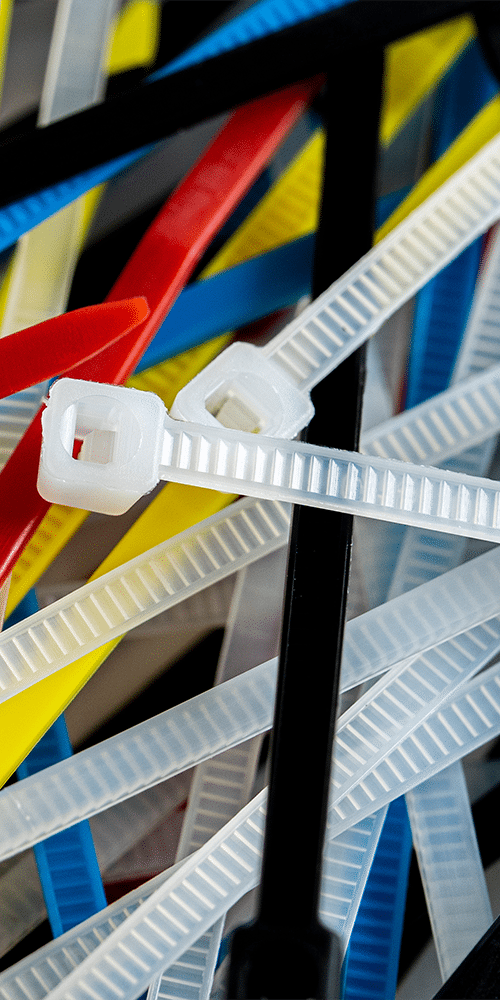
The color of a cable tie is not only a matter of aesthetics – in many cases, it also serves a practical function. Color coding allows quick identification of cable bundles, differentiation of circuits, or marking technical priorities. In complex or multipoint installations such as control cabinets, different colors greatly simplify cable management. Black cable ties are most commonly used outdoors because they contain UV stabilizers that protect the plastic from sun degradation. Blue detectable ties, due to metal additives, can be detected by control systems in the food or pharmaceutical industries, enhancing production safety. Thus, the color of a tie is not only a visual choice but also an organizational and control tool.
Cable ties with metal additives
How to correctly use cable ties?
Although cable ties are simple to use, their effectiveness and durability depend on proper installation. Incorrect application may damage wires, weaken fastening, or prematurely wear out the tie itself. This section presents tested methods and good practices worth following in daily work with cable ties.
Techniques for applying cable ties
Depending on the type of tie and the nature of the task, they can be tightened manually or with specialized tools. Manual pulling works well for household use or hard-to-reach places. In professional applications, using tensioners – manual or automatic – is recommended to ensure repeatable, safe tensioning and precise cutting of the strap end.
Optimal tension is crucial. Over-tightening may damage cable insulation or even break cables. Excessively loose ties will not hold properly and may slip off the mounted element. Also remember to space ties evenly – on longer bundles, they should be placed at regular intervals to distribute tension evenly.
How to join multiple cable ties?
When one tie is too short, series connection can be employed. The end of one tie is inserted into the head of another and tightening continues. This is a quick solution, but be aware that the connection point may be less strong than a continuous tie.
For applications requiring high durability, avoid excessive joining of ties. If frequent extensions are needed, choose a longer model or use ties designed for heavy-duty loads.
How to open, undo, and remove a cable tie?
Reusable models (releasable) have a button or lever enabling the release of the pawl and reuse of the tie. This solution is useful in temporary installations, server rooms, or exhibition setups.
Standard single-use ties must be cut to be removed. For this, side cutters, technical scissors, or a utility knife with a segmented blade work best. Always exercise caution to avoid damaging bundled wires or nearby elements. Avoid sudden jerks when removing to prevent injury or damage.
Proper use of cable ties is not only about aesthetics but also safety and longevity of the installation. Following these rules maximizes their potential without damage or early replacement.
Durability and strength of cable ties
Although cable ties are lightweight and inconspicuous, their durability and mechanical resistance can be surprising. The lifespan of a cable tie largely depends on the material and conditions in which it is used. Plastics such as nylon age over time – exposure to UV, extreme temperatures, and moisture reduces flexibility and strength.
Indoors, where ties are not exposed to harsh factors, their durability may reach several years. In outdoor installations, especially those exposed to intense sunlight and changing weather, this time may shorten to a few seasons. Therefore, UV-resistant ties, usually black, are recommended for outdoor use.
Additionally, ties exposed to chemicals, salts, or oils should be made from specialist materials such as stainless steel, ETFE, or polypropylene.
How many kilograms can a cable tie hold?
Tensile strength is one of the fundamental technical parameters of ties. This value indicates the maximum force a tie can withstand before breaking. For typical nylon models, values range from about 8 kg for thin ties up to 55–80 kg for versions 7.6 mm wide and larger.
Examples of applications and forces:
- Organizing household cables – 10–18 kg strength ties suffice.
- Securing pipes and components in automotive – ties with over 20–30 kg strength recommended.
- Industrial and structural uses – heavy-duty ties with over 50 kg strength.
Remember that over-tensioning or excessive weight may damage either the tie or the fastened element. Always choose a tie with an appropriate strength margin.
Can cable ties break?
Yes, cable ties can break, particularly due to improper use. Common causes include:
- Applying a load exceeding the tie’s capacity.
- Exposure to conditions unsuited to the material (e.g., UV on non-resistant ties).
- Aging of plastic, causing brittleness and fragility.
- Over-tightening causing micro-damage in the strap structure.
To avoid excessive stress, it is advisable to:
- Avoid tightening the tie "to the max" – leave minimal slack in the bundle.
- Prevent contact between ties and sharp edges.
- Regularly inspect ties in long-term and outdoor installations.
Using appropriate materials and installation techniques significantly extends tie life and minimizes failure risk. Remember to use certified ties compliant with industry standards for critical installations (e.g., electrical).
Applications of cable ties
The versatility of cable ties makes them applicable in almost every industry – from manufacturing to everyday home use. Their simplicity, availability, and durability make them indispensable tools for both professionals and hobbyists. Below are the most common usage areas and practical alternatives.
Professional

Electrical engineering and energy
Cable ties are widely used to bundle cables, wires, and conduits in low and high voltage installations. They facilitate cable route organization, cabinet assembly, and ensure installation aesthetics and safety.
HVAC and sanitary installations
HVAC technicians use ties to secure ventilation ducts, condensate pipes, thermometers, and control wires. In sanitation, they serve for temporary pipe fastening or element labeling.
Automotive and aerospace industries
In vehicles, ties organize electrical bundles, secure fuel lines, and mount internal components. Aviation uses only certified models resistant to high temperatures and vibrations.
Construction
On construction sites, ties are used for fastening tags, bundling cables, mounting temporary covers and protections. Heavy-duty models perform well securing pipes, beams, or formworks.
Household and DIY
Cable and wire organization
At home, cable ties help organize computer, TV, and home electronics cables. They simplify hiding wires and prevent tangling.
Garden, garage, travel
Useful for fastening fencing nets, plant supports, luggage securing, or tool repairs. In the garage, they can hang light items or join hoses and cords.
Emergency repairs and creative uses
In emergencies, ties can substitute broken straps, holders, or zippers. They are popular with hobbyists – used in modeling, LED installations, or crafts.
E-commerce and warehouses
Marking goods
Colored ties with labels are used to mark packages, group products, and tag batches. They facilitate logistics management and quality control.
Fast packing and binding
In warehouses and distribution centers, ties allow quick and durable bundling of items, sealing bags, or creating transport handles. They offer an alternative to adhesive tapes or clips.
Alternatives to cable ties
Although cable ties are highly practical, in some cases, more ecological or reusable solutions may be considered:
- Velcro® straps – reusable, easy to adjust and remove. Suitable for temporary installations, server rooms, and office cable organization.
- Textile ties and wire ties – thin, flexible, gentle to bundled elements. Used in electronics, floristry, and crafts.
- Clamp tapes and rubber bands – offer flexibility, ideal for temporary fastening, e.g. stage setups or decorations.
Choosing the right solution depends on work conditions, required durability, and reuse possibilities. Cable ties are indispensable in many cases, but knowing alternatives is valuable – especially where ecological approaches or flexible mounting matter.
What is worth remembering?
Cable ties are extremely versatile and practical fastening elements that find use both in industry and daily household tasks. Their simple design yet high effectiveness make them one of the most universal tools for organizing, fastening, and securing cables and objects.
Selecting the right tie type primarily depends on working conditions and technical requirements. For standard indoor use, nylon ties suffice, while in harsh environments – high temperatures, moisture, or chemical exposure – stainless steel, ETFE, or specialty plastic blends perform better. Considering reusable or detectable ties is advisable for temporary and industrial applications.
When purchasing and using, pay attention to material, strength class, UV resistance, and temperature range. Equally important are the tie’s length, width, locking mechanism, and additional features like labeling or surface mounting.
To ensure durability and safety, avoid over-tightening ties and ensure even spacing. Use UV-resistant models outdoors and periodically inspect and replace ties in exposed installations. For technical doubts, consult a qualified specialist.
A properly selected and installed cable tie guarantees a safe, aesthetic, and durable installation – regardless of project scale.
Transfer Multisort Elektronik (TME) is one of the world’s largest global distributors of electronic components, electrotechnical parts, workshop equipment, and industrial automation. The catalog includes over 1,500,000 products from 1,300 leading manufacturers. TME’s modern logistics centers in Łódź and Rzgów (Poland), with a combined area of over 40,000 m², ship nearly 6,000 packages daily to customers in more than 150 countries.
TME also invests in the development of knowledge and skills of young engineers and electronics enthusiasts through the TME Education project, and supports the tech community by organizing the TechMasterEvent series, promoting innovation and experience exchange.