Choosing an HDMI cable – which parameters matter?
Choosing an HDMI cable – which parameters matter?Date of publication: 08-01-2026 🕒 7 min read
HDMI is today one of the most important standards for transmitting image and sound. We encounter it practically everywhere – from televisions and game consoles, through projectors and computer monitors, to soundbars and amplifiers. Although HDMI cables look similar, they differ in parameters and quality of workmanship, which directly affects the comfort of use and the quality of transmitted image and sound. In this article, we will take a closer look at the types of HDMI cables, present the origins of this interface, and explain what to pay attention to when choosing them.
From this article you will learn:
- What is the HDMI standard?
- Versions of the HDMI standard – what changes and why is it important?
- Certificates and markings – how not to be fooled?
- Key technical parameters of the HDMI cable
What is the HDMI standard?
The HDMI standard (from English High-Definition Multimedia Interface) was developed jointly by a group of technology companies (including Sony, Toshiba, Panasonic, Philips, and Hitachi), and its first version appeared in December 2002. Already in 2003, the first devices supporting HDMI hit the market. Since then, the standard has been developed multiple times – each subsequent version introduced support for higher resolutions, greater bandwidth, and new technologies such as HDR and eARC. HDMI is a standard for digital transmission of image and sound, allowing multimedia devices to connect using a single cable. Thanks to this, we can transmit high-quality video images and multichannel sound without loss, in uncompressed form. HDMI replaced earlier analog connectors like VGA, DVI, or SCART, offering higher quality and greater convenience of use.
Choosing high-quality and certified HDMI cables is tremendously important for the comfort of using multimedia devices. It is the cable that determines whether image and sound will be transmitted stably and without loss. Certified cables guarantee that they actually support the standard for which they are intended – e.g., HDMI 2.0 or HDMI 2.1 – and thus can handle 4K or 8K resolution, high refresh rates, HDR, or modern audio formats. Poor quality cables often cause problems: image interference, screen flickering, audio dropouts, or lack of support for declared parameters. This is especially significant for gaming and home cinema equipment, where smoothness and highest signal quality matter. Investing in a good quality, certified cable thus not only provides a better experience when watching movies or playing games but also saves time and money. Such a cable eliminates the risk of technical problems and ensures compatibility with current and future equipment.
Read more about the history of the HDMI standard
Versions of the HDMI standard – what changes and why is it important?
The development of the standard results directly from the growing demands concerning devices for recording, playback, and display. HDMI has several main standards corresponding to successive versions of this connector and defining its capabilities in terms of image and sound transmission. They are as follows:
1) HDMI 1.0 is the first version of the HDMI standard, introduced in 2003. It enables digital transmission of Full HD (1080p) video and 8-channel sound over a single cable. The maximum bandwidth is 4.95 Gbit/s, which allowed for high-quality video and audio signals compared to earlier analog connectors such as VGA or SCART.
2) HDMI 1.1 introduced in 2004, extended HDMI 1.0 capabilities by adding support for DVD-Audio sound. This allowed playback of high-quality audio tracks from DVD-Audio discs.
3) HDMI 1.2 and HDMI 1.2a introduced in 2005 expanded HDMI capabilities with additional audio formats, which was especially important for computers and music players.
4) HDMI 1.3 and HDMI 1.3a–c introduced between 2006 and 2008 were a big step forward compared to previous standards. The focus was mainly on increasing bandwidth to 10.2 Gbit/s, adding support for Deep Color (30, 36, 48 bits), which allowed for displaying a wider color gamut and deeper shades. A new mini-HDMI connector type was also introduced for portable devices.
5) HDMI 1.4 and HDMI 1.4a–b versions introduced between 2009 and 2011. The first of these, HDMI 1.4, was a breakthrough version of this standard: it was the first to introduce support for 4K resolution (3840×2160 at 30Hz). Additionally, HDMI 1.4 was enhanced with ARC (Audio Return Channel), which allowed a TV to send audio back to an amplifier or soundbar using the same cable. HEC (HDMI Ethernet Channel) was also introduced – allowing the sharing of internet connection among devices. Besides the parameter changes, a micro HDMI connector for mobile devices was also presented.
HDMI cables in standard 1.4 offered by TME
6) HDMI 2.0 introduced in 2013 responded to the growing popularity of 4K TVs and monitors. The bandwidth was increased to 18 Gbit/s, enabling support for 4K resolution at 60Hz. This version also supported up to 32 audio channels, higher audio sampling rates (up to 1536kHz), and better audio-video synchronization, which was crucial for modern home cinemas. With the introduction of HDMI 2.0, simultaneous video display by multiple users, known as multi-stream, was enabled.
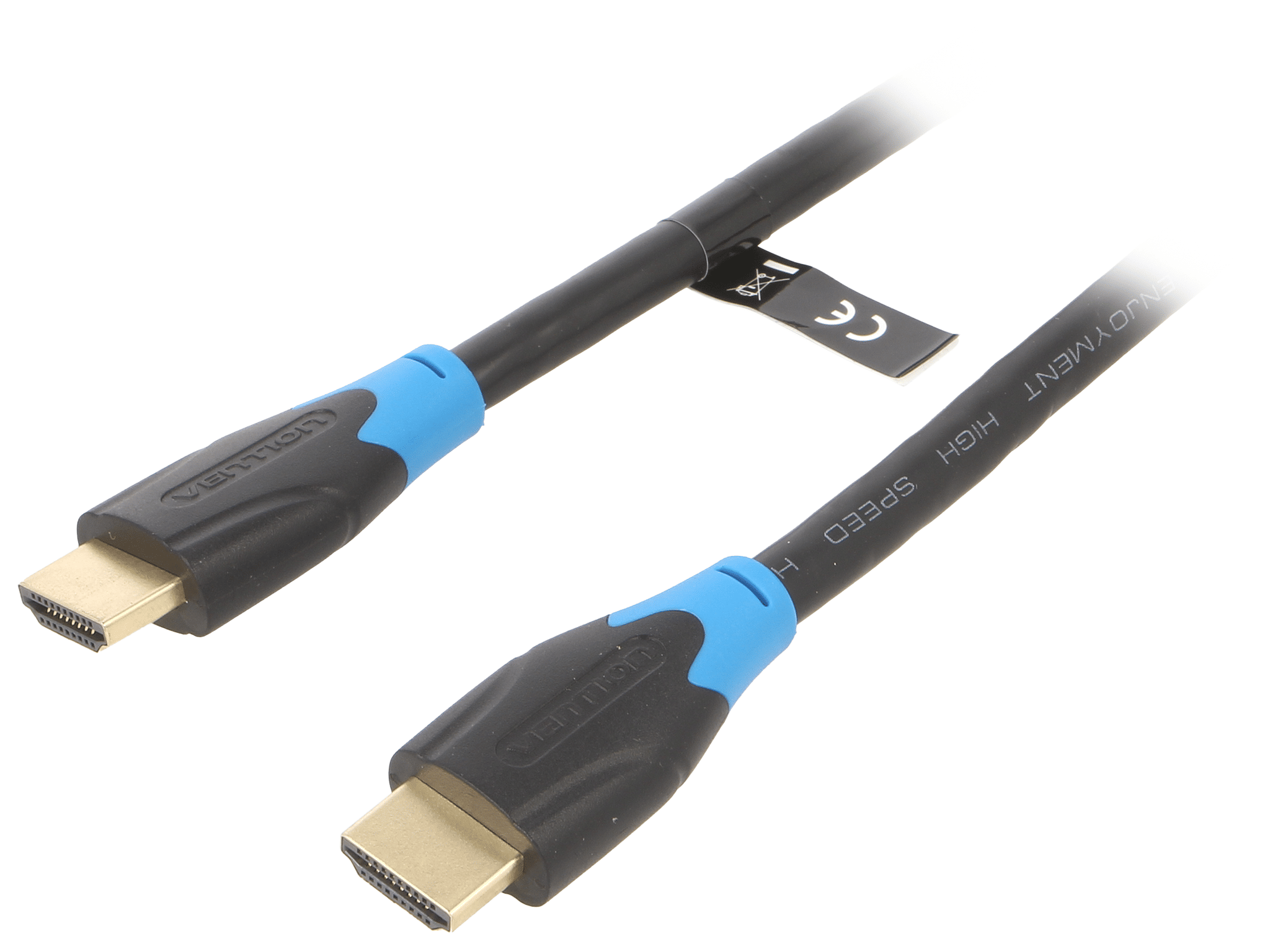
HDMI 2.0 cable supporting 2K, 3D, 4K, ARC, Full HD 1080p, HDR, HEC, UHD 2160p
HDMI 2.0a introduced in 2015 added support for HDR (High Dynamic Range), allowing display of images with greater contrast and a wider color gamut.
HDMI 2.0b followed in 2016. The HDR support was extended by the Hybrid Log-Gamma (HLG) standard, used among others in television broadcasts and streaming.
HDMI cables in standard 2.0 offered by TME
7) HDMI 2.1 was presented in 2017. It was the biggest quality leap in the history of this interface. The bandwidth increased to 48 Gbit/s, allowing support for 8K resolution at 60Hz and 4K at 120Hz. Support for Dynamic HDR was introduced, enabling each frame of a movie or game to be individually optimized for brightness, contrast, and colors. HDMI 2.1 also offered a new enhanced audio return channel eARC, allowing audio transmission in the highest quality, including lossless formats. Very important elements of this version are also features aimed at gamers: VRR (Variable Refresh Rate), QMS (Quick Media Switching) and QFT (Quick Frame Transport). Thanks to these, games became smoother, without stuttering and delays, which was crucial at the launch of new-generation consoles (PlayStation 5, Xbox Series X).
HDMI cables in standard 2.1 offered by TME

HDMI 2.1 cable supports standards including 8K, Dolby-True HD, DTS-HD, UHD 2160p, UHD 4320p
8) HDMI 2.2 – from January 7 to 10, 2025, at CES in Las Vegas, a new version of the HDMI standard – a connector used for transmitting image and sound in the highest quality – was presented. HDMI 2.2 offers much greater capabilities than previous solutions. Its bandwidth increased up to 96 Gbit/s, twice as much as HDMI 2.1. The new standard enables transmission of 4K images at 480Hz and also supports 12K resolution at 120Hz. It also introduced the option of displaying 4K at 240Hz with 10- or 12-bit color depth, ensuring exceptional smoothness and color accuracy. Additionally, new Ultra96 HDMI cables supporting the new specification will be introduced. At this moment, cables in the HDMI 2.2 standard are not yet available for sale but the technology will likely appear in the first devices only in a few years. A similar waiting time was required from the premiere to practical use in the case of the previous version – HDMI 2.1.
Certificates and markings – how not to be fooled?
When buying an HDMI cable, the certificate is key because it guarantees that the cable actually meets the declared parameters and ensures stable signal transmission. Many cables marketed as “HDMI 2.0” or “HDMI 2.1” are available on the market, but not all of them can fully support the capabilities of the given version of the standard. By purchasing a certified HDMI cable, we avoid problems with image flickering, audio dropouts, or lack of support for new functions such as HDR, eARC, or VRR. Table presenting HDMI standard certificates:
| Certificate / Marking | Supported resolution | Refresh rate | Additional features |
|---|---|---|---|
| Standard HDMI Cable | Up to 1080i / 720p | Up to 60Hz | – |
| High Speed HDMI Cable | 1080p, 4K at 30Hz | Up to 30Hz | 3D, Deep Color |
| Premium High Speed HDMI Cable | 4K at 60Hz | Up to 60Hz | HDR, hologram certification |
| Ultra High Speed HDMI Cable | 8K at 60Hz, 4K at 120Hz | Up to 120Hz | VRR, eARC, Dynamic HDR, QR code certification |
Key technical parameters of the HDMI cable
When choosing an HDMI cable, it is worth paying attention not only to its length or price but primarily to technical parameters that determine the quality of transmitted image and sound. These define what resolutions, refresh rates, and audio formats the cable can support. In this section, we will look at key features of HDMI cables – from bandwidth and supported resolutions to sound support features and quality of workmanship – to facilitate conscious selection of the appropriate cable.
Basic technical parameters of HDMI cables:
1) Bandwidth (from English Bandwidth) is one of the most important technical parameters because it defines the maximum amount of data the cable can transmit at a given time. It determines what quality of image and sound the cable can support. For specific versions, it amounts to:
- HDMI 1.0: 4.95 Gbit/s
- HDMI 1.3: 10.2 Gbit/s
- HDMI 2.0: 18 Gbit/s
- HDMI 2.1: 48 Gbit/s
- HDMI 2.2: 96 Gbit/s
2) Supported resolutions define the maximum number of pixels the HDMI cable can transmit from the source device (e.g., console, player, computer) to the display (TV, monitor, projector). The higher the resolution, the clearer and more detailed the image.
3) Refresh rate (Hz) specifies how many times per second the display presents a new image frame. It is measured in hertz (Hz) – the higher the value, the smoother and more natural the motion on the screen.
4) Sound support – audio support parameters are crucial for home cinema quality, gaming, or multimedia systems. Older cables and standards (e.g., HDMI 1.0) support up to 8 audio channels. Newer versions (HDMI 2.0 and above) allow support for up to 32 audio channels, enabling the transmission of very complex surround sound systems. HDMI cables can transmit both standard stereo sound and advanced digital formats:
- Dolby TrueHD – lossless sound used on Blu-ray discs and high-quality audio systems.
- DTS-HD Master Audio – similar to Dolby TrueHD, providing full lossless sound quality.
- Dolby Atmos / DTS:X – 3D object-based sound, where spatial effects are precisely placed in space.
- ARC (Audio Return Channel) – allows transmitting sound from the TV back to the amplifier or soundbar via the same HDMI cable.
- eARC (Enhanced Audio Return Channel) – a modern version of ARC, supporting high-quality audio and requiring Ultra High Speed cables.
5) HDMI cable shielding is very important, especially for the quality of signal transmission. Shielding is a protective layer surrounding the wires inside the cable, aimed at reducing electromagnetic interference (EMI) and radio frequency interference (RFI), as well as protecting against external signal influences. Additionally, an external cable braid can be applied, which increases the mechanical resistance of the cable and consequently its durability.
Transfer Multisort Elektronik (TME) is one of the world’s largest global distributors of electronic components, electrotechnical parts, workshop equipment, and industrial automation. The catalog includes over 1,500,000 products from 1,300 leading manufacturers. TME’s modern logistics centers in Łódź and Rzgów (Poland), with a combined area of over 40,000 m², ship nearly 6,000 packages daily to customers in more than 150 countries.
TME also invests in the development of knowledge and skills of young engineers and electronics enthusiasts through the TME Education project, and supports the tech community by organizing the TechMasterEvent series, promoting innovation and experience exchange.