Accuracy and precision in a hobbyist's practice
Accuracy and precision in a hobbyist's practiceDate of publication: 28-08-2025 🕒 10 min read
Many hobbyists do not pay attention to accuracy and precision at all. Others have very high expectations and false perceptions in this regard. Still others know that the issue is difficult, but would like to conduct as precise measurements as possible. The article highlights the general background of the issue.
 Title photograph
Piotr Górecki – promoter of electronics. He currently publishes his own magazine "Understanding Electronics". Previously, for many years, he was the Editor-in-Chief of the popular Polish magazine (Electronics for Everyone). He is also the author of hundreds of articles and educational projects. Until 1993, he worked in the telecommunications industry.
- Enemies of Accuracy and Precision
- Various Needs and Requirements
- What Quantities Does an Electronics Technician Measure
- The Ideal Voltage and Current Meter
- Measuring AC Voltages
- Temperature Measurements
- Frequency and Time Standards
Among hobbyists, there are extreme approaches to, broadly speaking, the issue of accuracy. Beginners are unaware of the problems – they are happy that they use various digital meters, which give a false impression of high accuracy. Some more advanced ones have partial awareness of the problem, but unfortunately, their perceptions of precision and accuracy are exaggerated, unrealistic in practice. The topic is discussed in school and at university, but the problem with hobbyists is that the overwhelming majority do not have access to prohibitively expensive laboratory measuring equipment of really high accuracy. A hobbyist usually uses various budget meters, and such equipment, due to its low price, must have compromise parameters.
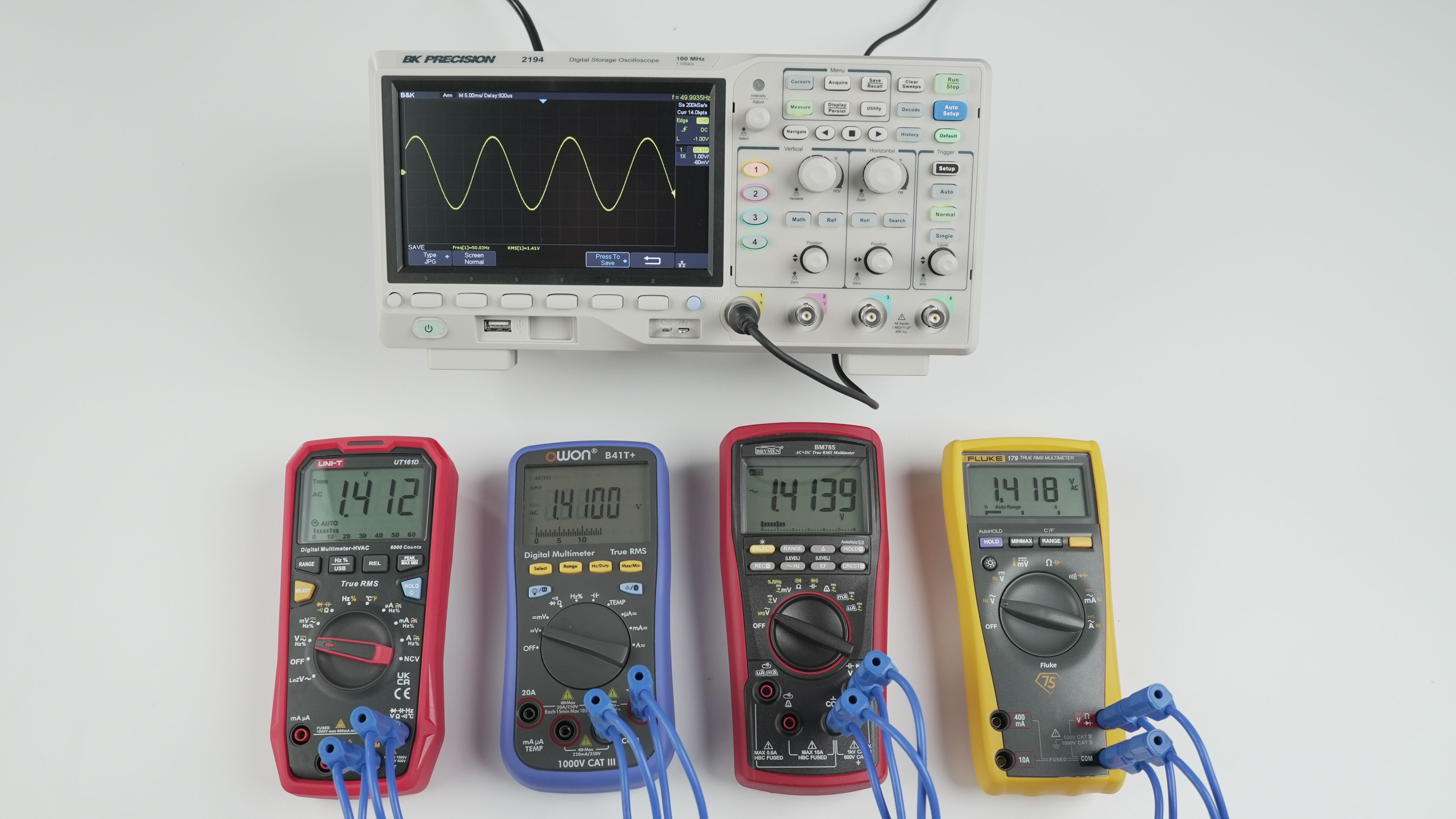
Title Photography shows a simple example – an attempt to measure AC voltage at a significant frequency (20 kHz). Some multimeters do not measure such a signal at all. Others show a large error. Some show a result close to the truth and not always are these devices the most expensive. It would be best to test your equipment in a good laboratory, but few have such an opportunity.
Enemies of Accuracy and Precision
The primary enemy is... lack of money, or more precisely – limited budget. Indeed, the best laboratory multimeters cost over 10,000 dollars or euros, and for that price, you can buy a not-so-bad car. Meanwhile, the cheapest, simplest digital multimeters can be bought for a few dollars. Undoubtedly, the simplest solutions and cheapest components are used in them. This must reflect on the parameters!
Beginners mainly associate low price with a wide tolerance of the used components, with the production spread of their values. Mainly resistors. However, in terms of high parameters of multimeters, it is not the tolerance of the components used in them that is the most important.
The price of multimeters is certainly influenced by the capabilities and available measurement ranges, as signaled by the title photography, but this is not an obvious dependency. The price of multimeters is mainly determined by the accuracy and stability of the readings. Interestingly, we pay the most not so much for accuracy, but for the stability of the readings, which unfortunately is never perfect. And here we come to the two biggest problems: one is changes in temperature, the other is changes in parameters related to aging, over time. That is why better measuring devices must be periodically calibrated and calibrated. We will often return to this very important topic. The price of a multimeter also depends on other factors, which I discussed in the series starting with the article What Multimeter for an Electronics Technician?
Various Needs, Expectations, and Requirements
Most multimeters used by hobbyists have an accuracy (whatever that really means) of about 1%, and in some measurements even up to 5%. It can be assumed that what the meter indicates may differ from the truth by one to several percent.In many typical electronic circuits, deviations or spreads of about 5% or 10% are perfectly acceptable. Therefore, a hobbyist rarely needs a meter with better accuracy than 1%. However, sometimes they need – an example might be measuring and setting the final voltage of LiIon chargers which, according to most sources, should be 4.2V with a tolerance no worse than ±50mV, i.e., about 1%.
To be sure that this is the case, a meter – voltmeter with better accuracy than 1%, ideally an order of magnitude, i.e., 0.1%. And that will not be a popular meter for a few dollars.
 Photo 1.
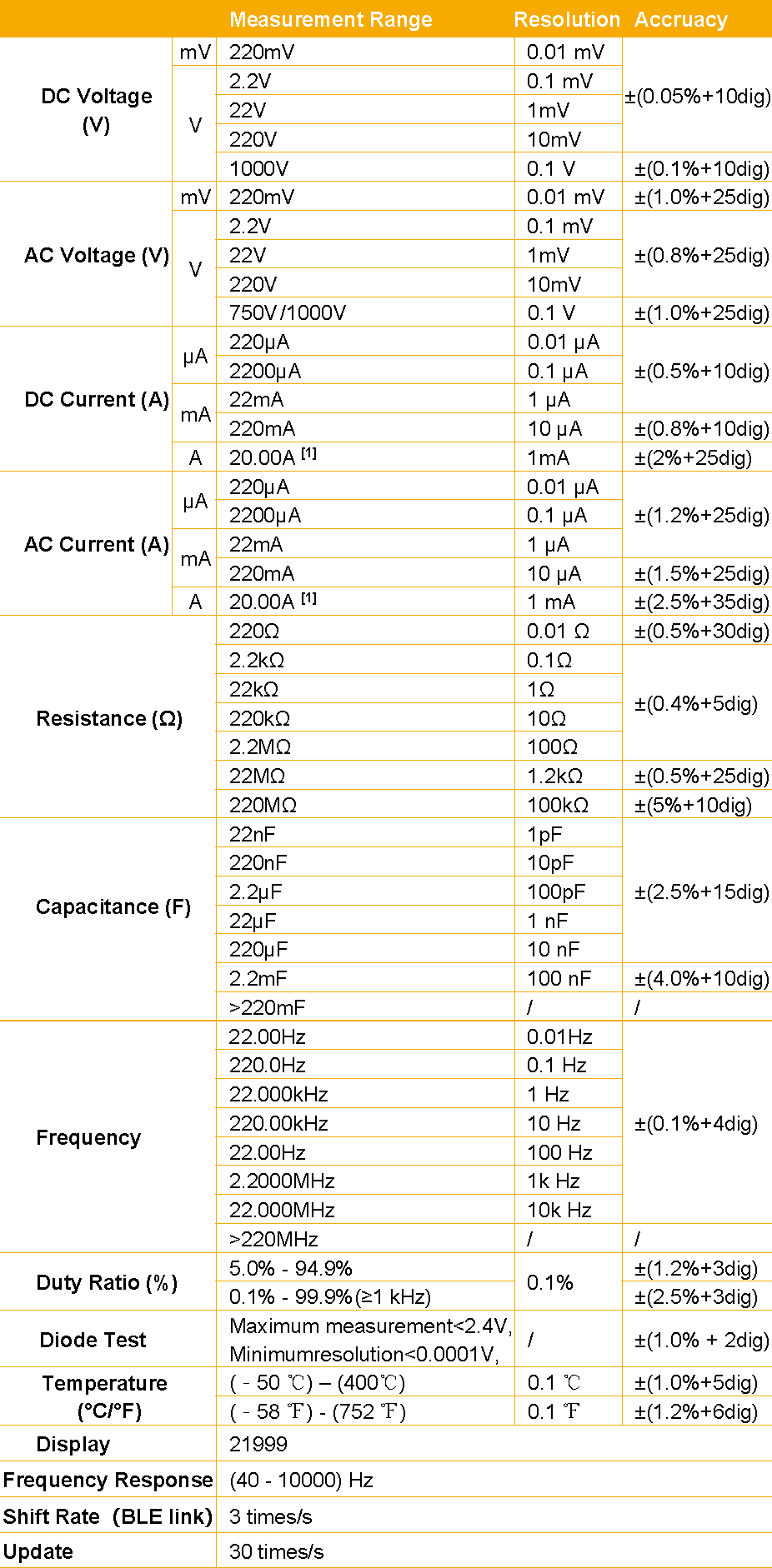
Therefore, every hobbyist electronics technician should have at least one better multimeter, which today is not as costly as it was until recently. However, many of us would like to measure with better accuracy, even much better than 0.1%, and not only DC voltages.The good news is that there are plenty of inexpensive multimeters on the market whose maximum accuracy is better than 0.1%. An example is shown in photo 1. Owon B41 T+ with wider capabilities (Bluetooth, autonomous recorder). This is an example of a noteworthy meter, cheap for its capabilities. The maximum accuracy is 0.05%, but only on DC voltage ranges.
 Drawing 2.
Drawing 2 is the specification of Owon B41 T+, where you can see that the accuracy (incorrectly described as Accruacy) of measurements other than DC Voltage is significantly worse. Similarly, it is in all multimeters, even those costing thousands of dollars. A multimeter is most accurate when measuring DC voltage. In various professional applications, meters, including multimeters, with generally high accuracy are needed. Sometimes the accuracy provided by cheap 4.5-digit meters, such as the one in illustration 1, is sufficient. However, often multimeters with much better parameters are necessary, and if one has sufficient financial resources, one can buy them.
Then mainly desktop, stationary multimeters, with displays 5.5 digits and even better are in play. Multimeters 6.5-digits should already be considered laboratory-grade, and even more so the best, i.e., 7.5 – and 8.5-digits. Their prices are already in the thousands of dollars. Laboratories are equipped with such the best and most expensive measuring devices, and that too depends on the available financial resources.
As for the accuracy of such the most expensive multimeters on various ranges and measurement functions, the matter is quite complicated and we will return to it. In any case, all better multimeters must be periodically checked (calibrated) and calibrated. And fully utilizing the capabilities and accuracy of the best multimeters is not as simple as it may seem.
It is also worth mentioning that in many professional applications, measuring devices are not necessarily very accurate, but solidly made, durable, and most importantly – safe for the user. This applies especially to devices that are used to measure dangerously high voltages, such as in power grid circuits. There high accuracy, on the order of fractions of a percent, is not needed, and the most important thing is safety and certainty that the measurements are not significantly falsified. Periodically renewed certificates and calibration certificates come into play.
What Quantities Does an Electronics Technician Measure?
Does a good multimeter, i.e., a universal meter, satisfy all the needs of an electronics technician in terms of electrical measurements? We omit oscilloscopes, which we will cover in a separate series of articles. Well, an electronics technician mainly measures voltages, most often DC, but also AC. Very often checks resistances, and much less often measures currents (DC and AC).
Power is not measured directly, but calculated, having voltage,currentand resistance.Sometimes measures capacitance, inductance, frequency and time, and temperature. Many multimeters provide such capabilities, but usually, other methods are better used to measure them. Other devices and methods are also needed to measure various“RF parameters”. This is a separate, broad field.
The Ideal Voltage and Current Meters
The basic principle is simple: an ideal meter connected to a circuit should not affect the operation of that circuit in any way. At first glance, the issue is obvious: the ideal voltmeter should have infinitely high input resistance. More precisely, not only resistance, but infinitely high impedance. Although this is impossible, there are various clever ways to circumvent the problem.
The ideal ammeter should have resistance, i.e., input, internal resistance, equal to zero. In most cheap meters, this is of course not the case. Typically, a digital multimeter as a voltmeter has an input resistance of 10 megaohms. As an ammeter, it has a small, but non-zero internal resistance.
It is worth knowing that expensive laboratory multimeters usually have a huge input resistance of many gigaohms, but only on lower ranges (up to 10...20V). Such high-ohm voltmeters are called electrometers.
It is also necessary to know that a few inexpensive multimeters on millivoltmeter ranges also have huge input resistance, which in some applications is a huge, sometimes even invaluable advantage.
Another interesting issue is nanovoltmeters (AC voltages), needed practically only for noise measurements. Here, usually, the input resistance is irrelevant, because the limitation is the input noise of the necessary input amplifiers, mainly unavoidable thermal noise. This is a separate interesting topic, concerning not so much voltmeters as ultra-low-noise amplifiers. And as for the ideal ammeter, which should have zero resistance (internal impedance), it should be known that there are such ammeters! However, in practice, these are mainly microammeters, nanoammeters, and picoammeters, some of which can measure negligible currents on the order of even single femtoamperes.
Measuring AC Voltages
For most hobbyists, the accuracy of measuring DC voltages is of the greatest importance. It is much worse with the accuracy of measuring AC voltages, especially "audio signals", as evidenced by the title photo: all multimeters were given a sinusoidal "audio" signal at a frequency of 20kHz and a level of +6 dBu (approx. 4.4Vpp, 1.55VRMS). Theoretically, all multimeters should consistently show a value close to 1.55V. Almost all failed to do so. Photo 3 shows that at a frequency of 1kHz it is definitely better! It can be seen that only a few multimeters can handle correct measurement of voltages in the full acoustic range of 20Hz-20kHz. Note at the bottom of drawing 3 that for the quite expensive OWON B41 T+ the measured frequency band (Frequency Response) reaches only up to 10kHz. Paradoxically, cheap and in many ways weak DT9205 multimeters handle measurements of AC voltages surprisingly well.
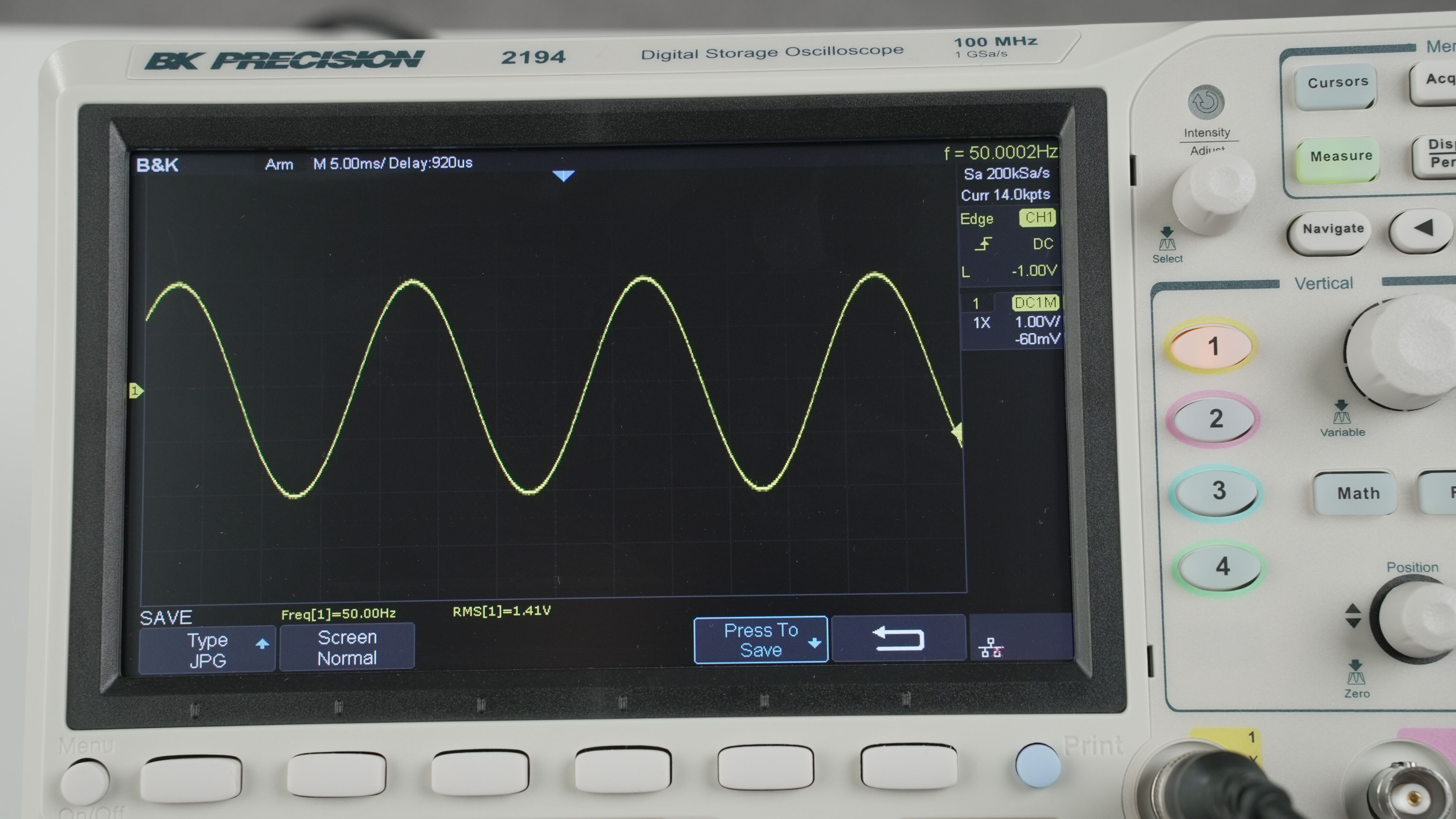
The practical problem lies in the fact that at first glance this is not visible, because in the specifications of cheaper, amateur multimeters, information about measuring AC waveforms is usually incomplete, and even misleading.One thing is the band of frequencies measured in measurements of AC voltages and currents. And a completely different issue is the presence on the meter of the inscription TRMS, TrueRMS, or RMS. Well, some mistakenly think that such an inscription is information that the meter correctly measures all AC voltages in the entire range of audio frequencies.And that's not true – such inscriptions indicate only that the device (more or less) correctly measures the RMS value of distorted voltage and current waveforms at 50Hz. And it says nothing about the band!
Why are some not-so-precise multimeters so expensive? It’s hard to determine based on a simplified specification. The reasons vary, and one of them may be their capabilities in measuring AC waveforms. We'll explore various aspects of measurement topics in future articles in this series, but for now, I’d like to briefly mention a few other types of measurements.
Temperature Measurements
Not all electronics enthusiasts understand the impact of temperature on all electronic circuits. They often underestimate both the necessity and the possibilities of temperature measurements. We’ll return to this topic, but when it comes to multimeters, their accuracy in measuring temperature via thermocouples is generally poor. The resolution is usually 1 degree Celsius, and the accuracy is much worse.
If precise temperature measurement is needed, it definitely shouldn't be done with common multimeters. However, it’s worth knowing that one of the best methods is using platinum sensors (RTDs) like PT100 or PT1000. In that case, you can use a very precise... ohmmeter. But a very precise one!
Frequency and Time Standards
For completeness, we must also mention time and frequency measurements. For a long time, time and frequency have been quantities that hobbyists could measure with accuracy far superior to other “electronic” quantities. Laboratories use ultra-precise cesium standards (atomic cesium clocks), offering accuracy or uncertainty in the order of 10⁻¹², which is 0.000001ppm = 0.0000000001%. The definition of a second is based on the phenomenon used in such devices.
In the past, quartz oscillators (XOs), especially oven-controlled (maintained at a constant temperature) OCXOs, served as standards for hobbyists. Today, rubidium standards are within reach of hobbyists, with prices no longer shocking and now affordable for many amateurs. In practice, even better accuracy can be achieved using stable radio signals, such as radio transmitters (e.g., 225kHz PR1 or German DCF signals). Modern hobbyists mainly use GPS signals as frequency and time references. It’s a fascinating topic, though not very well-known.
In any case, hobbyists can most easily achieve phenomenal accuracy when measuring frequency and time — much better than 10⁻⁹ (0.001ppm = 0.0000001%). For comparison: the most advanced amateur voltage standards, using the best Zener diodes, can reach accuracy or uncertainty around 10⁻⁶ (1ppm = 0.0001%). Slightly worse, and more difficult, but still comparable, are resistance measurements. Capacitance measurements are considerably more difficult and less accurate, and inductance measurements are even worse. We’ll return to this later. In the next article, we’ll discuss and clarify some very important concepts related to measurements.
©Piotr Górecki
Transfer Multisort Elektronik (TME) is one of the world’s largest global distributors of electronic components, electrotechnical parts, workshop equipment, and industrial automation. The catalog includes over 1,500,000 products from 1,300 leading manufacturers. TME’s modern logistics centers in Łódź and Rzgów (Poland), with a combined area of over 40,000 m², ship nearly 6,000 packages daily to customers in more than 150 countries.
TME also invests in the development of knowledge and skills of young engineers and electronics enthusiasts through the TME Education project, and supports the tech community by organizing the TechMasterEvent series, promoting innovation and experience exchange.