Size, value, accuracy, resolution, uncertainty
Size, value, accuracy, resolution, uncertaintyDate of publication: 15-09-2025 🕒 9 min read
In this short article, the third in a longer series on metering and measurement, contains very important information on the inaccuracies and misunderstandings and colloquial, often inaccurate, and even misconceptions, as well as bad habits, which can become traps. Earlier articles in this series can be found here
Piotr Górecki - popularizer of electronics. Currently publishes his own magazine "Understanding Electronics". Previously, for many years he was the Editor-in-Chief of a popular Polish magazine (Elektronika dla Wszystkich). He is also the author of hundreds of articles and educational projects. Until 1993, he worked in the telecommunications industry.
Metrology is a very broad field. Its part is metrology, which focuses on measuring instruments and measurements. A systematic exploration of the myriad of issues and aspects involved in measuring electrical quantities would require an extensive college-level course. For many, the most difficult aspects of the issue are the mathematical ones, where the principles of statistics and probability calculus come into play. In addition, there are a number of concepts and terms, whose meaning and significance are often mixed. In this series of articles on metrology, we want to approach the issue of measurement from the point of view of the practitioner, not always according to theory and strict terminology. Nevertheless, it is necessary to discuss some basic issues.
- Magnitudes and values
- Resolution versus accuracy
- Accuracy, precision and repeatability
- Error and uncertainty in measurement
- Multimeters and comparison methods
Magnitude, value, element...
Are size and value the same thing, or something else? In everyday language, the terms magnitude and value are often not differentiated. When we say voltage magnitude and voltage value, we understand, that they mean exactly the same thing.
However, we should remember, that strictly speaking, voltage is a physical quantity, property, that can be measured and its value given. Value of a physical quantity. Here it is necessary to distinguish between the physical quantity, parameter, from its value.
Physical quantities include just voltage, current (amperage), resistance, impedance, capacitance, inductance, frequency, and others. The values of these (physical) quantities are given in some units, about which more in a moment.
In colloquial language, we similarly often use other, related terms, without thinking or forgetting, what they really mean. How often do we hear or say ourselves, "I have mounted on the board a resistance of 47 ohms", or "I have soldered a capacitance of 10 microfarads in the circuit.". Meanwhile, resistance and capacitance are physical quantities. In the circuit on the board, we do not assemble physical quantities, parameters, but we mount specific elements: resistor and capacitor, which, of course, have some values.
This is not just a matter of accidental mental shortcuts. The problem is, that when talking about mounting a capacitance of 10 microfarads on a board, we equate an element (capacitor) with capacitance, that is, with one particular parameter of this element.
Seemingly rightly. But the problem is, that the real capacitor has different parameters, not only capacitance. Yes, for a capacitor the main parameter is capacitance, but every Capacitors also has some harmful resistance (ESR) and some parasitic inductance (ESL). No real capacitor can be considered a (pure) capacitance, because it is actually a... series resonant RLC circuit, and soldered in a circuit it can behave like this, as shown in the figure 1.
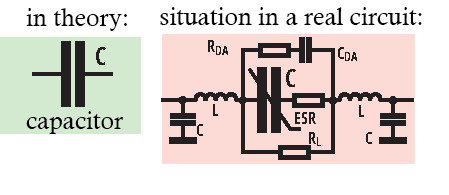
Figure 1
Identifying an element (in this example, a capacitor) only with capacitance distracts attention from the realities, from its harmful parameters, that is, from the harmful quantities, which also occur in it.
So it is worth being sensitized to distinguish between (physical) size and its value. It is also necessary to fight the habit or temptation to equate quantities, or parameters, with elements. And here is another erroneous identification.
Does resolution mean accuracy?
Less knowledgeable people are impressed by the indications of digital measuring instruments. The widespread belief in the superiority of digital over analog technology suggests, put simply, that the indication of a digital display is simply true, that the value shown fully corresponds to reality.
The truth is quite different. In part, the topic has already been discussed in a previous article Accuracy and range of measurements in electronics. You can read there, that the resolution of display readings is not the same, as the measurement accuracy in general.
Not everyone knows, that the first handheld digital multimeter was the Fluke 8020A (photo 2), released to the market in the year... 1977. A year later, Intersil, founded only a little earlier, introduced the famous, available to this day, integrated circuits - voltmeters 3,5-digital ICL7106 and ICL7107, which, to put it mildly, used ideas from the Fluke 8020A and the integrated circuits contained therein 429100.
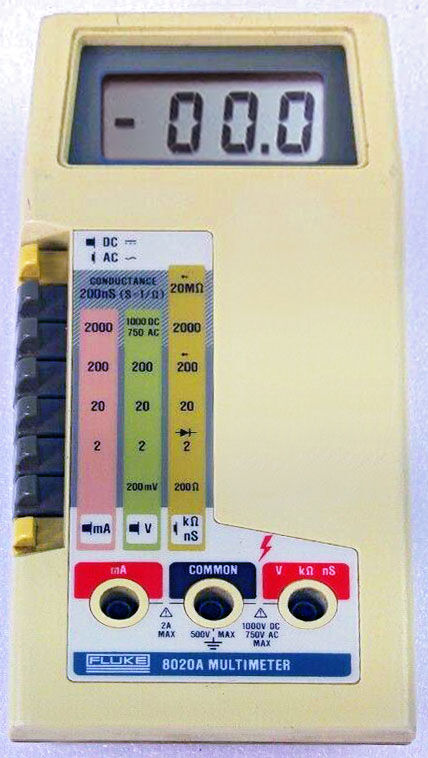
Photograph 2
The integrated circuits of the famous ICL710x family of voltmeters themselves use a truly accurate dual-integration method that is still used today in precision equipment. However, the display indication obviously depends on the value of the reference voltage, and this is noticeably affected by temperature.
The reference voltage source built in there has a thermal stability of 0,008%/°C (80ppm/°C), so, for example, a 15-degree change in the temperature of an Integrated circuits can cause a change in the display of 0,12%, and recall, that the resolution of the display is 0,05%.
So we see, that even the readings of the integrated voltmeters themselves are not perfectly accurate, and on top of that there are errors of circuits cooperating with it, if only the voltage dividers. With strong price competition, manufacturers of popular equipment try to save on everything, and the result is accuracy of instruments much worse than the resolution of their displays. There are many such cheap meters on the market.
You should know, that the design and implementation of really accurate, stable circuits and circuits preparing signal for voltmeters - analog-to-digital converter is really a serious challenge-digital converter is a really serious challenge, associated with increased costs. On the other hand, the use of display with a larger number of digits is no problem. All the more to modify the processor program, so that it displays more (meaningless) digits on the screen.
It would also be necessary to distinguish the number of digits of the display and the number of digits of the displayed result from the number of significant digits. The last digit, and very often even the last two digits of the displayed result are insignificant digits, which do not carry any valuable information. However, a large number of displayed digits makes an impression on uninformed people, who are willing to pay more for such a "more accurate" device. Often it is not more accurate at all, only the result is displayed with a higher resolution. Thus, we have discussed the distinction between resolution and accuracy, but this is not the end of the pitfalls.
Accuracy, precision and repeatability?
Just as we often confuse in colloquial language, and will probably confuse, the terms size and value, we also have trouble with two related concepts. Namely, we equate and interchangeably use the terms accuracy and precision.
We consider accurate meter and precise meter as synonyms. Meanwhile, in metrology, accuracy and precision are two distinctly different concepts, completely independent of each other. Metrology, as well as metrology, include not only the measurement of electronic quantities and "electronic" means of measurement.
Meanwhile, the term "accuracy" used in metrology means more or less the same thing, what we colloquially understand as accuracy. This, most generally, conformity to the truth, the conformity of the result to the true value. But here is a serious pitfall, about which in a moment.
However, in metrology, the term "precision" means something decidedly different from what the common perception suggests. Well, in the simplest terms, in metrology, precision is simply repeatability.
The topic is very broad and we can discuss some aspects of it separately if necessary. And now another important detail.
Accuracy, error, deviation, uncertainty, confidence
Of course, it is naive to imagine, that if we make a measurement, then we will know the truth about the value of the measured quantity. As a result of the measurement we will only get... result of the measurement, which is always only an approximation, not to say an estimate. A better or worse approximation. Often worse...
Metrology and metrology are surprisingly broad and altogether very difficult fields. People, who learned them many years ago, still have a different approach today than the one currently being presented. In the past, the focus was on deviations and errors. All of this, as it were, started with "true value". Intuitively, we understand, what "true value" is and it seems obvious, what is deviation or error.
In the simplest terms, error is the difference, deviation from the "true value". It is usually expressed as a percentage. And on the surface it is clear and obvious. But only on the surface. The problem is, that we NEVER know, what this "true value" is. We only know what the result of the measurement is. Because we never know, what the "true value" is, we can also never really determine, what the accuracy of the measurement is. Yes, strictly speaking, it is impossible to determine, what the accuracy of the measurement is, and certainly not the "percentages" given in the specifications of cheap instruments.
In light of this brief information, it is difficult to determine, what the "percentages" given in the specifications of most low-cost meters would actually be, usually under the term Accuracy (accuracy).
The problem was recognized years ago and now the "focal point" of the analysis is not the impossible to determine "true value". Nowadays, so to speak, we approach from the other side: we do not start with an unknown "true value", but we start with the most real measurement result possible. This uses curves such as the one in Figure 3 (from Wikipedia, public domain).
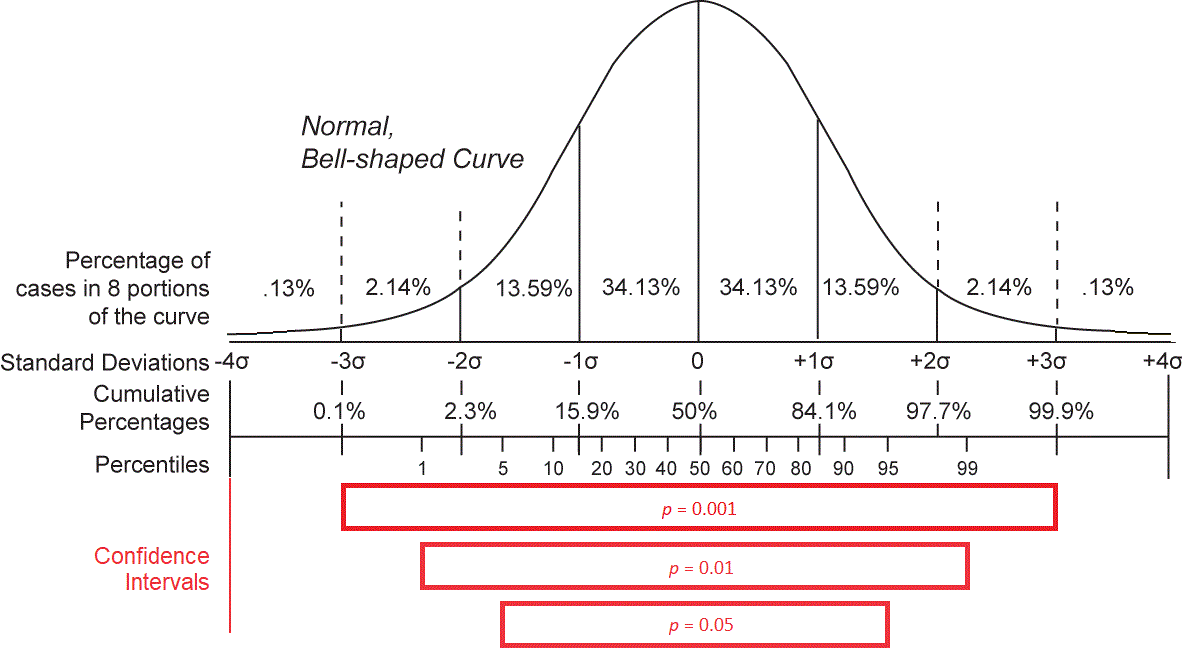
Figure 3
We then have the somewhat frightening concept of mesurand (measurand). But first of all, we have the result of a real measurement and we determine, or rather try to determine, not its correspondence to an unknowable "true value", but the uncertainty of the measurement. Therefore, in modern descriptions of measuring instruments used in electronics, there is less and less talk about accuracy, about error or errors and precision, and more and more precisely about the uncertainty of the result.
Simply put: it is very naive to believe, that if we take an expensive multimeter and make a measurement, then we will get some, true information about the measured value. Practicing electronics engineers repeatedly find out, that successive measurements of the same parameter, which according to expectations should give identical results, are sometimes strongly surprised by the discrepancy of the obtained results. Others reasons. In addition to the commonly understood "accuracy" of the multimeter expressed in percentage, numerous additional factors are important, not only technical, but also related, for example, to human errors. The calculus of probability comes into play very strongly. It turns out, that in many cases it is necessary to take into account not the result of a single measurement, but the average of many measurements.
If the various issues of measurement are taken under the magnifying glass, it will turn out, that it is necessary to take into account a number of elements, that we usually overlook or are not aware of at all. These are very extensive issues, requiring not a separate article, but a powerful series of articles.
Now we will only signal, that, in addition to the still well-holding concept of accuracy (accuracy), in the specifications of better instruments from reputable manufacturers, there appears not only the concept of measurement uncertainty (measurement uncertainty), ), but additionally also the term confidence level (confidence interval), which is usually 95%, sometimes 99%. What to remember, "Uncertainty" means that, what is commonly called accuracy (accuracy), expressed in percentages or "pips" (ppm).
The result of a measurement is usually given for a confidence level of 95%, which means 95-percent probability, that the actual value of the measured parameter is within the range defined by the (expanded) uncertainty of the measurement. However, there is no absolute, 100-percent guarantee, that this is the case. We should know about uncertainty and confidence, however, by strong habit still, also in the articles in this series, we use and will probably use, the terms "accuracy" and "precision" in the colloquial, inaccurate and imprecise sense.
Multimeter and comparative methods
Metering is generally the science of making measurements. To most young electronics engineers, the word "measurement" is associated with a multimeter, that is, a universal meter, multifunction. Digital Multimeters, of course.
The common perception is, that a multimeter is, after all, a universal meter, which is just for, for us to take it, choose the function you need, measurement range, put in two measurement cables (probes) into the appropriate sockets and... they measured, what you need. Most often we measure voltage, resistance and current. Often we use auxiliary functions such as acoustic transition-short-circuit checking and checking the voltage drop across a diode, which is essentially measuring resistance and voltage. Many Digital Multimeters can also measure capacitance and temperature. However, very few can measure inductance.
In any case, the colloquial perception is, that digital multimeters have displaced not only pointer meters, but also all other formerly used measuring instruments, in particular various measuring bridges.
Many electronics engineers believe, that the next stage of development, and even the crowning achievement of progress are scopometers, which is a combination of an oscilloscope and a multimeter, introduced to the market by Fluke, as well as Digital Multimeters. Photo 4 shows an advanced Fluke series scopometer 190, whose cheapest version costs several thousand dollars.

Photo 4
Some even believe, that the scopometer is an ideal measuring instrument, which replaces the entire former measuring laboratory. Generally this is not the case for several reasons. Yes, maybe under workshop conditions, if your requirements are not too high, a good scopometer will indeed meet all your measurement needs. Oscilloscopes and Scopemeters will be dealt with separately. However, here I would like to strongly emphasize, that for high requirements neither a scopometer, nor the best even Digital Multimeters will not meet your needs.
You may be surprised to learn, that if we want to measure with very high accuracy, then we often return to very old, as it turns out, very good methods. Mainly to bridge methods, which consist in comparing. On comparing with some kind of benchmark.
We will talk about such methods, we will also use them. For now, we are only tentatively signaling, that a digital multimeter is not always the best measuring instrument and that it is worthwhile, and even necessary to, to return to certain methods known for a long time, which only on the surface seem to be obsolete. The purpose of this article is not so much to explain the issue, but to signal some important issues important for every electronics technician, who wants to perform measurements correctly. In the next article of the series, titled Standards of electrical quantities, we will address the issue of standards.
Piotr Górecki
Transfer Multisort Elektronik (TME) is one of the world’s largest global distributors of electronic components, electrotechnical parts, workshop equipment, and industrial automation. The catalog includes over 1,500,000 products from 1,300 leading manufacturers. TME’s modern logistics centers in Łódź and Rzgów (Poland), with a combined area of over 40,000 m², ship nearly 6,000 packages daily to customers in more than 150 countries.
TME also invests in the development of knowledge and skills of young engineers and electronics enthusiasts through the TME Education project, and supports the tech community by organizing the TechMasterEvent series, promoting innovation and experience exchange.