Selecting an inductive sensor – different diameters and outputs
Selecting an inductive sensor – different diameters and outputs게시 날짜: 16-05-2019 업데이트 날짜: 10-04-2026 🕒 3 읽기 시간
Appropriately selected inductive sensor serves as the basis for properly operating technological line and for devices using this kind of automation components everyday. Currently, sensors are responsible for measurements, localising metal objects, counting, or drawing up transport routes in numerous manufacturing industries. Automatic control of machines and devices within production lines is based on proximity sensors.
How do inductive sensors work?
From technical perspective, this is quite complicated, but you don’t have to know the characteristics of a sensor in order to understand how it works. The sensor works by detecting any changes in the position of metal objects in its surroundings, and by sending signal (information) about the location of the object. One of the advantages of inductive sensors is touchless operation, which distinguishes them from contact sensors that require direct contact with the object.
Currently, manufacturing companies provide a wide range of automation components based on basic parameters.
Selecting sensor package
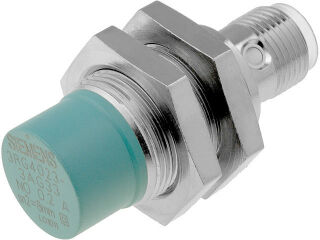
Inductive sensor package indicates the shape of the component, which in the case of cylindrical sensors (oval shape) has metric thread pitch enabling easy mounting. Thanks to this, the user can choose thread size or diameter based on the measurement table (e.g. cylindrical sensor M12 or ϕ12). Inductive sensors with packages in the shape of a cuboid are also available.
IP degree of protection – an important parameter of a contactless sensor
International Protection Rating describes package’s resistance to external factors in accordance with the IEC 60 529 (PN-EN 60 529) standard. In the string (IP XX), the first number represents the degree of protection against solids and contact, and the second number represents the degree of water infiltration into the device. Depending on the environment and operating conditions, an appropriate degree of protection is selected. In more demanding operating conditions, the device is exposed to external factors, therefore the degree of protection should be selected in such a way to ensure optimal working conditions for the sensor. The basic and most commonly found degree of protection is IP67, which ensures complete protection against dust (dust tight) and protection of the device when it is immersed in water up to 1 m for a defined short time (a few minutes). Similarly to the degree of tightness, the lifetime of a sensor can also be extended by selecting an appropriate material. Knowing the operating mode and working conditions of an inductive sensor lets you choose the material with appropriate properties. Currently, the most popular are stainless steel or brass sensors.
Supply voltage of a sensor
Supply voltage determines the amount of voltage required for the correct operation of the device. Inductive sensors can be powered with DC or AC current. Based on the design of the particular technological line, the user selects the voltage.
Key parameter – operational range of an inductive sensor
Unlike contact sensors, inductive sensors use the range to determine the position of a monitored object. In reality, this extends the lifetime of a component by eliminating factors occurring in the contact between the sensor and the object. In technological lines, the distance between the sensor and the object are often in millimetres.
Output configuration of a sensor
Output configuration determines the types of outputs of an inductive sensor, and consequently the type of the output signal. Inductive sensors are available in two-, three-, or four-wire versions. The most commonly used are three-wire sensors. They feature two wires responsible for providing power, and a binary signal, connected to a driver. In order to understand the output configuration of an inductive sensor, one needs to pay attention to the type of bipolar transistor used by the device (PNP transistor – positive output, NPN transistor - negative output). Depending on the configuration of the transistor, it can be enabled after detecting an object (normally open, NO), or when no object is detected (normally closed, NC). Types of output signal configuration:
-
PNP NO (the sensor puts high signal on the output when it detects an object)
-
PNP NC (the sensor puts high signal on the output when it does not detect an object)
-
NPN NO (the sensor puts low signal on the output when it detects an object)
-
NPN NC (the sensor puts low signal on the output when it does not detect an object)
Depending on the output signal that you need, you can also choose a sensor that provides analogue signal from the 4-20mA, 1-9V range.
Transfer Multisort Elektronik (TME)은 전자 부품, 전기 기술 부품, 작업장 장비 및 산업 자동화의 세계 최대 글로벌 유통업체 중 하나입니다. 카탈로그에는 1,300개 주요 제조업체의 1,500,000개 이상의 제품이 포함되어 있습니다. Łódź와 Rzgów (폴란드)에 있는 TME의 현대적인 물류 센터는 총 면적이 40,000 m² 이상이며 매일 약 6,000개의 패키지를 150개국 이상의 고객에게 발송합니다.
TME는 또한 TME Education 프로젝트를 통해 젊은 엔지니어와 전자공학 애호가들의 지식과 기술 개발에 투자하고 있으며, TechMasterEvent 시리즈를 조직하여 혁신과 경험 교류를 촉진하면서 기술 커뮤니티를 지원합니다。