MLCCs– construction and operating principles
MLCCs– construction and operating principles게시 날짜: 15-03-2023 🕒 7 읽기 시간

Construction of an MLCC
A capacitor is a component that stores energy in an electric field. One of the most common types of capacitors is MLCC (multilayer ceramic capacitor). MLCCs consist of a ceramic body with two sets of overlapping plates, which are electrically separated with a dielectric material. The dielectric is the most important component of the capacitor, as it determines the final range of capacitance, operating voltage and a variety of other parameters in a given series.

The capacitance of such a capacitor is described with the formula:

where:
 – dielectric permittivity
 – vacuum permittivity
 – number of capacitor layers
 – plate surface
 – separation between plates
Real capacitor model
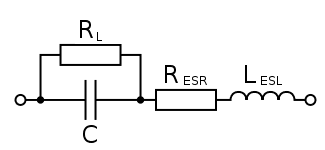
When discussing capacitors, we cannot limit the narrative just to the capacitance. A substitute model of a real capacitor is shown above. It consists of four components:
LESL – capacitor serial inductance, which must be taken into account for high-frequency circuits.
RESR – capacitor internal resistance, which generates losses in the form of heat i.e. heating the capacitor during work.
RL – resistance representing the path through which the leakage current flows.
C – capacitor capacitance.
Dielectric
Currently, MLCCs are constructed using materials based on barium titanate (BaTiO3) or calcium zirconate (CaZrO3).Adding other chemical elements or compounds can influence the dielectric properties. In this way, it is possible to obtain a dielectric with higher permittivity or better temperature stability.
In the case of MLCCs, there are two classes of ceramic capacitors which differ in dielectric chemical composition and properties.
Class 1
It’s a class intended for applications requiring stability and low losses. To produce such capacitors, a mixture of CaZrO3 and a variety of other chemical compounds is used. Such dielectrics have a lower permittivity than class 2 dielectrics but higher stability in a wide range of operating temperatures. The most popular class 1 dielectric is NP0 (C0G), which consists of rare metals (e.g. neodymium and samarium). This dielectric can operate in temperatures ranging from -55°C to +125°C, maintaining zero capacitance changes.
Class 2
There are a lot of different dielectrics available in this class, which contain 90-98% of BaTiO3. The electrical permittivity of class 2 dielectrics is slightly higher than that of class 1, which results in higher capacitor capacitance.
A disadvantage of class 2 capacitors is their lower temperature stability, which results in significant capacitance changes as a function of the temperature. This should be taken into consideration when selecting specific products.
The most common dielectrics on the market are labelled with code X5R, X7R or Y5V. These codes can be understood as labelling the dielectric’s specific temperature characteristics. The table below contains the explanation of this code.
| FIRST SYMBOL | SECOND SYMBOL | THIRD SYMBOL | |||
| MIN. OPERATING TEMP | MAX. OPERATING TEMP. | CAPACITANCE CHANGE IN THE ENTIRE TEMPERATURE RANGE | |||
| X | -55°C | 2 | +45°C | D | ±3.3% |
| Y | -30°C | 4 | +65°C | E | ±4.7% |
| Z | +10°C | 5 | +85°C | F | ±7.5% |
| 6 | +105°C | P | ±10% | ||
| 7 | +125°C | R | ±15% | ||
| S | ±-22% | ||||
| T | +22% / -33% | ||||
| U | +22% / -56% | ||||
| V | +22% / -82% | ||||
SMD MLCCs
The most commonly used MLCCs in the industry are the ones intended for surface mounting. A characteristic feature of this type of components is its small size, measured in single or even decimal parts of a millimetre. The smallest MLCC available on the market measures just 0.25x0.125 mm.
For demanding applications, connected MLCCs may be used, which consist of several MLCCs connected in parallel, having a common pair of leads. Such a solution ensures lower ESR and ESL, and a higher capacitance compared to a singular component.
THT MLCCs
MLCCs intended for THT mounting are available on the market as well, although it is a less commonly used solution, one of the reasons for it being more difficult automation of this type of mounting method and thus increased costs and extended manufacturing time.
Connected capacitors sets are available in THT variants as well. At the same time, there are fewer and fewer products of this type on the market, which is worth taking into account while planning the design, just like the issues related to costs and mounting time.
MLCC arrays
As mentioned before, the capacitors available on the market are getting increasingly smaller in terms of size. The miniaturisation of products allows to save space, cut costs and increase the capabilities of the application. Engineers working for not only manufacturers of components, but for the companies using them as well, are striving to decrease the size of circuits, which allows to shorten the mounting time and reduce manufacturing costs of finished devices.
MLCC arrays available in the TME catalogue
One of the ways to miniaturise a circuit is the use of capacitor arrays. An MLCC array is a combination of several MLCCs in a single housing, where each capacitor is separated and has its own leads. The growing role of this type of components can be seen, when we look at how they are currently used in e.g. mobile devices and cameras.
MLCCs – issues

MLCCs are small, thanks to which more of them can be mounted in a circuit or a PCB size can be decreased. This, however, comes with consequences, as using MLCCs results in some issues which are worth keeping in mind.
Due to their size and ceramic material, MLCCs do not tolerate mechanical deformations that can occur during mounting or operating the device. Such deformations could cause cracks in the ceramic housing, and, following that, lead to malfunctions or failure of the circuit.
This issue has been alleviated by adding a layer of conductive resin to capacitor electrodes. That way, the component endurance to deformations has been improved. Another solution that helps overcome the issue of large sensitivity is the use of MLCC arrays, which are characterised by a larger resistance to deformations.
Another drawback of MLCCs is their ageing. This issue, however, applies only to capacitors made of barium titanate (BaTiO3). It’s a process that involves changing the crystalline structure of a dielectric. Barium titanate has the form of a cube at a temperature higher than its Curie temperature, and after cooling down changes its structure to a less symmetrical one, which results in a decrease of the capacitor’s capacitance. This phenomenon is called ageing. Due to its polycrystal nature, MLCCs age for a longer period, counted in hundreds or even thousands of hours. This process, however, is reversible and requires the capacitor to be heated to a temperature higher than the Curie point of the given material. In the case of barium titanate, it means the temperature above 125°C. The heating can be performed in temperatures much higher than the Curie point.
MLCCs available at TME
TME offers more than ten thousand MLCCs supplied by the top manufacturers. The majority of those are class 1 and 2 SMD capacitors, but THT capacitors are available as well, guaranteeing access to optimal solutions even in non-standard designs. TME offers capacitors with a RoHS certificate and also ones compliant with the AEC-Q200 standard, adapted for applications in mechanical vehicles.
Transfer Multisort Elektronik (TME)은 전자 부품, 전기 기술 부품, 작업장 장비 및 산업 자동화의 세계 최대 글로벌 유통업체 중 하나입니다. 카탈로그에는 1,300개 주요 제조업체의 1,500,000개 이상의 제품이 포함되어 있습니다. Łódź와 Rzgów (폴란드)에 있는 TME의 현대적인 물류 센터는 총 면적이 40,000 m² 이상이며 매일 약 6,000개의 패키지를 150개국 이상의 고객에게 발송합니다.
TME는 또한 TME Education 프로젝트를 통해 젊은 엔지니어와 전자공학 애호가들의 지식과 기술 개발에 투자하고 있으며, TechMasterEvent 시리즈를 조직하여 혁신과 경험 교류를 촉진하면서 기술 커뮤니티를 지원합니다。