Microchip Technology at TME – 32-bit microcontrollers
Microchip Technology at TME – 32-bit microcontrollersDate of publication: 10/28/2026 🕒 6 min read
In modern devices, both domestic and industrial, the role of the electronic brain is increasingly played by a microcontroller. This solution is generally more advantageous than creating a specialized ASIC chip dedicated to a specific task. This means that microcontrollers must perform a wide range of tasks: reading sensors, handling user interfaces, controlling peripherals, and responding to unforeseen events. Moreover, all these tasks often need to be performed simultaneously. For this reason, the computing power of microcontrollers is constantly being increased.
In this article, we will look at 32-bit chips from Microchip Technology. This manufacturer's portfolio includes both energy-efficient designs for simpler applications and microcontrollers intended for motor control or handling complex network interfaces. However, it's important to remember that the number of bits alone does not determine the usefulness of a chip; the choice depends on the type of core, memory, available peripherals, and energy consumption requirements.
32-bit Microcontrollers from Microchip Technology
PIC32M, PIC32C, and SAM – Different 32-bit Architectures
Microcontrollers offered by Microchip Technology can be divided into two main categories, depending on the processor architecture. The PIC32M family uses MIPS32 cores. It includes, among others, PIC32MM, PIC32MX, PIC32MK, and PIC32MZ. Meanwhile, PIC32C and SAM are based on ARM cores. Depending on the series, these are designs from Cortex-M0+ and M23 to M4 and the most advanced M7. With such an extensive portfolio, a designer can select a chip for a specific application. It all depends on the size of the software, power supply method, the multitude of peripherals, or speed requirements.

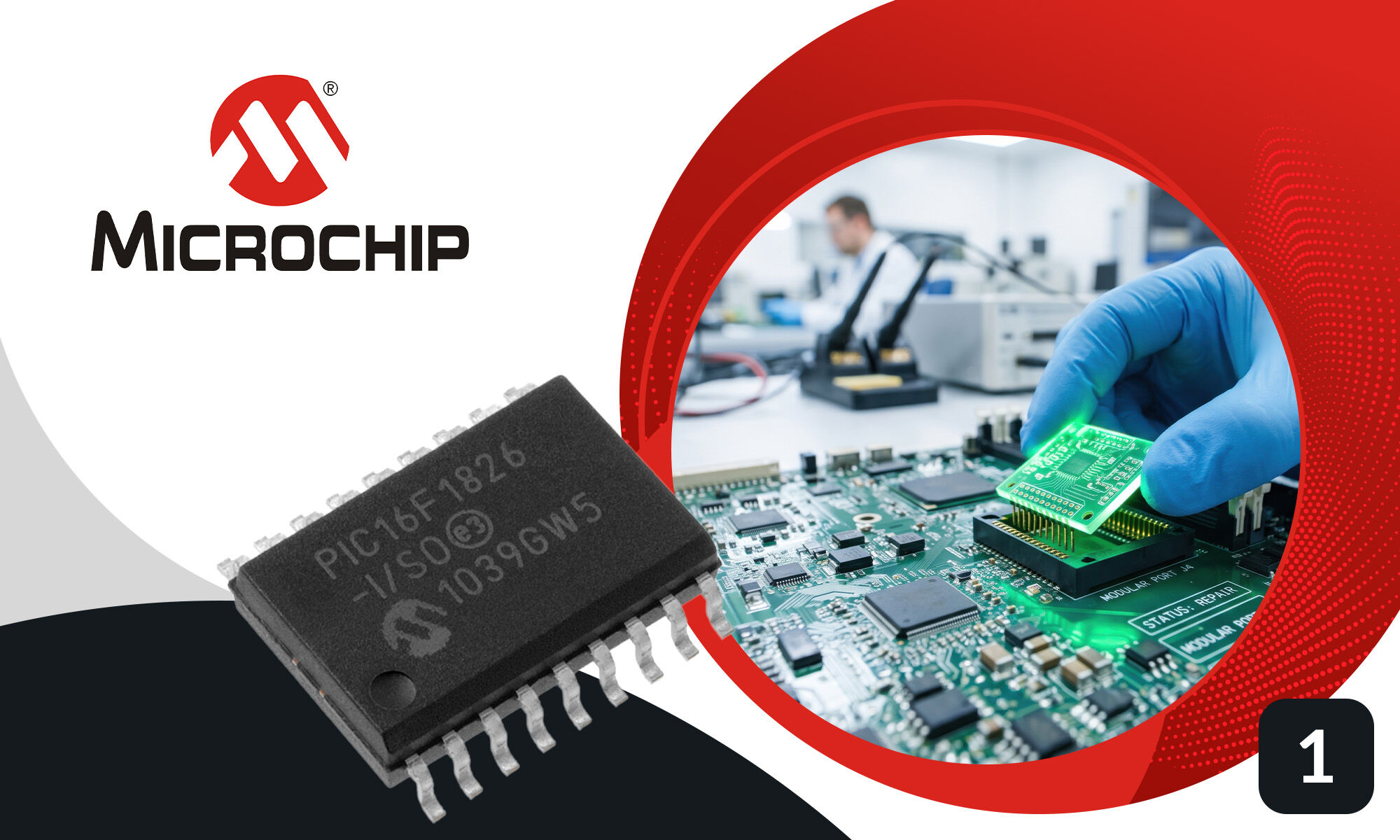
The microcontroller supports ADC, DAC, I2C, I2S, PWM, SPI, USART, USB interfaces.
A good starting point for simpler controllers might be PIC32MM. Microchip Technology positions this family as energy-efficient and equipped with peripherals that offload the processor, including DMA, real-time clock, and configurable logic cells. Among ARM-core systems, a similar role is played by the SAM D series, whose heart is the Cortex-M0+. Its power management system and DMA allow data to be transferred between selected hardware blocks without constantly engaging the core itself. This is useful, for example, in small IoT devices powered by a battery.
Applications with Network or Analog Signal Support
Many modern electronic devices require handling analog signals. For such applications, the PIC32MK family, combining a MIPS32 core with a floating-point unit, ADCs, comparators, operational amplifiers, and PWM and QEI peripherals, is well-suited. This set of peripherals can be used, among others, in motor control systems, simultaneously reducing the number of additional chips mounted on the PCB. Meanwhile, the PIC32CM family, based on the aforementioned Cortex-M0+/M23, offers (besides energy efficiency) two 12-bit ADCs enabling simultaneous sampling and counters dedicated to control. However, it's worth mentioning that these parameters apply to the mentioned families, and before choosing a specific chip, its capabilities should be checked in the datasheet.

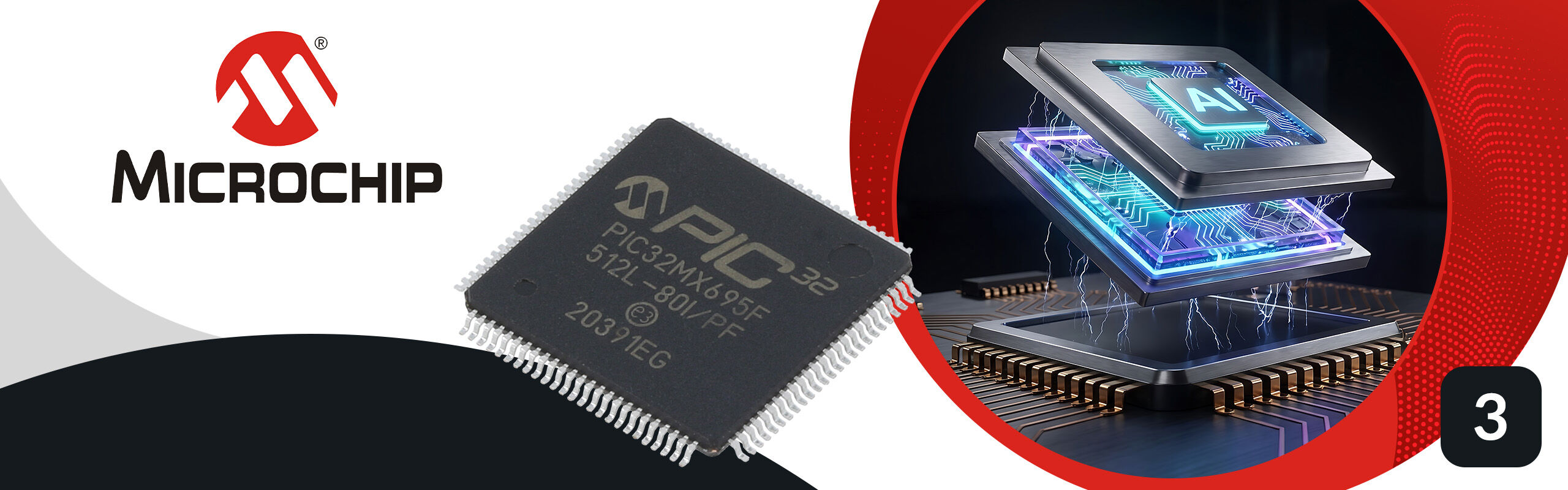
The model offers 256kB RAM, 256kB SRAM, and 1MB Flash
If the device needs to simultaneously communicate and execute a more complex program, consider the PIC32MZ EF. This series offers clock speeds up to 252MHz, up to 2MB Flash memory, and 512kB RAM, Ethernet, USB High-Speed, and CAN interfaces. Additionally, selected versions also have a hardware cryptographic accelerator. In the ARM group, examples include the SAM E5x, where the core is Cortex-M4F, and for the most demanding applications, the SAM E70, whose brain is Cortex-M7. However, it's important to remember that the presence of an Ethernet MAC controller does not mean that the microcontroller can be directly connected to the transmission medium. In many applications, an additional PHY chip is necessary to perform the physical layer functions of the Ethernet interface.

How to Choose the Right Microcontroller?
The first step in choosing the right chip should primarily be the interfaces that cannot be replaced programmatically without incurring significant costs. If the device is to communicate via CAN FD, you need to look for exactly this version of the controller. Details are also important because, for example, classic CAN 2.0B does not provide the same capabilities as CAN FD, and in specific applications, this may be significant. For Ethernet, check whether the chip has a MAC controller and whether it requires a PHY chip. For motor control, more important than the core's clock frequency may be ADC sampling, the number of PWM outputs, and the response time to a failure signal. In a measurement project, the resolution of the converter, its speed, and the method of data transfer via DMA will be important.

The element has 83 inputs/outputs.
Memory should also be carefully estimated. The size of the Flash memory should account not only for the program itself but also for constant data sets or additional libraries. Moreover, it's worth leaving some space for future updates. If the application is to store both the old and new versions of the software simultaneously, the organization of memory in a given model matters. RAM is consumed by communication buffers, task stacks, and intermediate data. When analyzing energy consumption, use values from datasheets for specific operating modes and consider the wake-up frequency, not just the current consumption in sleep mode, which is a common mistake in electronics design.
Security and Software
In an increasing number of devices, security mechanisms, including data protection and secure software updates throughout the product's life cycle, are becoming important. Selected ARM microcontrollers from Microchip Technology include mechanisms supporting secure boot and code isolation. For example, the PIC32CM series with Cortex-M23 core supports ARM TrustZone and hardware cryptographic functions. More advanced PIC32CK with Cortex-M33 core integrates a separate HSM (Hardware Security Module) security subsystem.
The MPLAB X IDE environment, XC32 compiler, MPLAB Code Configurator, and MPLAB Harmony v3 platform are dedicated to working with 32-bit Microchip Technology systems. Harmony provides peripheral libraries, drivers, sample projects, and middleware modules, including for USB, TCP/IP networks, and graphics. However, it's worth checking the availability of libraries for specific peripherals at the hardware selection stage.
Summary: Overview of Microchip 32-bit Microcontroller Families
| Family | Architecture | Main Applications |
|---|---|---|
| PIC32MM | MIPS32 | Energy-efficient controllers, portable devices, simple embedded systems |
| PIC32MX | MIPS32 | General-purpose control, USB, CAN, industrial systems |
| PIC32MK | MIPS32 | Precise motor control, drives, and industrial automation |
| PIC32MZ | MIPS32 | High-performance embedded systems, communication, graphics, audio |
| PIC32MZ-W1 | MIPS32 | IoT devices with Wi-Fi communication |
| SAM D | Arm Cortex-M0+ | Economical controllers, consumer electronics, HMI interfaces |
| SAM L | Arm Cortex-M23/M0+ depending on series | Battery-powered devices, IoT, sensors |
| SAM C | Arm Cortex-M0+ | Industrial and automotive controllers, CAN FD communication |
| SAM G | Arm Cortex-M4/M7 | Signal processing, communication applications depending on series |
| SAM D5x/E5x | Arm Cortex-M4F | Automation, industrial networks, USB, CAN FD |
| SAM E70/S70/V70/V71 | Arm Cortex-M7 | High-performance control, industrial communication, real-time systems |
| PIC32CM | Arm Cortex-M0+/M23 | Motor control, security, energy-efficient devices |
| PIC32CK | Arm Cortex-M33 | Secure controllers, IoT, industrial communication systems |
| PIC32CX | Arm Cortex-M4/M33 and others depending on series | Wireless connectivity, smart meters, security |
| PIC32CZ | Arm Cortex-M7 | High-performance industrial systems, connectivity, security-demanding applications |
| PIC32A | 32-bit DSC architecture | Analog processing, real-time control, power electronics |
Transfer Multisort Elektronik (TME) is one of the world’s largest global distributors of electronic components, electrotechnical parts, workshop equipment, and industrial automation. The catalog includes over 1,500,000 products from 1,300 leading manufacturers. TME’s modern logistics centers in Łódź and Rzgów (Poland), with a combined area of over 40,000 m², ship nearly 6,000 packages daily to customers in more than 150 countries.
TME also invests in the development of knowledge and skills of young engineers and electronics enthusiasts through the TME Education project, and supports the tech community by organizing the TechMasterEvent series, promoting innovation and experience exchange.