Hot-air stations
(53)Among the devices used for soldering and desoldering of all kinds of components and connections, next to the most popular heater and transformer soldering irons, there are hot air stations. These stations are very versatile and serve as basic equipment that proves useful (or even necessary) when working with electronic components. They are used for soldering and desoldering through-hole (THT) and surface-mounted components (SMD), including elements in Ball Grid Array (BGA), Plastic Leaded Chip Carrier (PLCC), Quad Flat Package (QFP), Small Outline Integrated Circuit (SOIC), Small Outline Package (SOP) and many others. While soldering and desoldering THT components can be done using a standard soldering iron equipped with a heating element or a soldering gun fitted with a transformer, soldering and desoldering of SMD components may be difficult or even impossible due to their small dimensions or the way they are mounted on a PCB. With a hot air station, you can also shrink heat-shrinkable sleeves and tubes, finish 3D prints (e.g. remove threads and discoloration), plasticize hot-melt glue or heat thermoplastics in order to form them, but there are many more applications of this device.
Hot air stations – structure and mode of operation
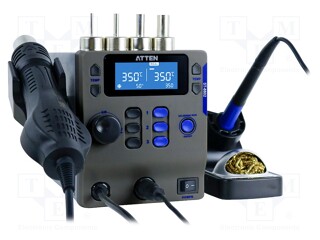
The handle with the working unit resembles a cob with a hot air outlet (nozzle) at its end, most often connected to the power and control unit. The rule of operation of such a device is relatively simple. The air is compressed by a small system in the form of a flow compressor or an ordinary fan, which is located at the opposite end of the handle or inside the control panel. Then, the air flows around the resistive heating element inside the handle, near the outlet, and heats it up to the temperature set by the user on the control unit. The accuracy of the set temperature depends on the quality of the components used in the production of a given hot air station, programmed correction factors for the characteristics of the measuring element (temperature sensor), as well as the method of regulating and setting the desired temperature, which can be analogue (temperature setting by means of a knob on the control unit) or digital (a knob, buttons or a touch panel). The latter one is more accurate, thanks to the control system maintaining the set temperature, using the so-called feedback, i.e. the reading from the temperature sensor located in the handle. Based on the difference between the set temperature and the current temperature, a control signal is generated that enables or disables the heater heating in such a way as to maintain the actual temperature at a constant, expected level. Thanks to this, the user is able to precisely set the air temperature at the outlet, even with an accuracy of 1°C, adequately to the currently performed operation. Most hot air stations have an additional display that informs the user about the preset or current temperature.
Range of hot air stations
There are several factors to consider when choosing a hot air station. First of all, the temperature range of hot air that the device is capable of producing and whether it will be the appropriate range for the intended work. Most hot air stations will operate safely in the temperature range up to around 450°C. However, there are stations that reach much higher temperatures, even up to 550°C. Also, the lower limit of the achievable temperature may be different for other models, ranging from 50°C to 150°C.
Another factor to consider when choosing a hot air station is its power. The higher the power of the soldering station, the shorter the heating time of the resistive heating element placed inside the handle and the greater the stability of the air temperature at the outlet, due to the faster response of the system to changes in the ambient temperature.
When choosing a soldering station, it is worth checking whether, in addition to setting the temperature, it also has a hot air flow control, i.e. the volume of air blown out per time unit, which is given in liters per minute. Some station models have the option of adjusting the hot air flow from the handle. It has buttons on it that allow you to increase or decrease the hot air flow. Other soldering stations do not offer such a possibility, and in the case of soldering/desoldering small, densely distributed surface-mounted components, if the nominal air flow is too high, some components next to the one that the user intended to solder or desolder may be unintentionally "blown off". A larger amount of air flow per time unit will certainly be useful when operating on a larger number of elements at the same time, but for precise work, when soldering or desoldering individual, small components, the user should reduce this flow so as not to exert too much influence on the components located nearby.
Before making a purchase, it is worth finding out if the set includes interchangeable nozzles of different diameters, useful for soldering or desoldering components of various sizes. For larger components, such as microprocessors or chips, it is worth using larger diameter nozzles to simultaneously and evenly heat all the pads in these circuits. However, when working with small components, such as resistors or SMD capacitors, nozzles with a much smaller diameter will be useful, to avoid heating adjacent components and their accidental desoldering or even blowing them off.
Hot air station features
It is also worth paying attention to additional functions of some models of hot air stations, which may be useful in some applications, such as: a heat dissipation guard which covers the desoldered component and protects other adjacent components from overheating, an additional thermocouple connector to monitor the temperature of the PCB, USB type A and type B sockets, a built-in suction pump, thanks to which a vacuum gripper can be used to grip and position components and integrated circuits, automatic energy saving mode, possibility of programming from a PC or saving temperature profiles
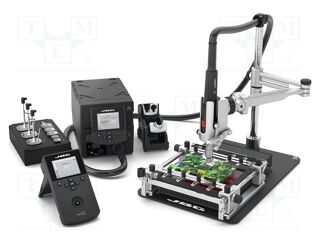
There are also more complex units called service stations, which, thanks to their modular design and versatility, allow you to operate a soldering iron, desoldering iron or gripping components with vacuum grippers. Most often they can handle more than one tool at a time.
Warehouse: