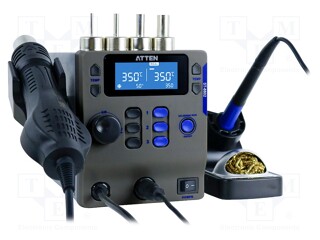
Soldering & desoldering stations
(276)BASIC EQUIPMENT FOR EVERY ELECTRONIC ENGINEER
A soldering station is, without a doubt, a primary tool for every electronic engineer. It is used for soldering, that is creating electric metal connections between two components. The opposite of a soldering iron is a desoldering iron, which is used for removing such metal connections between electronic elements. Soldering and desoldering stations are widely used by professionals in manufacturing plants or in service centres, as well as by DIY hobbyists. Moreover, it ought to be mentioned here that while constructing or repairing almost every type of device, we often encounter electronic elements constructed using the SMD (surface-mount) technology. Due to the small size of these elements, mounting them might prove to be quite troublesome. With his in mind, it is worth having a hot air soldering iron (the so-called ‘hot air’) at hand, which will make working with SMD components much easier.
JUST A SOLDERING IRON?
Nowadays, electronics manufactures outdo each other in finding ways of attracting the attention of potential clients. They offer multifunctional tools, which combine the functions of classic soldering and desoldering irons with hot air irons. With such stations, much less workbench space is taken by tools.
SOLDERING STATION – HOW IS IT BUILT AND HOW DOES IT WORK?
Regardless of the type of the device, the operating principle remains identical. Electric power supplied from the mains is transformed into heat, which is used to melt the solder. In soldering and desoldering irons heat is transmitted from the heating element, i.e. a coil heater, to the tip. In hot air desoldering irons, desoldering involves directing a controlled flow of hot air towards the element to be detached. Replaceable jets mounted on the tip of the iron make it easy to guide the hot air e.g. to a PCB board. Soldering and desoldering stations consist of a base (control) station and a soldering iron. In the case of desoldering stations, it is sometimes described as a desoldering pump or desoldering gun. Base stations usually have knobs and buttons for setting the temperature of the tip. While operating, one should remember to adjust the station to the technical parameters of the soldered elements. In the case of hot air stations, you can also control the air-flow rate.
WHAT TO KEEP IN MIND – STATION’S POWER
When choosing a soldering or desoldering station, one should consider the power of the station. In simple terms, the higher the power is, the faster the tip will achieve the assigned temperature. Bear in mind, though, that as a heated tip comes into contact with the solder, whose surface is much bigger, the temperature of the tip may drop significantly. If the power of the soldering iron is too low, it might happen that we won’t be able to maintain the required temperature, which would make soldering impossible.
SAFETY ABOVE ALL
When working with electronic components, especially in modern manufacturing plants, we need to undertake all safety measures available. Electronics is exposed to the harmful effects of electrostatics, which may irrevocably damage the equipment. When you choose a station, you should remember to check whether it has an appropriate ESD certification. At the same time, we ought to remember about people, whose safety is the key priority. When working with a soldering iron, we are obliged to take all safety precautions stated by the manufacturer of a specific device.
Warehouse: