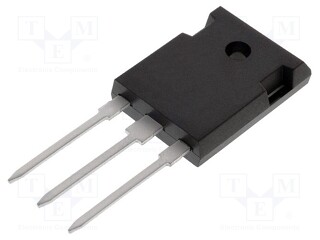
IGBT transistors
(1 495)IGBTs (insulated-gate bipolar transistors) belong to the group of semiconductor electronic components. They are used to control high-power currents, i.e. high voltages and/or amperages. Due to their much needed characteristics, IGBTs are used, for example, in inverters, which are powered by direct current at the input and generate alternating current at the output. IGBTs are also used in other power devices (e.g. converters, rectifiers, welders) and also in audio amplifiers and electric cars. The examples listed here are just some of the possible applications of these extremely useful electronic components.
The structure and characteristics of IGBTs
Insulated-gate bipolar transistors are electronic components with three leads. Similarly to ordinary bipolar transistors, they have a collector and an emitter, but instead of a base, IGBTs have a gate – a terminal identical to that in unipolar transistors, e.g. MOSFETs. In order to understand easily how they work, look at the equivalent circuit model of the component, i.e. its internal diagram. It shows the connected transistors: a bipolar PNP transistor and a unipolar MOSFET with an N-channel. MOSFET’s drain is connected to the bipolar transistor’s base, and the unipolar transistor’s gate and the collector and emitter of the bipolar transistor end with the outside leads.
The structure of an IGBT combines the advantages of unipolar and bipolar transistors. The first one is the simple control by applying the gate input voltage that is adequate for the emitter (approx. 4–8 V). Another advantage is its ability to conduct high-amperage currents. IGBTs have very high rated collector-emitter voltage, up to 6 kV. They are also suitable for controlling high-amperage currents, up to hundreds of amperes.
Despite their significant advantages, those components require their controlling devices to have a relatively high output current. It is connected with the need for rapid re-charging of the IGBT gate’s capacitance during high-frequency switching. The peak current may reach several amperes. However, it is a lower value than that necessary for controlling bipolar transistors with similar parameters. The IGBT current switching frequency (with proper controlling) may be as high as 30 kHz.
One of the advantages of IGBTs over widely used MOSFETs is a much lower forward voltage drop. In the case of MOSFETs the drop is small anyway, so they are often used for controlling various power receivers, e.g. LED strips. However, while conducting high-amperage currents, their internal resistance may cause high voltage drops and significant heating. IGBT voltage drops are much lower because the flowing current is bipolar.
IGBTs provide relatively prompt switching on of current circuits; however, compared to MOSFETs, switching off the current flowing through the component takes longer. Lowering voltage on an IGBT’s gate does not immediately switch it off. This phenomenon is sometimes called “the current tail”. It also limits the operating frequency of the component in the electronic circuit.
Like other electronic components, IGBTs are available as SMD (surface-mounted) or THT (through-hole technology) devices. They may also be sold as modules, i.e. systems of several IGBTs connected in parallel with additional electronic components (resistors, diodes etc.).
How to choose an IGBT for your application?
IGBT transistors have virtually identical parameters as other types of transistors. Take for instance the rated collector-emitter voltage, which specifies how high a potential difference can be applied between these leads without a breakdown and permanent damage to the semiconductor component. This parameter is expressed in volts [V]. The collector-emitter voltages for IGBTs may reach from ca. 300 V to as much as 5 kV.
Another important parameter is the collector current, i.e. the maximum average current flowing through the transistor. It is expressed in amperes [A]. Widely available IGBTs can handle currents from 1 A to 400 A. This parameter is connected to another one, known as power dissipation, expressed in watts [W], which may reach from 10 W to 2 kW. The higher the flowing current is, the higher power is dissipated as heat through the outer case. Components with bigger housings may reach higher values of dissipated power due to better heat dissipation. To increase its efficiency, passive cooling is often used. It is applied by affixing a radiator to the transistor (screwed or glued with heat-transfer glues). Another solution is an active cooling system, which is an airflow forced by a fan.
In addition to a rated collector current, manufacturers specify a peak collector current, which defines the maximum transient current that may flow through the component without causing its immediate thermal damage. IGBTs may handle up to 1 kA of peak currents.
Depending on the chosen controlling system, you should take into consideration the maximum permissible gate-emitter voltage (usually between 10 V and 30 V). In order to obtain information on the switching threshold of the selected transistor and the forward current achievable for the given conditions, you should read the specific component’s documentation. Among other things, it contains the characteristics of the relationship between the collector current and the collector-emitter voltage and gate-emitter voltage.
For adjusting a driver, an IGBT transistor’s gate charge, expressed in coulombs [C], is an important detail. Its value may vary from 6 nC to 1180 nC. It is a key parameter in terms of choosing a controlling device, which must have an adequate output current to optimally power and discharge the gate. This parameter is particularly important for high switching frequencies of the transistor.
Documentation also often contains transistors’ turn-on and turn-off delay times, which are significant for designing electronic circuits of certain types.
Warehouse: